
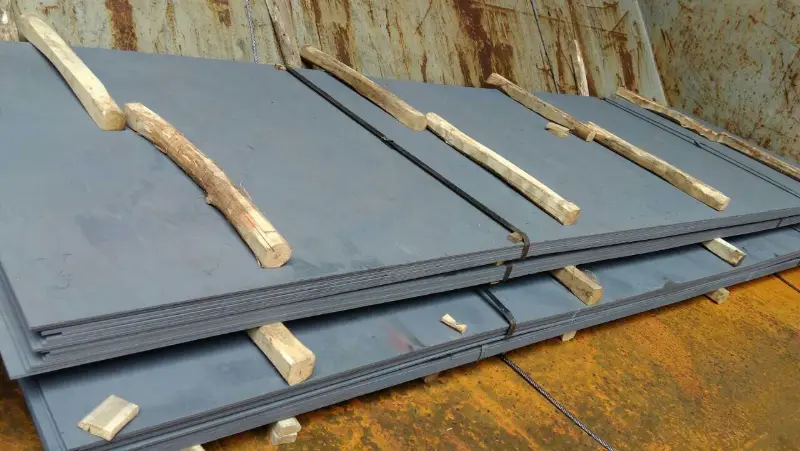
ASTM A709 HPS 100W
ASTM A709 Grade HPS100W High-Performance Bridge Steel – Weathering 100 ksi Plate
ASTM A709 Grade HPS100W is a high-performance, low-alloy structural steel with 100 ksi minimum yield strength intended for welded bridge construction. It offers excellent toughness, weldability, and atmospheric corrosion resistance (weathering).
Welding, thermal cutting, cold forming, machining; preheating may be required for thick sections
- Phone : +8618037372205
- Email : [email protected]
- WhatsApp: Contact via Whtsapp
- WeChat: +8618037372205
ASTM A709 HPS 100W Introduction
ASTM A709 Grade HPS100W (A709 Gr HPS100W) is a high-performance, low-alloy structural steel plate specifically developed for welded bridge construction. HPS denotes High Performance Steel, while W indicates weathering capability, meaning the steel forms a protective oxide layer under atmospheric exposure, reducing maintenance needs. This grade provides a minimum yield strength of 100 ksi (690 MPa) and combines high strength with excellent notch toughness, good weldability, and improved corrosion resistance. It is produced by quenching and tempering (Q&T) or thermomechanical controlled processing (TMCP). The alloy design employs microalloying elements such as vanadium, titanium, and nitrogen to achieve a fine grain structure, ensuring superior mechanical properties and low-temperature toughness. HPS100W is primarily used for critical bridge members like main girders, box sections, and tension flanges in both highway and railway bridges, where both strength and long-term durability are essential.
ASTM A709 HPS 100W Chemical Composition
Chemical composition limits according to ASTM A709/A709M for Grade HPS100W. The steel is microalloyed with vanadium, titanium, and aluminum for grain refinement and nitrogen control. W denotes weathering steel with a corrosion index ≥ 6.0 calculated per ASTM G101. Residual elements are limited to ensure good weldability and toughness. Values may be refined by the manufacturer but must remain within specified boundaries.
| Element | Value (%) | Notes |
|---|---|---|
| C | ≤ 0.14 | Carbon – controls hardenability |
| Mn | 1.00 – 1.50 | Manganese – for strength and deoxidation |
| Si | 0.30 – 0.50 | Silicon – deoxidizer and strength contributor |
| P | ≤ 0.020 | Phosphorus – maximum for toughness |
| S | ≤ 0.010 | Sulfur – kept low for cleanliness |
| Cu | ≤ 0.30 | Copper – contributes to weathering resistance |
| Ni | ≤ 0.50 | Nickel – improves toughness and corrosion resistance |
| Cr | 0.45 – 0.70 | Chromium – essential for weathering capability |
| Mo | 0.02 – 0.08 | Molybdenum – minor addition for strength |
| V | 0.04 – 0.08 | Vanadium – grain refiner and precipitation strengthener |
| Ti | 0.01 – 0.03 | Titanium – N scavenger, grain refinement |
| Al (soluble) | 0.010 – 0.040 | Aluminum – grain refinement and deoxidation |
| N | ≤ 0.015 | Nitrogen – controlled to avoid embrittlement |
ASTM A709 HPS 100W Thermal & Electrical Physical Properties
Physical properties are typical for high-strength low-alloy steel and are not part of the minimum requirements of ASTM A709. Values are provided for design calculations and are applicable at ambient temperature unless otherwise noted. Density, elastic moduli, and thermal expansion are consistent with standard structural steels such as A709 HPS100W. Note: These values are representative and can vary slightly with processing and temperature.
| Property | Value | Unit | Test Condition |
|---|---|---|---|
| Density (ρ) | 7.85 | g/cm³ | At 20 °C |
| Elastic Modulus (E) | 205 | GPa (29.7 x 10³ ksi) | At 20 °C, tension |
| Shear Modulus (G) | 79 | GPa (11.5 x 10³ ksi) | At 20 °C, calculated from E and ν |
| Poisson's Ratio (ν) | 0.30 | - | Elastic range, ambient temperature |
| Thermal Expansion Coefficient (α) | 11.7 | x 10⁻⁶ /K | 20 °C to 100 °C |
| Thermal Conductivity (λ) | 42 | W/m·K | At 20 °C |
| Specific Heat Capacity | 0.486 | J/g·K | At 20 °C |
| Electrical Resistivity (ρe) | 0.22 | µΩ·m | At 20 °C |
ASTM A709 HPS 100W Mechanical Properties
Mechanical property requirements per ASTM A709/A709M for Grade HPS100W plate. Tests are performed on specimens taken in the transverse direction unless otherwise noted. Charpy V-notch impact tests are mandatory and values listed are for the standard test temperature of 0 °F (-18 °C). For thicknesses above 2.5 in., elongation may be lower as specified by the standard.
| Property | Requirement | Unit | Test Condition / Thickness |
|---|---|---|---|
| Yield Strength (ReH) | ≥ 100 | ksi (≥ 690 MPa) | Plate thickness ≤ 4 in. (100 mm), transverse |
| Tensile Strength (Rm) | 110 – 130 | ksi (760 – 895 MPa) | Plate thickness ≤ 4 in. (100 mm), transverse |
| Elongation (A) | ≥ 16 | % | 8 in. (200 mm) gauge length, transverse, thickness ≤ 2.5 in. |
| Elongation (A) | ≥ 18 | % | 2 in. (50 mm) gauge length, transverse, thickness ≤ 2.5 in. |
| Bend Test | No cracks on outside of bent portion | - | Bend diameter per A709, 180° bend, mandrel dia. dependent on thickness |
| Charpy V-Notch (KV₂) | ≥ 35 | ft·lbf (≥ 47 J) | 0 °F (-18 °C), longitudinal specimen |
| Charpy V-Notch (KV₂) | ≥ 25 | ft·lbf (≥ 34 J) | 0 °F (-18 °C), transverse specimen |
ASTM A709 HPS 100W Fully Equivalent Material Standards & Alternative Designations
The following steel grade is technically identical to ASTM A709 Grade HPS100W, developed jointly by AASHTO and ASTM for bridge construction. It is the only standard that matches chemical composition, mechanical properties, and weathering requirements exactly.
| Country/Region | Standard | Grade | Remarks |
|---|---|---|---|
| USA | AASHTO M270/M270M | Grade HPS100W | Identical chemistry and mechanical properties; the AASHTO standard incorporates ASTM A709 HPS100W by reference for use in federally funded bridge projects. |
ASTM A709 HPS 100W Application Introduction
ASTM A709 HPS100W is designed for critical primary members in welded bridges, especially where high strength reduces dead load and permits longer spans. Its weathering characteristic eliminates the need for painting in many environments, lowering life-cycle costs. With excellent weldability using standard procedures and low hydrogen consumables, it can be fabricated into complex bridge subassemblies. Typical applications include main longitudinal and transverse girders, box-girder flanges and webs, diaphragms, and orthotropic deck plates. It is also suitable for hybrid design with other HPS grades (50W, 70W) to optimize economy. In addition to new construction, HPS100W is used in bridge rehabilitation and widening projects where matching existing steel strength is necessary. Because of its robust low-temperature toughness, HPS100W performs reliably in cold climates and fatigue-critical details.
Product Applications: Plate girders for simple and continuous spans, Steel box girders for elevated roadways, Truss bridges – top and bottom chords, end posts, Composite steel-concrete girder systems, Arch bridge ribs and tie members, Bridge deck replacement panels
Processed into products: Flanges and webs of welded plate girders, Stiffeners, diaphragm plates, and cross frames, Gusset plates and splice plates, Bolted or welded field splices, Pins, hangers, and rocker links (subject to thickness limitations), Orthotropic deck components including troughs and closure strips
Application industries: Highway and expressway bridge construction, Railway bridge structures, Pedestrian and bicycle bridges, Offshore structural applications (with assessment of marine corrosion), Heavy infrastructure and long-span roof systems
ASTM A709 HPS 100W Similar/Comparable High-Strength Steels
Steel grades that provide similar minimum yield strength (100 ksi / 690 MPa) but may differ in weathering capability, toughness, or delivery condition. They can be considered for alternative design when the specific requirements of HPS100W (e.g., weathering index, low-temperature impact) are not mandatory or can be compensated by additional painting/protection.
| Country/Region | Standard | Grade | Remarks |
|---|---|---|---|
| USA | ASTM A514/A514M | Grade S (100 ksi) / Grade Q | Quenched and tempered steel plate with 100–130 ksi tensile range; not weathering (requires painting). Toughness requirements differ. |
| Europe | EN 10025-6 | S690Q (1.8931) | Quenched and tempered structural steel with min 690 MPa yield. Corrosion resistance is that of ordinary structural steel, and weathering must be requested separately (e.g., per EN 10025-5). |
| China | GB/T 16270 | Q690E / Q690F | High strength structural steel plates with min 690 MPa yield; impact tested at -40°C or -60°C respectively. Not inherently weathering; additional corrosion requirements not part of base specification. |
Notes:
Welding: Use low-hydrogen practices (SMAW, SAW, FCAW, GMAW) with matching or undermatching filler metals designed for 690 MPa steels. Preheat and interpass temperature control should follow manufacturer's recommendations, especially for thick sections (>1.5 in.). Formability: Cold bending radii must comply with A709 bending test criteria; hot forming, if used, must be followed by re-heat treatment. Weathering: The steel is only classified as weathering if the atmospheric corrosion index calculated per ASTM G101 is ≥6.0. The actual performance depends on environment; periodic washing may be required in some locations to maintain protective patina. Availability: Plates are generally produced in as-rolled widths up to 120 in. and lengths up to 600 in., with thicknesses typically up to 4 in. (100 mm). Delivery with mill test certificates including Charpy results is mandatory. Design Standards: AASHTO LRFD Bridge Design Specifications define applicable resistance factors and fatigue provisions for HPS100W.
- Share



