
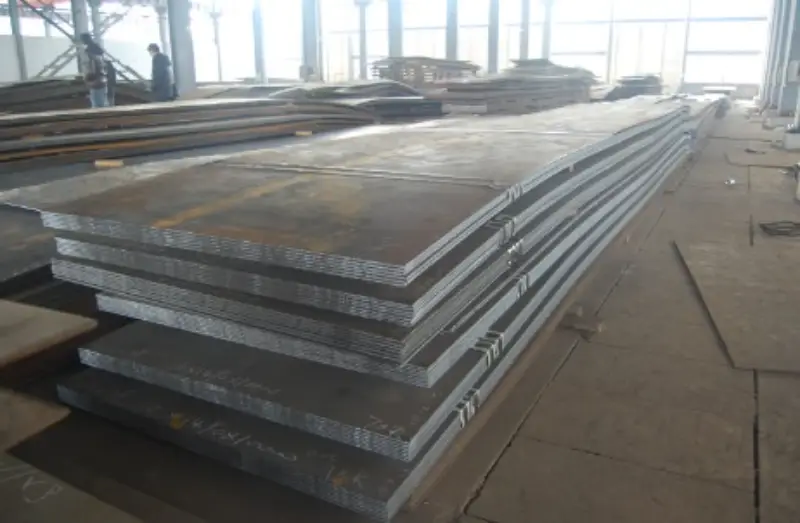
ASTM A709 Grade 100W High-Strength Weathering Steel for Bridges
ASTM A709 Grade 100W High-Strength Weathering Steel for Bridges | Properties, Equivalents & Applications
Detailed material data for ASTM A709 Grade 100W (A709GR100W) carbon and low-alloy high-strength weathering steel plate. Includes chemical composition, mechanical and physical properties, international equivalents, and application guidance for structural engineering.
Quenching and tempering (Q&T), hot rolling; suitable for welding, bending, cutting, and machining
- Phone : +8618037372205
- Email : [email protected]
- WhatsApp: Contact via Whtsapp
- WeChat: +8618037372205
ASTM A709 Grade 100W High-Strength Weathering Steel for Bridges Introduction
ASTM A709 Grade 100W is a high-strength low-alloy weathering steel plate intended for welded bridges and other structural applications. It offers a minimum yield strength of 100 ksi (690 MPa) and excellent atmospheric corrosion resistance due to its alloying with copper, chromium, and nickel. This grade provides a protective oxide layer that reduces the need for painting, lowering life-cycle costs. The material is supplied in the quenched and tempered (Q&T) condition, ensuring uniform mechanical properties and good toughness at low temperatures. Typical plate thicknesses range up to 2.5 inches (63.5 mm). It is widely used in critical bridge components such as main girders, trusses, and load-bearing plates where high strength, weldability, and durability are required.
ASTM A709 Grade 100W High-Strength Weathering Steel for Bridges Chemical Composition
The chemical composition of ASTM A709 Grade 100W is designed to provide high strength, good weldability, and atmospheric corrosion resistance. Copper, chromium, and nickel are added to achieve the weathering characteristics. Molybdenum and vanadium contribute to strength and toughness after quenching and tempering. Maximum limits on phosphorus and sulfur ensure cleanliness and ductility. Microalloying with titanium and boron helps control grain size and hardenability.
| Element | Standard Value (max or range) | Remarks |
|---|---|---|
| Carbon (C) | 0.10 - 0.20 | Typical range for heat analysis |
| Manganese (Mn) | 0.95 - 1.30 | Heat analysis |
| Phosphorus (P) | ≤ 0.035 | Maximum |
| Sulfur (S) | ≤ 0.040 | Maximum |
| Silicon (Si) | 0.15 - 0.35 | Heat analysis |
| Nickel (Ni) | 0.70 - 1.00 | Heat analysis; may be higher for thicker sections |
| Chromium (Cr) | 0.40 - 0.65 | Heat analysis |
| Molybdenum (Mo) | 0.40 - 0.60 | Heat analysis |
| Vanadium (V) | 0.03 - 0.08 | Heat analysis |
| Copper (Cu) | 0.15 - 0.50 | Heat analysis; key for weathering |
| Titanium (Ti) | 0.01 - 0.03 | Heat analysis |
| Boron (B) | ≤ 0.0025 | Maximum |
| Residual elements | As per ASTM A709 general requirements | Comply with producer practice |
ASTM A709 Grade 100W High-Strength Weathering Steel for Bridges Thermal and Electrical Physical Properties
Physical properties are typical for quenched and tempered low-alloy steel. These values may vary slightly with exact composition and heat treatment condition. The density is assumed for structural steel. Thermal expansion and thermal conductivity are similar to other Cr-Mo steel grades. Electrical resistivity is slightly higher than carbon steel due to alloying.
| Property | Typical Value | Unit | Test Condition / Remarks |
|---|---|---|---|
| Density (ρ) | 7.85 | g/cm³ | At room temperature |
| Elastic Modulus (E) | 200 | GPa | Tension, room temperature |
| Shear Modulus (G) | 77 | GPa | Calculated from E and ν |
| Poisson's Ratio (ν) | 0.30 | — | Typical for steel |
| Thermal Expansion (α) | 12.0 | 10⁻⁶/°C | Average from 20°C to 100°C (68°F to 212°F) |
| Thermal Expansion (α) | 13.0 | 10⁻⁶/°C | Average from 20°C to 200°C (68°F to 392°F) |
| Thermal Conductivity (λ) | 42 | W/m·K | At 100°C (212°F) |
| Thermal Conductivity (λ) | 40 | W/m·K | At 200°C (392°F) |
| Specific Heat Capacity | 0.48 | J/g·K | Approximate at room temperature |
| Electrical Resistivity (ρₑ) | 0.22 | µΩ·m | At room temperature |
ASTM A709 Grade 100W High-Strength Weathering Steel for Bridges Mechanical Properties
Mechanical properties are determined on quenched and tempered specimens. Values depend on plate thickness. The yield and tensile strengths comply with ASTM A709 Grade 100W requirements. Elongation is measured using an 8-inch (200 mm) or 2-inch (50 mm) gauge length based on specimen geometry. Bend tests ensure formability. Charpy V-notch impact tests may be specified per Supplementary Requirements (S5, S8) for low-temperature toughness.
| Property | Specified Value | Unit | Test Condition / Remarks |
|---|---|---|---|
| Yield Strength (ReH) | ≥ 100 (690) | ksi (MPa) | For thickness ≤ 2.5 in. (63.5 mm); 0.2% offset method |
| Tensile Strength (Rm) | 110 - 130 (760 - 895) | ksi (MPa) | Same thickness range |
| Elongation (A) | ≥ 18 | % | In 8 in. (200 mm) gauge length |
| Elongation (A) | ≥ 21 | % | In 2 in. (50 mm) gauge length |
| Bend Test (Bend diameter) | 3T (T = plate thickness) | — | Bent 180° without cracking; thickness ≤ 0.5 in. (12.7 mm) |
| Charpy Impact (KV) at -18°C (0°F) | ≥ 20 (≥ 27) | ft·lbf (J) | Average of 3 specimens; optional supplementary requirement S5 |
| Charpy Impact (KV) at -34°C (-30°F) | ≥ 20 (≥ 27) | ft·lbf (J) | Optional S8; for lower service temperatures |
ASTM A709 Grade 100W High-Strength Weathering Steel for Bridges Completely Equivalent Material Standards and Replaceable Grades
| Country/Region | Standard | Grade | Remarks |
|---|---|---|---|
| International | ISO 4950-2 | E690 DD (E690 Q) | High yield strength quenched and tempered; chemical composition can be adjusted for weathering (Cu, Cr, Ni) but not specified as weathering class; consult producer. |
| China | GB/T 4171 | Q690GNH (Q690GNHL) | High-strength weathering structural steel; yield strength ≥ 690 MPa; contains Cu, Cr, Ni for atmospheric resistance; plate standard GB/T 4171 includes this grade. |
| Japan | JIS G 3128 | SHY685 (SHY685N) | High yield strength steel for welded structures; min YS 685 N/mm² (99.5 ksi) comparable; not a weathering grade but can be produced with atmospheric corrosion resistance as per JIS G 3114 if required. |
| Europe | EN 10025-6 | S690Q (+N) | Hot-rolled quenched and tempered structural steel; direct strength equivalent; not inherently weathering; additional alloying for corrosion resistance must be agreed. |
ASTM A709 Grade 100W High-Strength Weathering Steel for Bridges Application Introduction
ASTM A709 Grade 100W is optimized for welded bridge construction and other heavy structural applications exposed to the atmosphere. Its combination of high strength and weathering characteristics allows for reduced maintenance and lighter structures. It is suitable for use in both fracture-critical and non-fracture-critical members, provided appropriate toughness requirements are met. Preheating and controlled interpass temperatures are recommended during welding. Post-weld heat treatment is generally not required for thicknesses up to 2.5 inches, but stress relief may be considered for very thick or highly restrained joints.
Product Applications: Highway and railway bridge girders (I‑beams, box girders, trusses), Pier and tower components, Floating dock and barge frames, Excavator and dragline booms, arms, Heavy‑duty trailers chassis, Structural framing for stadiums and tall buildings
Processed into products: Main tension chords and compression members in trusses, Web and flange plates in built‑up girders, Splice plates and connection gussets, Bearing stiffeners and diaphragms, Bolted and welded end connections, Cut‑outs and shaped plates for complex joint assemblies
Application industries: Bridge engineering and construction, Heavy civil infrastructure, Offshore and marine structures (with painting or as-is), Pressure vessel and storage tank fabrication (non-ASME code applications), Crane and heavy-lift equipment, Shipbuilding (with additional classification society approval)
ASTM A709 Grade 100W High-Strength Weathering Steel for Bridges Similar or Approximate Substitute Materials
| Country/Region | Standard | Grade | Remarks |
|---|---|---|---|
| USA | ASTM A514/A517 | Grade F (or Q) | High-strength quenched & tempered alloy steel plate; similar strength (100 ksi) but not specifically a weathering grade; Grade F has similar Cr-Mo-V composition; A709 Grade 100 (non-W) is identical metallic composition but without Cu/Ni guarantees. |
| USA | ASTM A709 | Grade 100 (non-W) | Same strength and composition base; lacks deliberate copper and chromium for weathering; may be used if painting is acceptable. |
| Europe | EN 10025-6 | S690QL | High-strength; with low-temperature toughness (QL); can be ordered with extra alloying (Cu, Cr) for corrosion resistance. |
| Australia | AS/NZS 3678 | Grade 700 (quenched & tempered) | Structural steel with YS 700 MPa; compositions vary; weathering variants available upon specific request. |
Notes:
Supplementary requirements from ASTM A709 may include Charpy testing at various temperatures (S5, S8), through‑thickness tensile testing (S6), ultrasonic examination (S9), and restriction on chemical composition for improved weldability. For welded bridges, consult AWS D1.5 Bridge Welding Code. Grade 100W plates require careful handling to preserve the protective patina. If painting is desired, special surface preparation must be followed. Availability in thickness > 2.5 in. may be limited; consult manufacturer for specific design requirements.
- Share



