
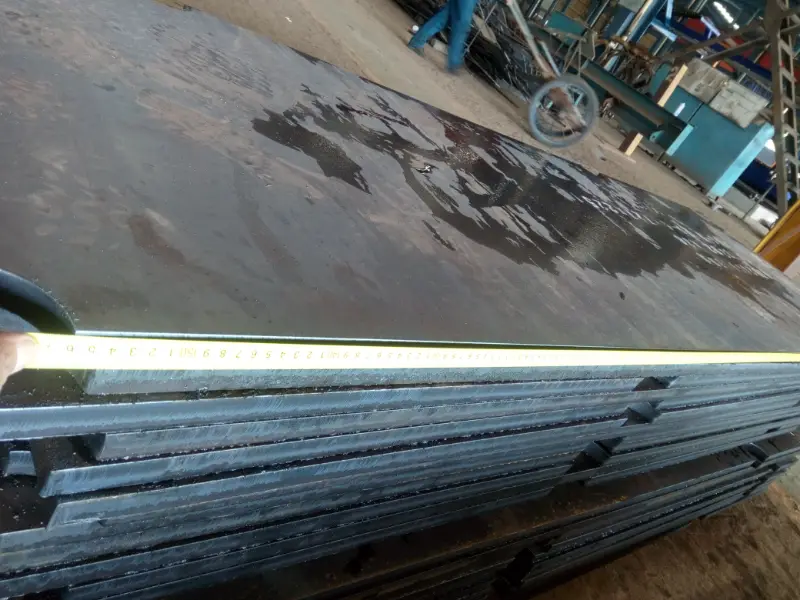
ASME SA572 Grade 50 (SA572GR50) Carbon Steel Plate
ASME SA572 Grade 50 Carbon Steel Plate – High-Strength Low-Alloy Structural Steel for Pressure Vessels and Bridges
Comprehensive datasheet for ASME SA572 Grade 50 (SA572GR50) carbon steel plate: chemical composition, mechanical properties, thermal and electrical physical properties, equivalent grades, and application guide for structural and pressure-containing applications.
Welding, hot forming, cold forming (with caution due to higher strength), machining, drilling, punching, shearing, and galvanizing
- Phone : +8618037372205
- Email : [email protected]
- WhatsApp: Contact via Whtsapp
- WeChat: +8618037372205
ASME SA572 Grade 50 Carbon Steel Plate Introduction
ASME SA572 Grade 50 (SA572GR50) is a high-strength low-alloy (HSLA) niobium-vanadium structural steel plate covered by the ASME Boiler and Pressure Vessel Code, Section II, Part A. It is functionally identical to ASTM A572 Grade 50 and is designed to offer improved strength-to-weight ratios and good weldability. This grade provides a minimum yield strength of 345 MPa (50 ksi), making it widely used in welded structures, bridges, buildings, and pressure vessel components where weight savings and high strength are critical.
Key characteristics:
- High yield and tensile strength with good ductility
- Excellent weldability using standard procedures
- Improved atmospheric corrosion resistance compared to plain carbon steel
- Supplied in normalized, as-rolled, or stress-relieved condition depending on thickness and requirements
ASME SA572 Grade 50 Carbon Steel Plate Chemical Composition
The chemical composition conforms to ASME SA-572/SA-572M requirements for Grade 50. Limits represent heat analysis and are typical for plates up to 32 mm thick. For thicker sections, slight adjustments in alloying elements may apply. Trace elements such as niobium (columbium), vanadium, and titanium are intentionally added for grain refinement and precipitation strengthening.
| Element | Standard Value (max, %) | Remarks |
|---|---|---|
| Carbon (C) | 0.23 | For plates ≤ 32 mm; may be lower for thicker gauges |
| Manganese (Mn) | 1.35 | May be adjusted depending on thickness and carbon equivalent |
| Phosphorus (P) | 0.035 | Max limit |
| Sulfur (S) | 0.035 | Max limit |
| Silicon (Si) | 0.40 | Max, residual from deoxidation |
| Vanadium (V) | 0.01 – 0.15 | Optional grain-refining element |
| Niobium (Nb) | 0.005 – 0.05 | Columbium, optional grain refiner |
| Titanium (Ti) | 0.006 – 0.04 | Optional |
| Nitrogen (N) | 0.015 | Max if Ti is present; otherwise not specified |
| Chromium (Cr) | 0.30 | Max, residual |
| Nickel (Ni) | 0.30 | Max, residual |
| Molybdenum (Mo) | 0.06 | Max, residual |
| Copper (Cu) | 0.20 | Min when specified for improved corrosion resistance (optional) |
ASME SA572 Grade 50 Carbon Steel Plate Thermal and Electrical Physical Properties
Physical properties are typical for ASME SA572 Grade 50 steel at room temperature unless otherwise stated. Values may vary slightly with actual chemical composition, heat treatment, and temperature. Thermal expansion and conductivity data are provided for common temperature ranges.
| Property | Typical Value | Unit | Test Condition |
|---|---|---|---|
| Density (ρ) | 7.85 | g/cm³ | At 20°C |
| Elastic Modulus (E) | 200 | GPa | At 20°C, tension |
| Shear Modulus (G) | 80 | GPa | At 20°C, calculated |
| Poisson's Ratio (ν) | 0.27 – 0.30 | — | At 20°C, elastic range |
| Thermal Expansion Coefficient (α) | 12.0 | 10⁻⁶/K | 20°C to 100°C |
| Thermal Expansion Coefficient (α) | 12.5 | 10⁻⁶/K | 20°C to 200°C |
| Thermal Expansion Coefficient (α) | 13.2 | 10⁻⁶/K | 20°C to 400°C |
| Thermal Conductivity (λ) | 51.9 | W/m·K | At 20°C |
| Thermal Conductivity (λ) | 46.0 | W/m·K | At 200°C |
| Thermal Conductivity (λ) | 38.0 | W/m·K | At 400°C |
| Specific Heat Capacity (cp) | 486 | J/kg·K | At 20°C to 100°C |
| Electrical Resistivity (ρe) | 0.15 – 0.20 | μΩ·m | At 20°C |
ASME SA572 Grade 50 Carbon Steel Plate Mechanical Properties
Mechanical properties are based on standard test specimens taken from plates in the as-delivered condition. Values meet the minimum requirements of ASME SA-572/SA-572M. Transverse test requirements apply for plates > 600 mm wide. Impact properties are not mandatory but can be ordered as per supplementary requirements (e.g., Charpy V-notch for service temperatures).
| Property | Standard Requirement | Unit | Test Condition |
|---|---|---|---|
| Yield Strength (ReH) | ≥ 345 | MPa | Plate thickness ≤ 32 mm, transverse, 0.2% offset |
| Tensile Strength (Rm) | ≥ 450 | MPa | All thicknesses, transverse |
| Elongation in 200 mm (A200) | ≥ 18 | % | Plate thickness ≤ 32 mm, longitudinal |
| Elongation in 50 mm (A50) | ≥ 21 | % | Plate thickness ≤ 32 mm, longitudinal |
| Bend Test (Diameter/Thickness) | D = 1.5t (≤ 20 mm thick) | ratio | 180° bend, transverse, no cracks |
| Bend Test (Diameter/Thickness) | D = 2.0t (>20 to 25 mm thick) | ratio | 180° bend, transverse |
| Bend Test (Diameter/Thickness) | D = 2.5t (>25 to 32 mm thick) | ratio | 180° bend, transverse |
| Charpy V-Notch Impact (optional) | ≥ 27 J at -20°C | J | Transverse, for S355J2 equivalent, when specified |
| Charpy V-Notch Impact (optional) | ≥ 27 J at 0°C | J | Transverse, for S355J0 equivalent, when specified |
ASME SA572 Grade 50 Carbon Steel Plate Completely Equivalent Material Standards and Designations
| Country/Region | Standard | Grade/Designation | Remarks |
|---|---|---|---|
| USA | ASTM A572/A572M | Grade 50 [345] | Identical to ASME SA572; widely available in the structural steel market. |
| European Union | EN 10025-2 | S355JR, S355J0, S355J2 | S355J2 offers guaranteed impact at -20°C; closest to SA572 Gr.50 with optional Charpy. |
| Japan | JIS G3106 | SM490A | Similar strength level; requires verification of impact requirements. |
| China | GB/T 1591 | Q345B (or Q355B under new standard) | Widely used; minor differences in Mn and microalloying; Q355B corresponds to new GB/T 1591-2018. |
| International | ISO 4950-2 | E355 | High yield strength structural steel; comparable chemical and mechanical properties. |
| Australia/New Zealand | AS/NZS 3678 | Grade 350 | Yield ≥350 MPa; tensile ≥480 MPa; similar applications. |
| India | IS 2062 | E350BR / E350C | High strength structural steel grade E350 matches 350 MPa min yield. |
ASME SA572 Grade 50 Carbon Steel Plate Application Introduction
ASME SA572 Grade 50 steel plate combines high strength, good formability, and excellent weldability, making it an economical choice for weight-sensitive structures. It is extensively used in the construction, pressure vessel, and transportation industries. Below are typical application areas and products.
Fabrication considerations:
- Preheat is generally not required for plates up to 40 mm thickness; for heavier sections, preheat to 100–150°C may be recommended.
- Post-weld heat treatment (PWHT) is not required by code but may be applied for service conditions or to relieve residual stresses.
- Hot forming should be performed at 850–1050°C followed by air cooling; subsequent normalizing may restore mechanical properties.
Product Applications: Welded pressure vessels (ASME Section VIII, Div. 1), Boiler drums and steam headers, Building columns, beams, and trusses, Bridge girders and deck plates, Transmission line poles and telecommunication towers, Offshore platform decks and flare booms, Heavy-duty truck frames and trailer components, Excavator booms, crane jibs, and chassis, Wind turbine foundation inserts and tower sections
Processed into products: Flanges, nozzles, and manways for pressure vessels, Gusset plates, base plates, and stiffeners, Splice plates and connection plates, Welded T-joints and cruciform joints in column fabrication, Pin joints and abutments in bridges, Lifting lugs and padeyes for offshore lifts, Crane runway beams and runway rail support brackets, Chassis cross members and suspension brackets
Application industries: Pressure vessel and boiler manufacturing, Structural steel construction (high-rise buildings, stadiums, industrial plants), Bridge engineering (road, railway, and pedestrian bridges), Offshore and marine structures (jackets, topside modules), Mining and earth-moving equipment, Railway rolling stock and freight car frames, Wind turbine towers and support structures, Automotive and truck chassis components
ASME SA572 Grade 50 Carbon Steel Plate Similar or Comparable Substitute Materials
| Country/Region | Standard | Grade/Designation | Remarks |
|---|---|---|---|
| USA | ASTM A572/A572M | Grade 55 [380] | Higher yield strength (380 MPa); increased carbon and alloy content; may require preheat for welding. |
| USA | ASTM A572/A572M | Grade 60 [415] | Further increased strength; limited ductility and more stringent forming conditions. |
| USA | ASTM A709/A709M | Grade 50 [345] | Specification for bridges; identical strength to SA572 Gr.50 but with additional fracture critical requirements. |
| USA | AASHTO M270 | Grade 50W | Weathering steel alternative with improved corrosion resistance; similar strength. |
| European Union | EN 10025-3 | S355N/NL | Normalized fine-grain steel with improved impact properties; suitable for demanding low-temperature service. |
| Japan | JIS G3106 | SM490B | Higher impact toughness compared to SM490A; better for dynamic loading. |
Notes:
Supplementary Requirements: Optional requirements (S1 to S98) may be invoked, including Charpy V-notch impact testing, vacuum degassing, ultrasonic examination, and restricted chemical composition for improved toughness. For pressure vessel applications, SA572 plates are typically ordered to the ASME SA-572/SA-572M specification with both ASME Section II and Section VIII requirements.
Weldability: Grade 50 can be readily welded using SMAW, SAW, GMAW, and FCAW processes with low-hydrogen electrodes. Carbon equivalent (CE) is typically 0.38–0.43, allowing good weldability with standard procedures.
Corrosion Resistance: Atmospheric corrosion resistance is about twice that of carbon structural steel, but it is not classified as a weathering steel; for enhanced atmospheric corrosion, consider ASTM A588 Grade A or equivalent.
- Share



