
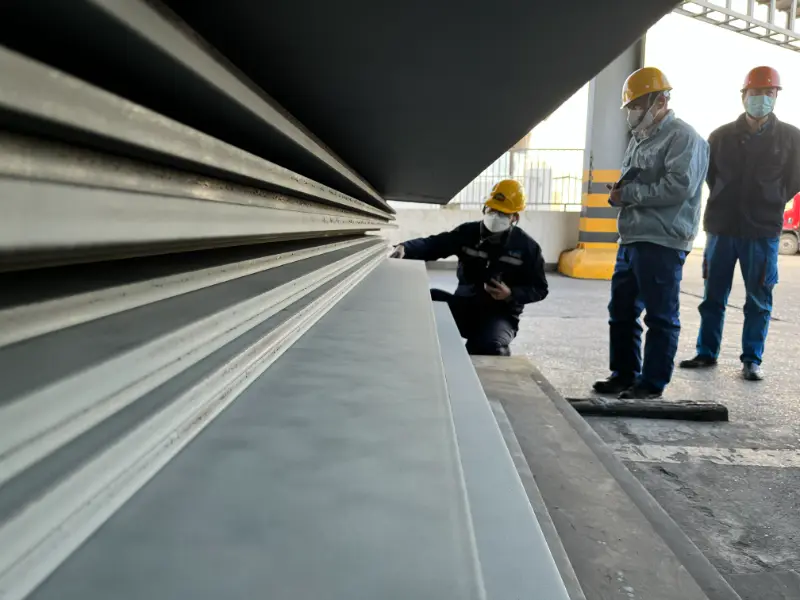
ASME SA572 Grade 55 Carbon Steel Plate
ASME SA572 Grade 55 (SA572GR55) Carbon Steel Plate – High-Strength Low-Alloy Data Sheet
Complete material specifications for ASME SA572 Grade 55 (SA572GR55) carbon steel plate: chemical composition, mechanical and physical properties, international equivalents, similar materials, and detailed application guidance based on the official ASME SA572/SA572M standard.
Welding (SMAW, SAW, GMAW, FCAW), bolting, riveting, hot forming, cold bending, machining, and thermal cutting
- Phone : +8618037372205
- Email : [email protected]
- WhatsApp: Contact via Whtsapp
- WeChat: +8618037372205
ASME SA572 Grade 55 Carbon Steel Plate Introduction
ASME SA572 Grade 55 (SA572GR55) is a high-strength low-alloy (HSLA) structural steel plate covered by the ASME SA572/SA572M specification, which is identical to ASTM A572/A572M. It offers a minimum yield strength of 55 ksi (380 MPa) in thicknesses up to 40 mm and is widely used in welded, bolted, and riveted structures. The steel is characterized by its fine-grain practice and controlled microalloying elements such as niobium, vanadium, and titanium, which provide enhanced strength while maintaining good weldability and formability. Key features:
- Minimum yield strength of 380 MPa (55 ksi) for thickness ≤40 mm
- Tensile strength range of 485–620 MPa (70–90 ksi)
- Excellent weldability with standard low-hydrogen processes
- Good notch toughness can be obtained when optional impact testing is specified
- Available in as-rolled, normalized, or TMCP conditions upon agreement
ASME SA572 Grade 55 Carbon Steel Plate Chemical Composition
The chemical requirements for Grade 55 are defined to ensure consistent strength and weldability. The steel is supplied with fine-grain practice and may contain intentional additions of microalloying elements such as niobium, vanadium, or titanium. General limits:
- Phosphorus and sulfur are strictly controlled to low levels for improved cleanliness and toughness.
- Silicon and manganese are present for deoxidation and strength.
- Copper may be specified (min 0.20%) when improved atmospheric corrosion resistance is desired.
- When microalloying elements are used, their maximum contents are as listed; combinations of Nb, V, Ti are allowed with sum limits as noted.
| Element | Content (max, wt%) | Remarks |
|---|---|---|
| Carbon (C) | 0.25 ≤0.75 in. (20 mm); 0.26 >0.75–1.5 in. (20–40 mm); 0.27 >1.5–4 in. (40–100 mm) | Thickness dependent; melt analysis |
| Manganese (Mn) | 1.35 | For all thicknesses |
| Phosphorus (P) | 0.030 | |
| Sulfur (S) | 0.030 | |
| Silicon (Si) | 0.40 (plates and bars); 0.15–0.40 (structural shapes) | For shapes, range may be 0.15–0.30 if specified |
| Copper (Cu) (if ordered as copper-bearing steel) | 0.20 min | Optional; provides enhanced atmospheric corrosion resistance |
| Niobium (Nb) (optional microalloy) | 0.05 | May be added; if both Nb and V are used, Nb+V ≤0.15% |
| Vanadium (V) (optional microalloy) | 0.15 | May be added; if both Nb and V are used, Nb+V ≤0.15% |
| Titanium (Ti) (optional microalloy) | 0.05 | May be added; used for grain refinement |
| Nitrogen (N) (if combined with V) | 0.015 (when V is added) | Maximum nitrogen when vanadium is added |
ASME SA572 Grade 55 Carbon Steel Plate Thermal and Electrical Physical Properties
The following physical property values are typical for carbon-manganese structural steels similar to ASME SA572 Grade 55. They are not specified in the standard but are provided for engineering reference. Notes:
- Values are measured at room temperature unless a temperature range is indicated.
- Thermal properties may vary slightly with composition and heat treatment condition.
- These data are suitable for general design calculations, heat transfer analysis, and electrical resistance estimation.
| Property | Typical Value | Unit | Test Condition / Temperature |
|---|---|---|---|
| Density (ρ) | 7.85 | g/cm³ | 20°C |
| Modulus of Elasticity (E) | 200 | GPa | 20°C |
| Shear Modulus (G) | 80 | GPa | 20°C |
| Poisson's Ratio (ν) | 0.3 | - | 20°C |
| Coefficient of Thermal Expansion (α) | 11.7 | 10⁻⁶/°C | 20–100°C |
| Thermal Conductivity (λ) | 52 | W/(m·K) | 20°C |
| Specific Heat Capacity (cp) | 470 | J/(kg·K) | 20°C |
| Electrical Resistivity (ρe) | 0.15 | µΩ·m | 20°C |
ASME SA572 Grade 55 Carbon Steel Plate Mechanical Properties
Tensile and bend properties are determined in accordance with ASTM A370/A6. The minimum required values depend on plate thickness. Key points:
- Yield strength of 380 MPa (55 ksi) is guaranteed for thicknesses up to 40 mm; for thicker plates it steps down to 345 MPa (50 ksi).
- Tensile strength falls in the range 485–620 MPa for all thicknesses.
- Elongation requirements vary with thickness and gauge length; the 2-inch (50 mm) gauge length is most commonly specified.
- Cold bend test performs a 180° bend with a pin diameter proportional to specimen thickness, demonstrating adequate ductility for forming.
- Charpy V-notch impact testing is not mandatory but can be added as a supplementary requirement.
| Property | Required Value | Unit | Test Condition / Thickness |
|---|---|---|---|
| Yield Strength (ReH) | ≥380 [55] | MPa [ksi] | Thickness ≤40 mm (≤1.5 in.) |
| Yield Strength (ReH) | ≥345 [50] | MPa [ksi] | Thickness >40–100 mm (>1.5–4 in.) |
| Tensile Strength (Rm) | 485–620 [70–90] | MPa [ksi] | All thicknesses |
| Elongation (A), 2 in. (50 mm) gauge | ≥21 | % | Thickness ≤20 mm (≤0.75 in.) |
| Elongation (A), 2 in. (50 mm) gauge | ≥18 | % | Thickness >20–40 mm (>0.75–1.5 in.) |
| Elongation (A), 2 in. (50 mm) gauge | ≥17 | % | Thickness >40–100 mm (>1.5–4 in.) |
| Elongation (A), 8 in. (200 mm) gauge | ≥18 | % | Thickness ≤20 mm |
| Elongation (A), 8 in. (200 mm) gauge | ≥16 | % | Thickness >20–40 mm |
| Elongation (A), 8 in. (200 mm) gauge | ≥15 | % | Thickness >40–100 mm |
| Bend Test (180°) – Ratio of bend diameter to specimen thickness | 2t | - | Thickness ≤20 mm |
| Bend Test (180°) – Ratio of bend diameter to specimen thickness | 2.5t | - | Thickness >20–40 mm |
| Bend Test (180°) – Ratio of bend diameter to specimen thickness | 3t | - | Thickness >40–100 mm |
ASME SA572 Grade 55 Carbon Steel Plate Exact Equivalent Standards and Substitutable Grades
| Country/Region | Standard | Grade | Remarks |
|---|---|---|---|
| United States | ASTM A572/A572M | Grade 55 | Identical specification; ASME SA572 is adopted from ASTM A572 with additional ASME Boiler and Pressure Vessel Code endorsement. |
ASME SA572 Grade 55 Carbon Steel Plate Application Introduction
ASME SA572 Grade 55 steel is engineered for structural applications where high strength, good weldability, and moderate corrosion resistance are required. It is commonly used in the construction of welded bridges, buildings, and heavy equipment. The material can be formed, welded, and machined using standard practices. Typical uses:
- Main members of welded highway and railway bridges
- Columns, beams, and trusses in high-rise buildings
- Booms, arms, and chassis of heavy-duty construction machinery
- Jacket legs, decks, and piles in offshore structures
- Towers and foundations for wind turbines
- Pressure vessel shells and cylinders when supplementary toughness requirements are met
Product Applications: Welded I-beams and built-up girders, Transmission towers, Bridge decks and orthotropic plates, Offshore platform tubulars and nodes, Excavator and crane booms, Wind turbine tower sections, Sheet piling and bearing piles
Processed into products: Bridge main girders, cross beams, stiffeners, Building columns and moment frames, Loader arms and bulldozer blades, Bearing shoes and base plates, Weldments for pressure vessel shells (when normalized or impact tested), Railway wagon frames and bolsters, Pinhole plates and connecting plates
Application industries: Civil and Bridge Engineering, Building and Construction, Heavy Machinery and Equipment Manufacturing, Offshore and Marine Structures, Power Generation (Wind, Thermal), Pressure Vessel and Storage Tank (with additional specifications), Infrastructure and Piling
ASME SA572 Grade 55 Carbon Steel Plate Similar/Comparable Alternative Materials
| Country/Region | Standard | Grade | Remarks |
|---|---|---|---|
| Europe | EN 10025-2 | S355J2 / S355K2 | Yield strength 355 MPa, slightly lower than 380 MPa. Higher toughness options available. Commonly substituted when full 55 ksi strength is not critical. |
| China | GB/T 1591 | Q390C / Q390D | Minimum yield strength 390 MPa, slightly exceeding Grade 55. Good match for high-strength structural applications with similar chemical controls. |
| Japan | JIS G3106 | SM520B / SM520C | Tensile strength 520–640 MPa, yield ≥365 MPa (some thicknesses). Close mechanical properties; often used in heavy welded structures. |
| Canada | CSA G40.21 | 380W | Yield strength 380 MPa (55 ksi) with similar chemistry range; a near equivalent often accepted for structural steel in North America. |
Notes:
Supplementary requirements: ASME SA572/SA572M offers several optional supplementary requirements (S1 to S30) that can be invoked by the purchaser, such as Charpy V-notch impact testing at various temperatures, ultrasonic examination, fine austenitic grain size, and restricted chemistry. Always specify these when ordering for critical applications. Weldability: This grade can be welded by common methods (SMAW, SAW, GMAW, FCAW) with low-hydrogen practices and appropriate preheat/interpass temperatures depending on thickness and carbon equivalent. Post-weld heat treatment is generally not required for thicknesses under 50 mm but can be performed if stress relieving is needed. Forming: Minimum recommended bending radii should follow the bend test ratios to avoid cracking. Hot forming should be carried out within the normalizing temperature range (850–950°C) and followed by cooling in still air.
- Share



