
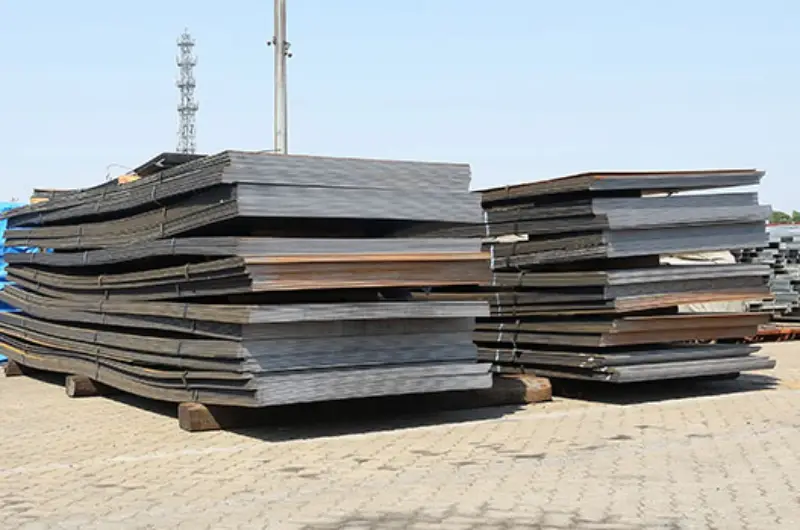
ASME SA572 Grade 60 High-Strength Low-Alloy Steel Plate
ASME SA572 Grade 60 High-Strength Low-Alloy Steel Plate for Structural Engineering
Comprehensive technical data for ASME SA572 Grade 60 (SA572GR60) carbon steel plate, including chemical composition, mechanical and thermal properties, equivalent standards, and typical structural applications.
Hot rolling, controlled rolling, normalizing, welding, cold forming, machining, thermal cutting
- Phone : +8618037372205
- Email : [email protected]
- WhatsApp: Contact via Whtsapp
- WeChat: +8618037372205
ASME SA572 Grade 60 High-Strength Low-Alloy Steel Plate Introduction
ASME SA572 Grade 60 is a high-strength low-alloy (HSLA) structural steel plate designed for bolted, riveted, or welded construction. It exhibits a minimum yield strength of 60 ksi (415 MPa) and is primarily strengthened by microalloying elements such as niobium, vanadium, or a combination thereof, depending on the specific type. The grade offers an excellent strength-to-weight ratio, superior weldability, and good notch toughness compared to plain carbon steels, enabling lighter and more durable structures.
- Key characteristics: High strength with minimum yield of 415 MPa, good formability and weldability, normalized or as-rolled delivery condition, and enhanced atmospheric corrosion resistance.
- Typical types: Type 1 (Nb), Type 2 (V), Type 3 (Nb+V), Type 4 (V+N).
- Thickness range: Up to 4 in. (100 mm) for the 60 ksi strength level.
ASME SA572 Grade 60 High-Strength Low-Alloy Steel Plate Chemical Composition
The ladle analysis limits for ASME SA572 Grade 60 are specified according to thickness and deoxidation practice. The listed values correspond to typical Type 1 (niobium-bearing) chemistry for plates up to 1.25 in. (32 mm) thickness, unless different grades are ordered. Phosphorus and sulfur are critical for toughness and are controlled to low levels.
- Microalloying: Nb, V, or their combinations are used to achieve the required strength through grain refinement and precipitation hardening.
| Element | Standard Value (max or range) | Remarks |
|---|---|---|
| C | ≤0.26 (for thickness ≤ 0.75 in.) | Carbon equivalent is controlled for weldability |
| Mn | ≤1.35 (for Grade 60, thickness ≤ 0.75 in.) | Higher Mn may be used with C reduction |
| P | ≤0.04 | Phosphorus – maximum limit |
| S | ≤0.05 | Sulfur – maximum limit |
| Si | ≤0.40 (product analysis, unless otherwise agreed) | Silicon range typically 0.15–0.40 for killed steel |
| Nb (Type 1) | 0.005–0.05 | Niobium for grain refinement and strengthening |
| V (Type 2) | 0.01–0.15 (if ordered as Type 2) | Vanadium strengthening |
| N (max) | ≤0.015 (when applicable for Type 4) | Nitrogen content may be limited |
ASME SA572 Grade 60 High-Strength Low-Alloy Steel Plate Thermal and Electrical Physical Properties
Physical properties are calculated at room temperature (20 °C) unless stated otherwise. These values are typical for high-strength low-alloy steel of the 415 MPa yield class and can vary slightly with exact composition and heat treatment. The thermal expansion coefficient and thermal conductivity are essential for design calculations involving thermal gradients.
| Property | Typical Value | Unit | Test Condition |
|---|---|---|---|
| Density (ρ) | 7.85 | g/cm³ | 20 °C |
| Modulus of Elasticity (E) | 200 – 210 | GPa | Room temperature |
| Shear Modulus (G) | 80.0 | GPa | Room temperature, calculated from E and ν |
| Poisson's Ratio (ν) | 0.30 | - | Elastic range |
| Coefficient of Thermal Expansion (α) | 12.0 × 10⁻⁶ | /K (1/°C) | 20–200 °C |
| Thermal Conductivity (λ) | ~ 50 | W/(m·K) | 20 °C |
| Specific Heat Capacity (cp) | ~ 460 | J/(kg·K) | 20 °C |
| Electrical Resistivity (ρe) | 0.15 – 0.20 | µΩ·m | 20 °C |
ASME SA572 Grade 60 High-Strength Low-Alloy Steel Plate Mechanical Properties
Mechanical properties are based on transverse test specimens taken from plates. The tensile properties are valid for thicknesses up to 4 in. (100 mm) with a minimum yield strength of 60 ksi (415 MPa). Elongation values depend on plate thickness and gauge length. Bend test is performed to ensure formability and weld integrity. Impact toughness is not mandatory unless supplementary requirements (e.g., Charpy V-notch) are specified at the time of order.
| Property | Specified Value | Unit | Test Condition / Thickness |
|---|---|---|---|
| Yield Strength (ReH) | ≥ 415 (≥ 60) | MPa (ksi) | Thickness ≤ 100 mm (4 in.) |
| Tensile Strength (Rm) | 520 – 660 (75 – 95) | MPa (ksi) | Standard full-thickness tensile test |
| Elongation (A) | ≥ 21 | % | Gauge length 50 mm, thickness ≤ 20 mm (0.75 in.) |
| Elongation (A) | ≥ 18 | % | Gauge length 50 mm, thickness 20-40 mm (0.75–1.5 in.) |
| Elongation (A) | ≥ 17 | % | Gauge length 50 mm, thickness 40–70 mm (1.5–2.75 in.) |
| Elongation (A) | ≥ 16 | % | Gauge length 200 mm, thickness ≤ 20 mm |
| Bend Test (Bend Diameter) | 180° bend, d = 1.5t | - | t = specimen thickness, for elongation ≥ 18% material |
| Charpy V-notch (KV) | Optional – to be agreed | J (ft·lbf) | Typically 27 J @ -20°C for toughness grades |
| Hardness | Not specified (typical 160–210) | HBW | Based on as-rolled condition |
ASME SA572 Grade 60 High-Strength Low-Alloy Steel Plate Completely Equivalent Material Standards and Substitutable Grades
| Country/Region | Standard | Designation/Grade | Remarks |
|---|---|---|---|
| USA | ASTM A572/A572M | Grade 60 (Type 1,2,3,4) | Identical technical requirements; SA572 is ASME adoption |
| Canada | CSA G40.21 | 400W (closely matches 415 MPa yield) | Similar strength level, fine-grain practice |
| Europe | EN 10025-3 | S420N/S420NL | Matching 420 MPa yield, impact toughness options available |
| International | ISO 4950-2 | E420DD | High yield strength structural steel with equivalent strength |
| China | GB/T 1591 | Q420C/D/E | Mechanical match; chemical composition adjusted per Chinese standard |
ASME SA572 Grade 60 High-Strength Low-Alloy Steel Plate Application Introduction
ASME SA572 Grade 60 is intended for structural applications where weight savings and high strength are critical. Its excellent weldability and impact toughness (when specified) make it suitable for dynamically loaded and low-temperature structures. The steel can be formed and machined using standard practices. Preheating may be required for thick sections or when a low-hydrogen environment is essential.
Product Applications: Welded plate girders and box columns, Built-up H-beams and stiffened panels, Heavy-duty floor plates and decking, Pressure vessel supporting skirts and stands, Crane runways and gantry beams, Scaffolding planks and temporary structures, Reinforced components for concrete-steel composite construction
Processed into products: Truss members and connection nodes, Crane booms, outriggers, and chassis frames, Lock gates, stop logs, and dam penstocks, Heavy machinery bases and mounting plates, Mining truck frames and loader arms, Barge hatch covers and coamings, Military bridging components, Ship deck insert plates and transverse bulkheads
Application industries: Building and civil engineering (high-rise, stadiums, industrial buildings), Bridge construction (main girders, cross beams, deck support), Transmission towers and telecommunication masts, Offshore and marine structures (deck plating, support frames), Mining and construction equipment (dump bodies, excavator arms), Pressure vessel and storage tank external supports, Railway wagons and other heavy transport equipment, Wind turbine tower internals and foundations
ASME SA572 Grade 60 High-Strength Low-Alloy Steel Plate Similar/Near-Equivalent Substitute Materials
| Country/Region | Standard | Designation/Grade | Remarks |
|---|---|---|---|
| Japan | JIS G3106 | SM570 | Higher tensile strength (570–720 MPa), yield ≥ 460 MPa; suitable for more demanding applications |
| Europe | EN 10025-2 | S355J2+N | Lower yield (355 MPa), widely available; may require thicker sections for same strength |
| USA | ASTM A709/A709M | Grade 50S/HPS 50W | Yield 345–485 MPa range, used for bridge steels; not a direct 60 ksi replacement |
| Brazil | ABNT NBR 5000/5008 | CG-42 (42 kgf/mm²) | Similar yield strength (≈412 MPa); limited international interchange |
| India | IS 2062 | E410 / Fe 540 | Yield strength 410–540 MPa range; check specific grade for 415 MPa min yield |
| Russia | GOST 19281 | 09G2S (09Г2С), S390 class | Yield ≥ 390 MPa; common CIS structural steel, slightly lower strength |
Notes:
Welding: Preheating (50–150°C) is recommended for thicknesses above 25 mm or when the carbon equivalent exceeds 0.43. Low-hydrogen electrodes or gas-shielded processes are preferred. Post-weld heat treatment is generally not required.
Forming: Cold bending is possible with a minimum inside radius of 2.0t (t = plate thickness) for the transverse direction; hot forming should be performed above 900°C and followed by normalizing if required.
Corrosion protection: As-rolled surfaces develop protective patina in mild environments, but painting or galvanizing is advised for aggressive conditions. Ordering specification: ASME SA572 Grade 60 must be ordered with type designation (1,2,3, or 4) and any supplementary requirements such as Charpy testing, ultrasonic examination, or through-thickness properties.
- Share



