
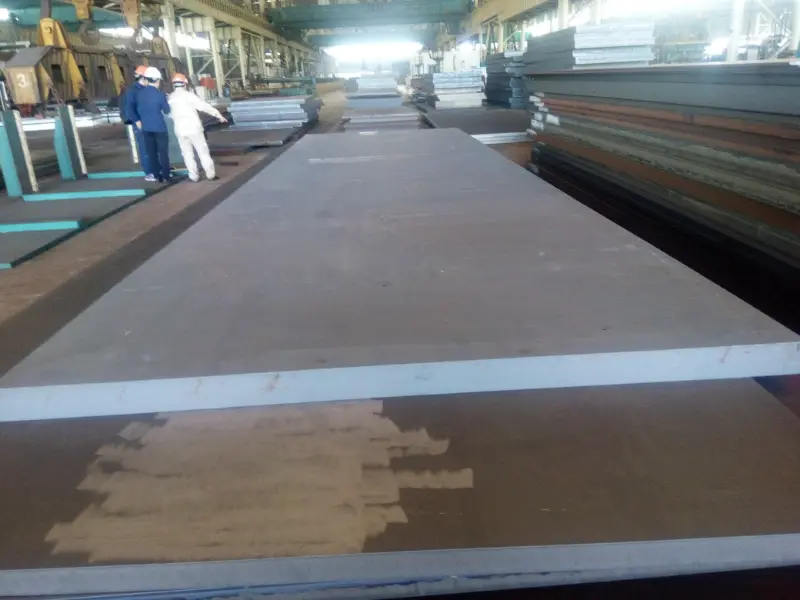
ASME SA514 Grade M High-Strength Quenched & Tempered Alloy Steel Plate
ASME SA514 Grade M High-Strength Quenched & Tempered Alloy Steel Plate
Detailed technical data sheet for ASME SA514 Grade M (SA514GRM) carbon/ alloy steel plate, including chemical composition, mechanical properties, physical properties, and equivalent grades.
Hot rolling, quenching, tempering, cutting, welding
- Phone : +8618037372205
- Email : [email protected]
- WhatsApp: Contact via Whtsapp
- WeChat: +8618037372205
ASME SA514 Grade M High-Strength Quenched & Tempered Alloy Steel Plate Introduction
ASME SA514 Grade M is a high-strength, low-alloy quenched and tempered structural steel plate with a minimum yield strength of 100 ksi (690 MPa). It is specifically designed for welded bridges and other structures where weight reduction and high strength are critical. This grade belongs to the ASTM A514/A514M family and is recognized for its excellent combination of strength, weldability, and notch toughness. The alloying elements — chromium, nickel, molybdenum, and vanadium — provide deep hardenability, ensuring uniform mechanical properties throughout the plate thickness up to 2 inches (50 mm). Boron is added in controlled amounts to further enhance hardenability without impairing toughness. Typical applications include heavy-duty construction machinery, offshore platforms, crane booms, and pressure vessels. The steel is supplied in the quenched and tempered condition and can be fabricated using conventional welding methods, provided proper preheat and interpass temperatures are observed.
- Minimum yield strength 100 ksi (690 MPa) in thicknesses up to 2 in.
- Excellent strength-to-weight ratio for lightweight structural design.
- Good toughness at low temperatures when supplementary Charpy requirements are invoked.
- Weldable with low-hydrogen practices.
ASME SA514 Grade M High-Strength Quenched & Tempered Alloy Steel Plate Chemical Composition
The chemical composition of ASME SA514 Grade M is meticulously controlled to ensure high strength after quenching and tempering. Alloying elements such as chromium, nickel, and molybdenum contribute to hardenability, while vanadium and titanium provide grain refinement. Boron, in trace amounts, significantly improves hardenability. Maximum limits on phosphorus and sulfur maintain cleanliness and toughness.
| Chemical Element | Standard Value | Remarks |
|---|---|---|
| Carbon (C) | 0.12–0.21 | Core hardenability element |
| Manganese (Mn) | 0.45–0.70 | Deoxidizer and strength contributor |
| Phosphorus (P) | ≤ 0.020 | Impurity control for toughness |
| Sulfur (S) | ≤ 0.010 | Impurity control for toughness |
| Silicon (Si) | 0.20–0.35 | Deoxidizer |
| Nickel (Ni) | 0.50–1.00 | Toughness and hardenability |
| Chromium (Cr) | 0.50–0.80 | Hardenability and corrosion resistance |
| Molybdenum (Mo) | 0.15–0.25 | Hardenability and high-temperature strength |
| Vanadium (V) | 0.03–0.08 | Grain refinement and precipitation strengthening |
| Titanium (Ti) | 0.01–0.03 | Grain refinement and nitrogen fixation |
| Boron (B) | 0.001–0.003 | Enhanced hardenability |
| Copper (Cu) | ≤ 0.50 | Residual element; may aid atmospheric corrosion resistance |
ASME SA514 Grade M High-Strength Quenched & Tempered Alloy Steel Plate Thermal and Electrical Physical Properties
Physical properties are representative for quenched and tempered low-alloy steel plates at room temperature unless otherwise noted. These values are useful for engineering calculations involving thermal expansion, heat transfer, and structural analysis. Slight variations may occur depending on the exact heat treatment and specific composition within the allowable range.
| Performance Item | Standard Requirement Value | Unit | Test Condition |
|---|---|---|---|
| Density (ρ) | 7.83 (0.283 lb/in³) | g/cm³ | 20 °C |
| Elastic Modulus (E) | 200 (29 × 10⁶ psi) | GPa | 20 °C |
| Shear Modulus (G) | 79.3 (11.5 × 10⁶ psi) | GPa | 20 °C |
| Poisson's Ratio (ν) | 0.29 | — | 20 °C |
| Thermal Expansion Coefficient (α) | 11.7–13.0 (6.5–7.2 × 10⁻⁶/°F) | 10⁻⁶/K | 20–200 °C |
| Thermal Conductivity (λ) | 35 (24 Btu·in/(ft²·h·°F)) | W/m·K | 20 °C |
| Specific Heat (c) | 460 (0.11 Btu/lb·°F) | J/kg·K | 20 °C |
| Electrical Resistivity (ρ_e) | 0.23 (14.2 μΩ·in) | μΩ·m | 20 °C |
ASME SA514 Grade M High-Strength Quenched & Tempered Alloy Steel Plate Mechanical Properties
Mechanical properties are determined on transverse test specimens after quenching and tempering. The tensile test requirements apply to plates up to 2 in. (50 mm) in thickness. Elongation requirements vary slightly with plate thickness. When supplementary impact testing is specified, Charpy V-notch values are agreed upon between the purchaser and the manufacturer.
| Performance Item | Standard Requirement Value | Unit | Test Condition |
|---|---|---|---|
| Yield Strength (ReH) | ≥ 100 (690 MPa) | ksi (MPa) | Transverse, thickness ≤ 2 in. (50 mm), quenched and tempered |
| Tensile Strength (Rm) | 110–130 (760–895 MPa) | ksi (MPa) | Transverse, thickness ≤ 2 in. (50 mm), quenched and tempered |
| Elongation (A) | ≥ 18 | % | Gauge length 2 in. (50 mm), thickness ≤ 3/4 in. (20 mm) |
| Elongation (A) | ≥ 17 | % | Gauge length 2 in. (50 mm), thickness > 3/4 in. to 2 in. (20–50 mm) |
ASME SA514 Grade M High-Strength Quenched & Tempered Alloy Steel Plate Fully Equivalent Material Standards and Replaceable Grades
| Country/Region | Standard | Grade | Remarks |
|---|---|---|---|
| USA | ASTM A514/A514M | Grade M | Identical standard; ASME SA514 adopts ASTM A514 specification. |
| Europe | EN 10025-6 | S690QL | Comparable minimum yield strength (690 MPa) but chemistry differs slightly. |
| International | ISO 4950-2 | E690T | High yield strength quenched and tempered structural steel. |
| Japan | JIS G 3128 | SHY685 / SHY685N | High tensile strength steel with similar applications. |
| China | GB/T 16270 | Q690D / Q690E | High strength structural steel with Charpy impact requirement at -20°C (D) or -40°C (E). |
ASME SA514 Grade M High-Strength Quenched & Tempered Alloy Steel Plate Application Introduction
ASME SA514 Grade M is optimized for welded structural applications where high strength-to-weight ratio is essential. Its combination of 690 MPa yield strength, good toughness, and weldability makes it a preferred material for heavy-duty, dynamically loaded components. Proper fabrication practices, including controlled preheat and low-hydrogen welding, are necessary to preserve the quenched and tempered properties.
- Mobile crane booms: main chord and lacing members.
- Excavator and mining equipment: arms, buckets, and frame components.
- Offshore structures: node cans, legs, and brace members.
- Bridge construction: flange plates, box girders, and tension members.
- Pressure vessels: shells requiring high strength (when dual-certified with A517).
Product Applications: Mobile crane telescopic booms, Heavy truck chassis and frames, Excavator booms and sticks, Offshore jacket legs and nodes, Bridge box girders and truss chords, High-pressure vessel shells
Processed into products: Welded boom sections and butt joints, High-stress gusset plates, Load-bearing brackets and lifting eyes, Structural stiffeners and rib plates, Kingpost bases and slewing ring supports, Cutterhead frames for tunnel boring machines
Application industries: Construction Machinery, Offshore and Marine, Mining Equipment, Bridge Building, Pressure Vessel Manufacturing, Transportation Equipment
ASME SA514 Grade M High-Strength Quenched & Tempered Alloy Steel Plate Similar / Alternative Material Recommendations
| Country/Region | Standard | Grade | Remarks |
|---|---|---|---|
| USA | ASTM A517/A517M | Grade M | Pressure vessel quality plate with same chemical composition; suited for moderate and lower temperature service. |
| USA | ASTM A514/A514M | Grades B, H, F | Other A514 grades with slightly different alloying for various thickness ranges; comparable strength. |
| Europe | EN 10025-6 | S690Q / S690QL1 | Alternative toughness levels (QL: -40°C, QL1: -60°C) with similar tensile properties. |
| Japan | JIS G 3128 | SHY685NS | Weathering version with improved atmospheric corrosion resistance. |
| China | GB/T 16270 | Q690F | Low-temperature grade with impact test at -60°C. |
Notes:
Welding: Preheat and interpass temperature control are recommended, typically 100–200°C depending on thickness. Low-hydrogen electrodes (AWS E11018 or equivalent) should be used. Post-weld heat treatment (PWHT) is generally not required for thicknesses up to 50 mm unless specified for stress relief. Availability: Plates are normally supplied in the quenched and tempered condition with mill test reports showing chemical and mechanical compliance. Supplementary requirements (Charpy V-notch, ultrasonic examination, etc.) can be specified per ASME SA514. Limitations: Maximum thickness is 2 in. (50 mm); for thicker sections, alternative grades like S690QL or other A514 grades capable of the required thickness should be considered. The steel is not intended for prolonged use at temperatures above 400°C.
- Share



