
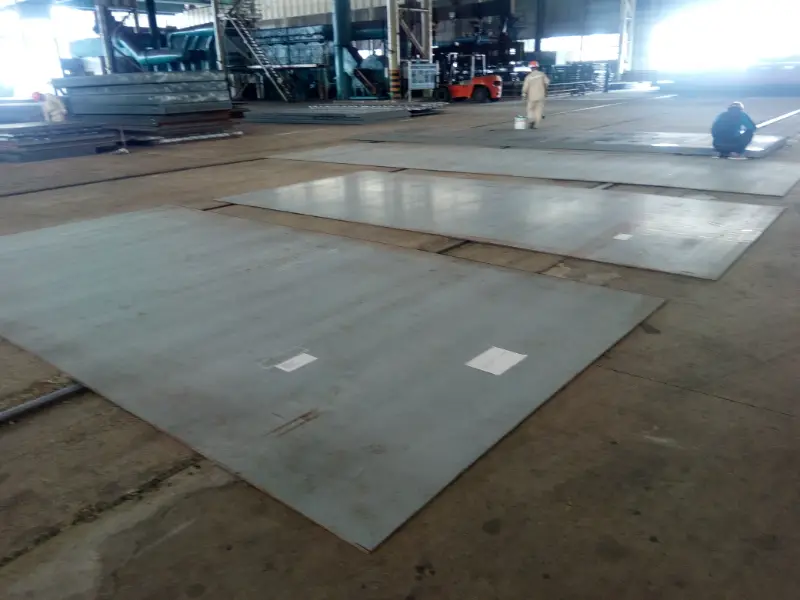
ASME SA514 Grade P High Strength Quenched and Tempered Alloy Steel Plate
ASME SA514 Grade P High-Strength Quenched & Tempered Alloy Steel Plate | Properties & Equivalents
Comprehensive guide to ASME SA514 Grade P carbon steel plate including chemical composition, mechanical and thermal properties, international equivalents, similar materials, and detailed application insights.
Hot rolling, quenching and tempering, cutting, cold forming (limited), welding (with preheat and low-hydrogen practice), machining.
- Phone : +8618037372205
- Email : [email protected]
- WhatsApp: Contact via Whtsapp
- WeChat: +8618037372205
ASME SA514 Grade P High Strength Quenched and Tempered Alloy Steel Plate Introduction
ASME SA514 Grade P is a high-yield, quenched and tempered alloy steel plate intended for structural applications where weight savings and high strength are critical. It offers a minimum yield strength of 100 ksi (690 MPa) in thicknesses up to 2.5 inches (63.5 mm), with excellent notch toughness at low temperatures. The chemistry is optimized for deep hardenability, allowing the plate to achieve uniform through-thickness properties. Grade P is characterized by its balance of chromium, nickel, and molybdenum, providing good weldability under controlled conditions. Key features:
- High strength-to-weight ratio
- Good formability and toughness
- Suitable for low-temperature service
- Available in thicknesses up to 6 inches (150 mm) with varying mechanical properties
ASME SA514 Grade P High Strength Quenched and Tempered Alloy Steel Plate Chemical Composition
The chemical composition of ASME SA514 Grade P is strictly controlled to achieve the required strength and toughness after quenching and tempering. The alloy design includes chromium, nickel, and molybdenum for hardenability, and low sulfur and phosphorus for improved notch toughness. All values are maximum unless otherwise indicated.
| Element | Standard Value (wt. %) | Remarks |
|---|---|---|
| Carbon (C) | 0.12–0.21 | For plate thickness ≤ 2.5 in. (63.5 mm) |
| Manganese (Mn) | 0.45–0.70 | For plate thickness ≤ 2.5 in. (63.5 mm) |
| Phosphorus (P) | 0.025 max | |
| Sulfur (S) | 0.010 max | |
| Silicon (Si) | 0.20–0.35 | |
| Nickel (Ni) | 1.20–1.50 | |
| Chromium (Cr) | 0.85–1.20 | |
| Molybdenum (Mo) | 0.45–0.60 | |
| Vanadium (V) | 0.03 max | Optional grain refiner |
| Boron (B) | 0.001–0.005 | Required for hardenability |
| Copper (Cu) | 0.25 max | Residual element |
| Titanium (Ti) | Not specified | May be present as a microalloying element in some heats |
ASME SA514 Grade P High Strength Quenched and Tempered Alloy Steel Plate Thermal and Electrical Physical Properties
The following physical properties are typical for ASME SA514 Grade P in the quenched and tempered condition. These values can vary slightly depending on the exact tempering temperature and composition within the grade. Reference: steel physical property databases and ASM handbook for similar low-alloy Cr-Ni-Mo steels.
| Property | Typical Value | Unit | Test Condition |
|---|---|---|---|
| Density (ρ) | 7.85 | g/cm³ | At 20°C (68°F) |
| Elastic Modulus (E) | 205 (29.7 × 10³) | GPa (ksi) | Tension, room temperature |
| Shear Modulus (G) | 79 (11.5 × 10³) | GPa (ksi) | Calculated from E and Poisson's ratio |
| Poisson's Ratio (ν) | 0.29 | – | At room temperature |
| Thermal Expansion Coefficient (α) | 11.7 (6.5) | µm/m·°C (µin./in.·°F) | Over 20–100°C (68–212°F) |
| Thermal Expansion Coefficient (α) | 12.2 (6.8) | µm/m·°C (µin./in.·°F) | Over 20–200°C (68–392°F) |
| Thermal Expansion Coefficient (α) | 12.8 (7.1) | µm/m·°C (µin./in.·°F) | Over 20–300°C (68–572°F) |
| Thermal Conductivity (λ) | 42 (24) | W/m·K (Btu·in./hr·ft²·°F) | At 100°C (212°F) |
| Thermal Conductivity (λ) | 38 (22) | W/m·K (Btu·in./hr·ft²·°F) | At 200°C (392°F) |
| Specific Heat Capacity (cp) | 460 (0.11) | J/kg·K (Btu/lb·°F) | Room temperature |
| Electrical Resistivity (ρe) | 0.25 (15) | µΩ·m (µΩ·in.) | At room temperature |
ASME SA514 Grade P High Strength Quenched and Tempered Alloy Steel Plate Mechanical Properties
Mechanical properties are guaranteed for quenched and tempered condition. The tensile and yield strengths depend on plate thickness. For thickness ≤ 2.5 in. (63.5 mm), yield strength minimum is 100 ksi (690 MPa). Charpy V-notch impact test is typically required at -20°F (-29°C) with minimum 20 ft·lb (27 J) for standard applications. Requirements per ASME SA514/SA514M.
| Property | Standard Required Value | Unit | Test Condition / Thickness |
|---|---|---|---|
| Yield Strength (ReH), min | 100 (690) | ksi (MPa) | Plate thickness ≤ 2.5 in. (63.5 mm) |
| Yield Strength (ReH), min | 90 (620) | ksi (MPa) | Plate thickness > 2.5 in. to 6 in. (63.5–150 mm) |
| Tensile Strength (Rm) | 110–130 (760–895) | ksi (MPa) | Plate thickness ≤ 2.5 in. (63.5 mm) |
| Tensile Strength (Rm) | 100–130 (690–895) | ksi (MPa) | Plate thickness > 2.5 in. to 6 in. (63.5–150 mm) |
| Elongation (A) in 2 in. (50 mm), min | 18 | % | All thicknesses; based on 2 in. gauge length |
| Reduction of Area, min | 40 (for round bar specimens) | % | When specified, for thickness > 0.75 in. |
| Bend Test (180° bend, mandrel diameter) | No cracks on outside of bent portion | – | Bend radius = 2t (t = plate thickness) for t ≤ 2.5 in., 3t for > 2.5 in. |
| Charpy V-Notch Impact (KV), min | 20 (27) | ft·lb (J) | At -20°F (-29°C), longitudinal specimen (typical requirement for structural applications) |
| Charpy V-Notch (alternate) | 15 (20) | ft·lb (J) | At -50°F (-46°C) when specified for low-temperature service |
ASME SA514 Grade P High Strength Quenched and Tempered Alloy Steel Plate Complete Equivalent Standards and Substitute Grades
| Country/Region | Standard | Grade/Designation | Remarks |
|---|---|---|---|
| USA | ASME SA514 / ASTM A514 | Grade P | Original standard; identical requirements |
| European Union | EN 10025-6 | S690QL | Closest match; Q&T condition, min. yield 690 MPa; compare chemistry with 1.8988 |
| European Union | EN 10137-2 | S690QL | Predecessor standard; still used for reference |
| International | ISO 4950-2 | E690DD | High yield strength flat products; DD = delivery condition quenched & tempered |
| Japan | JIS G 3128 | SHY685 | High yield strength steel for welded structures, min. yield 685 MPa |
| China | GB/T 16270 | Q690D | High strength structural steel plates, quenched and tempered; D impact class (-20°C) |
| Germany | DIN EN 10025-6 | S690QL / S690QL1 | S690QL1 may have different thickness tolerances; check hardenability requirements |
| United Kingdom | BS EN 10025-6 | S690QL | Same as EN standard; widely available |
ASME SA514 Grade P High Strength Quenched and Tempered Alloy Steel Plate Application Introduction
ASME SA514 Grade P plates are utilized where high strength, good toughness, and weldability are essential. The material is often selected for weight-critical applications in mobile equipment and permanent structures. Due to its quenched and tempered condition, caution must be exercised during welding, cutting, and forming to avoid softening or cracking. Typical application sectors include:
Product Applications: Welded pressure vessels and storage tanks (ASME Section VIII Division 1 and 2), Mobile crane telescopic booms and lattice booms, Dump truck bodies and excavator buckets, Jack-up rig chords and rack plates, Steel bridge girders and bolted/riveted connections, Heavy-lift slings and spreader bars, Piles and retaining structures for deep excavation
Processed into products: Flanges and tube sheets for pressure vessels, Boom sections and outriggers for hydraulic excavators, Crane rail girders and runway beams, Welded I-beams and box columns, Mining dragline buckets and shovel front-end components, Structural reinforcement plates and gussets, Armor kits for vehicle lateral protection
Application industries: Pressure Vessel Fabrication (when dual-certified to SA517 Grade P), Heavy Equipment and Mining Machinery, Bridge Construction (especially orthotropic decks and main girders), Offshore and Marine Engineering (jack-up rig legs, crane pedestals), Industrial Lift and Material Handling (forklift masts, crane booms), Defense and Armor Plate (structural components), Civil Engineering (high-rise building columns, stadium structures)
ASME SA514 Grade P High Strength Quenched and Tempered Alloy Steel Plate Similar/Comparable High-Strength Quenched & Tempered Steels
| Country/Region | Standard | Grade | Remarks |
|---|---|---|---|
| USA | ASTM A514 | Grade Q | Very similar to Grade P but with slightly higher Ni (1.20–1.50) and different Cr, Mo range; often interchangeable. |
| USA | ASTM A514 | Grade E | Cr-Mo-B steel, min. yield 100 ksi, for thickness up to 6 in.; chemical composition differs (Cr 1.40–2.00, Mo 0.40–0.60). |
| USA | ASTM A517 | Grade P | Same chemistry as SA514 Grade P but intended for pressure vessel applications; identical mechanical requirements. |
| Europe | EN 10025-6 | S700QL | Higher strength (700 MPa min. yield) with similar alloying concept; check weldability guidelines. |
| China | GB/T 16270 | Q690E | Low temperature impact test at -40°C; requires similar alloy design with Ni content. |
| Australia/New Zealand | AS/NZS 3597 | Grade 700 | Structural steel with yield 690–700 MPa; quenched and tempered condition; not a direct copy but functionally equivalent. |
Notes:
Welding Caution: Low-hydrogen practices and preheat (typically 150–250°F) are mandatory to avoid hydrogen-induced cracking. Post-weld heat treatment is generally not recommended as it may reduce strength. Formability: Cold forming should be limited to large radii; hot forming can be performed but must be followed by a new quench and temper.
Certification: Plates are usually supplied with mill test reports (MTR) showing chemical analysis, tensile, and impact results. Dual certification to ASTM A517 Grade P is common when plates are ordered for pressure vessel use under ASME BPV Code.
- Share



