
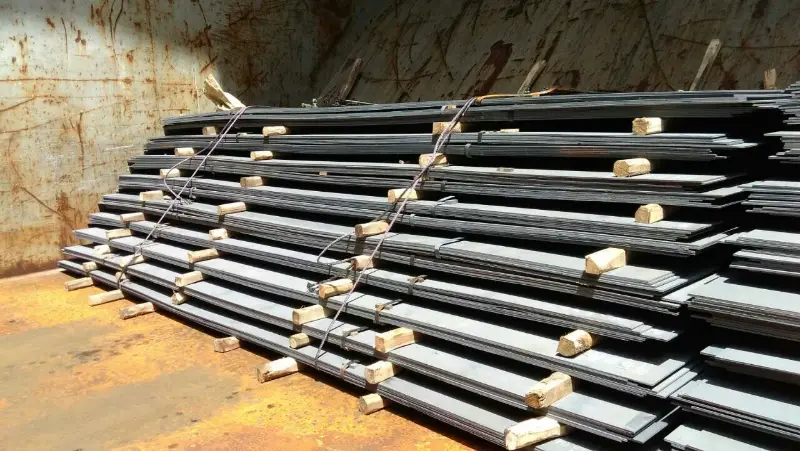
ASME SA514 Grade Q High-Strength Quenched & Tempered Alloy Steel Plate
ASME SA514 Grade Q High-Strength Quenched & Tempered Alloy Steel Plate
Explore the technical properties, chemical composition, mechanical and thermal characteristics of ASME SA514 Grade Q steel. A high-strength, low-alloy structural steel plate designed for heavy-duty applications.
Hot rolling followed by quenching and tempering; can be cut, formed, welded (with appropriate preheat and filler metals), and machined.
- Phone : +8618037372205
- Email : [email protected]
- WhatsApp: Contact via Whtsapp
- WeChat: +8618037372205
ASME SA514 Grade Q High-Strength Quenched & Tempered Alloy Steel Plate Introduction
ASME SA514 Grade Q (also designated SA514GRQ) is a high-yield, quenched and tempered low-alloy steel plate intended primarily for structural applications where weight savings and high strength are critical. This grade meets the requirements of the ASME Boiler and Pressure Vessel Code, Section II, Part A, and is essentially identical to ASTM A514 Grade Q. It provides a minimum yield strength of 690 MPa (100 ksi) in thicknesses up to 65 mm (2.5 in.), with excellent notch toughness and weldability when proper procedures are followed. The alloy design, featuring nickel, chromium, and molybdenum, ensures deep hardenability and uniform mechanical properties across the plate thickness. Common delivery conditions are quenched and tempered (Q&T). The steel is widely employed in the construction of pressure vessels, bridges, heavy machinery, and offshore structures.
ASME SA514 Grade Q High-Strength Quenched & Tempered Alloy Steel Plate Chemical Composition
The chemical composition of SA514 Grade Q must conform to the ladle analysis limits specified in the ASME SA-514/SA-514M standard. The alloying elements ensure high hardenability and the development of a tempered martensitic structure.
- Boron addition (0.0005%-0.005%) significantly enhances hardenability.
- Nickel and chromium provide strength and atmospheric corrosion resistance.
- Molybdenum improves high-temperature strength and hardenability.
- Vanadium contributes to grain refinement and precipitation strengthening.
Product analysis tolerances may apply per the standard.
| Element | Required Value (wt%) | Notes |
|---|---|---|
| Carbon (C) | 0.20 max | Increases hardenability |
| Manganese (Mn) | 0.95 - 1.30 | Desoxidizer and hardenability enhancer |
| Phosphorus (P) | 0.035 max | Considered an impurity |
| Sulfur (S) | 0.035 max | Considered an impurity |
| Silicon (Si) | 0.15 - 0.35 | Deoxidizer |
| Nickel (Ni) | 1.20 - 1.50 | Toughness and corrosion resistance |
| Chromium (Cr) | 1.00 - 1.50 | Hardenability and wear resistance |
| Molybdenum (Mo) | 0.40 - 0.60 | Hardenability and creep strength |
| Vanadium (V) | 0.03 - 0.08 | Grain refiner and precipitation hardener |
| Boron (B) | 0.0005 - 0.005 | Significant hardenability effect |
ASME SA514 Grade Q High-Strength Quenched & Tempered Alloy Steel Plate Physical Properties
The physical properties listed represent average room-temperature data for quenched and tempered low-alloy steel of similar chemistry. Exact values may vary slightly with heat treatment and composition within the specification range. These values are not part of the mandatory requirements but are useful for design calculations.
- Density is based on a typical alloy steel composition.
- Thermal conductivity and expansion apply over common engineering ranges.
- Electrical resistivity is included for completeness.
| Property | Typical Value | Unit | Condition |
|---|---|---|---|
| Density (ρ) | 7.85 | g/cm³ | At 20°C |
| Elastic Modulus (E) | 205 | GPa | Tension, room temperature |
| Shear Modulus (G) | 80 | GPa | Calculated from E and ν |
| Poisson's Ratio (ν) | 0.28 | — | Within elastic range |
| Thermal Expansion Coefficient (α) | 11.7 × 10⁻⁶ | /K | Between 20°C and 100°C |
| Thermal Conductivity (λ) | 42 | W/(m·K) | At 20°C |
| Specific Heat Capacity (c) | 460 - 500 | J/(kg·K) | At 20°C |
| Electrical Resistivity (ρₑ) | 0.23 × 10⁻⁶ | Ω·m | Room temperature |
ASME SA514 Grade Q High-Strength Quenched & Tempered Alloy Steel Plate Mechanical Properties
Tensile and impact test requirements are based on specimen orientation and plate thickness. The values below are the minimum requirements per ASME SA-514/SA-514M for plates up to 65 mm (2.5 in.) in thickness.
- Yield strength and tensile strength are determined using transverse specimens.
- Elongation is measured in a 2-inch (50 mm) gauge length for rectangular test pieces.
- Bend test requirements: 180° bend around a diameter of 2t for t ≤ 19 mm; 2.5t for 19 mm < t ≤ 40 mm; 3t for 40 mm < t ≤ 65 mm (where t = specimen thickness).
- Charpy V-notch impact tests may be specified as supplementary requirements; typical values at -40°C are provided but are not mandatory unless agreed upon.
| Property | Required Value | Unit | Test Condition |
|---|---|---|---|
| Yield Strength (ReH) | ≥ 690 | MPa | Transverse, Q&T, thickness ≤ 65 mm |
| Tensile Strength (Rm) | 760 - 895 | MPa | Transverse, Q&T, thickness ≤ 65 mm |
| Elongation (A) | ≥ 16 | % | In 50 mm (2 in.), transverse, thickness ≤ 65 mm |
| Reduction of Area (Z) | ≥ 40 (typical) | % | Round specimen, transverse, thickness ≤ 65 mm |
| Bend Test (180°) | No cracks | — | Bend diameter: 2t (t ≤ 19 mm); 2.5t (19< t ≤40 mm); 3t (40< t ≤65 mm) |
| Charpy V-Notch (KV2) | ≥ 27 (typical supplementary) | J | Longitudinal, at -40°C (optional S14 requirement) |
ASME SA514 Grade Q High-Strength Quenched & Tempered Alloy Steel Plate Completely Equivalent Material Standards and Substitutable Grades
The following designations represent identical chemistry and mechanical requirements as ASME SA514 Grade Q. They may be directly substituted in engineering and procurement documents.
| Country/Region | Standard | Grade | Notes |
|---|---|---|---|
| USA | ASTM A514/A514M | Grade Q | Identical to ASME SA514; often dual certified. |
| USA | ASME SA-514/SA-514M | Grade Q | Original specification. |
ASME SA514 Grade Q High-Strength Quenched & Tempered Alloy Steel Plate Application Introduction
SA514 Grade Q is engineered for welded structures where high strength-to-weight ratios are paramount. It is suitable for both static and dynamic loads. Proper welding techniques, including preheating and low-hydrogen consumables, are essential to avoid cracking.
Product Applications: Welded pressure vessels and storage tanks, Bridge girders and structural frames, Offshore platform legs and nodes, Mobile crane booms and outriggers, Mining truck bodies and shovel buckets, Heavy-duty transport trailers
Processed into products: Flanges and reinforcing pads for pressure vessels, Thick-wall pipe transition pieces, Excavator boom sections, Truss chord members, Support rings for wind turbines, Dump body reinforcement plates
Application industries: Heavy construction and civil engineering, Pressure vessel and boiler fabrication, Offshore and marine engineering, Mining and earthmoving equipment, Crane and lifting equipment manufacturing, Bridge building
ASME SA514 Grade Q High-Strength Quenched & Tempered Alloy Steel Plate Similar / Alternative Material Recommendations
The materials listed below have comparable strength levels and are often used in similar applications, but they may differ in chemical composition, toughness, or availability. Verification of specific requirements is necessary before substitution.
| Country/Region | Standard | Grade | Notes |
|---|---|---|---|
| Europe | EN 10025-6 | S690Q (1.8931) | Similar yield strength; toughness class Q (min. 30 J at -20°C). Not identical due to different alloying approach. |
| Europe | EN 10025-6 | S690QL (1.8928) | Similar but with mandatory impact at -40°C; may substitute if low-temperature toughness not compulsory. |
| Japan | JIS G 3128 | SHY685 (HV685) | High yield strength quenched and tempered plate; chemistry differs slightly. |
| USA | ASTM A514/A514M | Grade B | Slightly lower yield (690 MPa), different Ni-Cr-Mo balance; more readily available in some sizes. |
| International | ISO 4950-2 | S690Q | Equivalent to EN S690Q; plate from ISO markets. |
Notes:
- Welding: Preheating (typically 100–200°C) and interpass control are strongly recommended. Use low-hydrogen electrodes matching the strength class (e.g., AWS A5.28 E110C-K4).
- Forming: Because of the high strength, cold forming is limited; hot forming must be followed by a new quench and tempering treatment.
- Corrosion Resistance: Not intended for severe corrosive environments without protective coatings.
- Certification: Material test reports should clearly state tempering temperature and mechanical test results as per ASME SA-514/SA-514M.
- Share



