
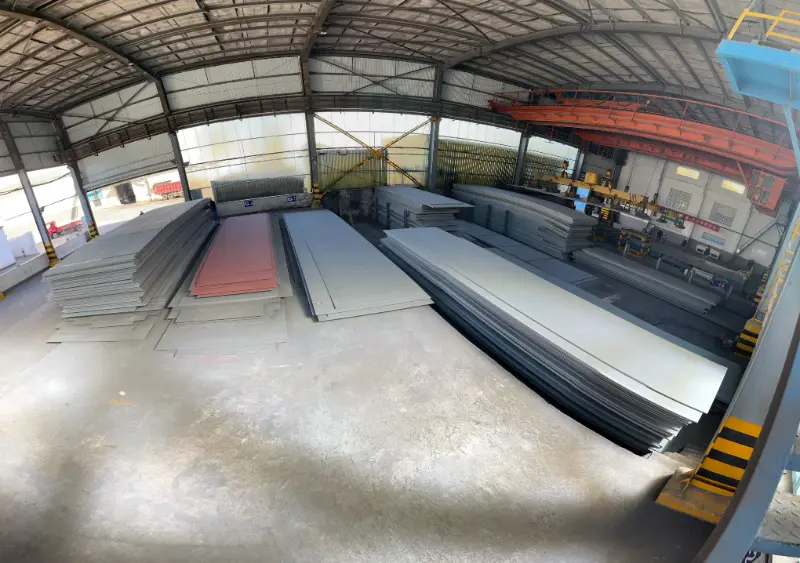
ASME SA514 Grade R High-Strength Quenched & Tempered Alloy Steel Plate
ASME SA514 Grade R (SA514GRR) Carbon Steel Plate - High-Strength Quenched & Tempered Alloy Steel
ASME SA514 Grade R is a high-yield, quenched and tempered carbon steel plate designed for structural applications requiring excellent weldability and high strength. With minimum yield strength up to 690 MPa, it offers outstanding load-bearing capacity and toughness.
Suitable for welding (low-hydrogen processes recommended), bending, forming, machining, and limited cold forming; post-weld heat treatment may be required depending on thickness and service conditions.
- Phone : +8618037372205
- Email : [email protected]
- WhatsApp: Contact via Whtsapp
- WeChat: +8618037372205
ASME SA514 Grade R High-Strength Quenched & Tempered Alloy Steel Plate Introduction
ASME SA514 Grade R (SA514GRR) is a structural quality carbon steel plate produced to the ASME SA-514/SA-514M specification. It belongs to the family of high-yield-strength, quenched and tempered alloy steels intended for welded structures. Key characteristics:
- Excellent combination of high strength and good weldability due to low carbon content and microalloying with boron and titanium.
- Minimum yield strength of 100 ksi (690 MPa) in thicknesses up to 2½ in., and 90 ksi (620 MPa) for thicker sections up to 6 in.
- Good notch toughness at low temperatures when specified.
- Uniform mechanical properties through-thickness achieved by quenching and tempering heat treatment.
- Widely used in heavy equipment, cranes, bridges and structural components subjected to severe loading conditions.
ASME SA514 Grade R High-Strength Quenched & Tempered Alloy Steel Plate Chemical Composition
The chemical composition of ASME SA514 Grade R is carefully controlled to achieve high strength and good weldability. It features a low carbon base (0.15–0.20%) with additions of chromium, nickel, and molybdenum for hardenability, plus boron and titanium for grain refinement. Maximum limits on phosphorus and sulfur ensure cleanliness. Note: Values are according to ASME SA-514/SA-514M for Grade R.
| Element | Content (%) | Remarks |
|---|---|---|
| Carbon (C) | 0.15 – 0.20 | Low carbon for weldability |
| Manganese (Mn) | 0.85 – 1.15 | Contributes to strength and hardenability |
| Phosphorus (P) | ≤ 0.035 | Maximum for ductility |
| Sulfur (S) | ≤ 0.040 | Maximum for toughness |
| Silicon (Si) | 0.20 – 0.35 | Deoxidation and strength |
| Chromium (Cr) | 1.00 – 1.50 | Hardenability and corrosion resistance |
| Nickel (Ni) | 1.00 – 1.50 | Toughness and hardenability |
| Molybdenum (Mo) | 0.45 – 0.60 | Enhances high-temperature strength and hardenability |
| Boron (B) | 0.001 – 0.005 | Microalloying for deep hardenability |
| Titanium (Ti) | 0.01 – 0.03 | Grain refinement and nitrogen fixation |
ASME SA514 Grade R High-Strength Quenched & Tempered Alloy Steel Plate Thermal and Electrical Physical Properties
The following are typical physical properties for quenched and tempered alloy steel of SA514 Grade R type. These values are for general engineering use and may vary slightly depending on exact heat treatment and composition. They are not part of the specification requirements.
| Property | Typical Value | Unit | Test Condition |
|---|---|---|---|
| Density (ρ) | 7.85 | g/cm³ | Room temperature |
| Modulus of Elasticity (E) | 205 | GPa | Tension, room temperature |
| Shear Modulus (G) | 80 | GPa | Calculated from E and ν |
| Poisson's Ratio (ν) | 0.30 | – | Room temperature |
| Thermal Expansion Coefficient (α) | 11.7 | ×10⁻⁶ /°C | 20 – 100 °C |
| Thermal Expansion Coefficient (α) | 12.5 | ×10⁻⁶ /°C | 20 – 200 °C |
| Thermal Expansion Coefficient (α) | 13.3 | ×10⁻⁶ /°C | 20 – 300 °C |
| Thermal Conductivity (λ) | approx. 38 | W/(m·K) | at 20 °C |
| Thermal Conductivity (λ) | approx. 35 | W/(m·K) | at 200 °C |
| Specific Heat Capacity (cp) | 460 – 500 | J/(kg·K) | 20 – 100 °C |
| Electrical Resistivity (ρe) | 0.23 | μΩ·m (×10⁻⁶ Ω·m) | at 20 °C |
ASME SA514 Grade R High-Strength Quenched & Tempered Alloy Steel Plate Mechanical Properties
Mechanical properties are determined after quenching and tempering. Tensile and yield strengths depend on plate thickness. Elongation requirements guarantee ductility. A guided-bend test ensures formability and weld soundness. Note: For thicknesses greater than 2½ in. (65 mm) up to 6 in. (150 mm) included, the yield strength minimum is reduced to 90 ksi (620 MPa). Bending radii as per standard.
| Property | Value | Unit | Test Condition / Thickness |
|---|---|---|---|
| Yield Strength (ReH) | ≥ 690 (100 ksi) | MPa (ksi) | Thickness ≤ 2½ in. (65 mm) |
| Yield Strength (ReH) | ≥ 620 (90 ksi) | MPa (ksi) | Thickness > 2½ in. to 6 in. (150 mm) |
| Tensile Strength (Rm) | 760 – 895 (110 – 130 ksi) | MPa (ksi) | Thickness ≤ 2½ in. (65 mm) |
| Tensile Strength (Rm) | 690 – 895 (100 – 130 ksi) | MPa (ksi) | Thickness > 2½ in. to 6 in. (150 mm) |
| Elongation (A50) | ≥ 18 | % | Gauge length 2 in. (50 mm), thickness ≤ ¾ in. (20 mm) |
| Elongation (A200) | ≥ 18 | % | Gauge length 8 in. (200 mm), thickness > ¾ in. |
| Bend Test (180°) | No cracks on outside of bent portion | – | Mandrel diameter per specification (e.g., 2t for t≤¾ in. at 110-130 ksi) |
ASME SA514 Grade R High-Strength Quenched & Tempered Alloy Steel Plate Fully Equivalent Material Standards and Substitute Grades
The following internationally recognized grades are essentially identical in chemical composition and mechanical properties to ASME SA514 Grade R.
| Country / Region | Standard | Grade | Remarks |
|---|---|---|---|
| USA | ASTM A514/A514M | Grade R | Identical; ASME SA514 adopts ASTM A514 |
| Europe | EN 10025-6 | S690Q (with supplementary B+Ti) | Equivalent when ordered with controlled boron and titanium; close mechanical match |
| International | ISO 4950-2 | E690DD or E690Q | High yield structural steel, similar strength level; verify chemistry additions |
ASME SA514 Grade R High-Strength Quenched & Tempered Alloy Steel Plate Application Introduction
Thanks to its high yield strength and good weldability, ASME SA514 Grade R is ideal for weight-saving designs in heavy engineering. Typical industries and applications:
Product Applications: Mobile crane telescopic booms and outriggers, Hydraulic excavator arms and buckets, Heavy-duty truck frames and semi-trailer structures, Mining dump truck beds and loader frames, Bridge girders, orthotropic deck plates, Offshore platform legs and spud cans, Pressure vessels and storage tanks (when supplied with U-stamp requirements)
Processed into products: Boom sections and chord members for lattice truck cranes, Load-carrying beams and columns in high-rise buildings, Cutting edges and wear liners (when combined with hardfacing), Pinned and bolted structural joints, Welded box structures for heavy machinery, Turntables and slewing rings for excavators
Application industries: Construction and building machinery (cranes, excavators, bulldozers), Mining and quarry equipment (dump truck bodies, crusher frames), Bridge engineering (orthotropic decks, main girders, bracing), Heavy transport (truck chassis, trailer components), Energy and offshore (jack-up rig legs, structural nodes, pressure vessels under ASME BPVC), General structural engineering where high strength-to-weight ratio is critical
ASME SA514 Grade R High-Strength Quenched & Tempered Alloy Steel Plate Similar / Alternative Material Recommendations
The grades listed below offer comparable mechanical properties and can be considered for substitution, but chemical composition may differ. Always verify suitability for the specific application and welding requirements.
| Country / Region | Standard | Grade | Remarks |
|---|---|---|---|
| USA | ASTM A514 | Grade Q | Higher Ni (1.50–2.00) and Cr, similar strength; often used as alternative |
| USA | ASTM A514 | Grade S | Slightly higher alloy content (Mo, V); similar strength range |
| USA | ASTM A517 | Grade R | Pressure vessel quality version of SA514-R; identical chemistry and properties |
| Europe | EN 10025-6 | S690QL | Low-temperature tough variant; often used for cranes and heavy structures |
| Japan | JIS G 3128 | SHY685 / SHY685N | 800 MPa class high-yield steel, can match strength after heat treatment adjustment. |
Notes:
- The material is typically supplied with a mill test report (MTR) showing heat analysis and tensile properties. Supplementary requirements (e.g., Charpy V-notch impact tests, ultrasonic testing) may be specified per ASME SA-514 order.
- Welding must follow qualified procedures using low-hydrogen electrodes to prevent cold cracking; preheat and interpass temperatures are critical for thicker sections.
- Post-weld heat treatment (stress relieving) is generally not recommended for SA514 grades in the Q&T condition to avoid strength loss; consult the standard for exceptions.
- For pressure vessel applications under ASME BPVC Section VIII, Grade R may be used provided the design stress values are taken from the code tables.
- Forming and bending should be performed in the Q&T condition with liberal bend radii; hot forming requires re-heat treatment.
- Share



