
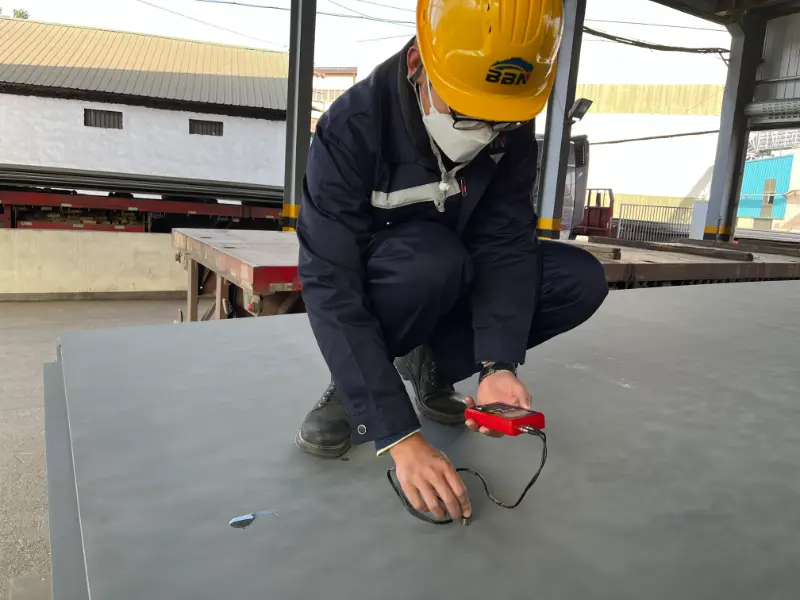
ASME SA514 Grade A Steel Plate
ASME SA514 Grade A Steel Plate: High-Strength Quenched & Tempered Alloy for Structural Use
Explore ASME SA514 Grade A carbon steel plate, a high-yield-strength, quenched and tempered alloy steel designed for structural applications requiring high strength and good weldability.
Hot Rolling, Quenching, Tempering, Welding (with preheat and low-hydrogen procedures), Machining (in annealed or tempered condition)
- Phone : +8618037372205
- Email : [email protected]
- WhatsApp: Contact via Whtsapp
- WeChat: +8618037372205
ASME SA514 Grade A Steel Plate Introduction
ASME SA514 Grade A (SA514GRA) is a high-yield-strength, quenched and tempered alloy steel plate intended primarily for structural applications where weight savings and durability are critical. This grade conforms to the ASME SA514/SA514M standard and is characterized by its excellent combination of high strength, good weldability, and notch toughness at low temperatures. The alloying elements, such as chromium and molybdenum, along with a precise heat treatment process, provide a minimum yield strength of 100 ksi (690 MPa) in thicknesses up to 2.5 inches (63.5 mm). Its primary use is in welded bridges, buildings, and other structures, but due to its properties, it is also suitable for a range of mechanical and pressure-retaining components under specific ASME code approvals. However, its maximum carbon content and carbon equivalent require strict adherence to welding procedures to avoid hydrogen-induced cracking.
ASME SA514 Grade A Steel Plate Chemical Composition
The chemical composition of SA514 Grade A is carefully balanced to achieve deep hardenability and high strength after quenching and tempering. Carbon is restricted to maintain weldability, while manganese and silicon act as primary deoxidizers and strength contributors. Chromium and molybdenum enhance hardenability and provide resistance to softening during tempering. Boron is a potent hardenability agent added in trace amounts. Strict limits on phosphorus and sulfur ensure excellent cleanliness and notch toughness.
| Element | Standard Value (max, unless range or min is indicated) | Remarks |
|---|---|---|
| Carbon (C) | 0.21 | Max |
| Manganese (Mn) | 0.80 - 1.10 | Heat Analysis Range |
| Phosphorus (P) | 0.020 | Max |
| Sulfur (S) | 0.010 | Max |
| Silicon (Si) | 0.30 - 0.50 | Heat Analysis Range |
| Nickel (Ni) | 0.30 | Max (Residual element) |
| Chromium (Cr) | 0.50 - 0.80 | Heat Analysis Range |
| Molybdenum (Mo) | 0.18 - 0.28 | Heat Analysis Range |
| Zirconium (Zr) | 0.05 - 0.15 | May be used for grain refinement/sulfide shape control |
| Boron (B) | 0.0005 - 0.005 | Hardenability agent |
| Titanium (Ti) | 0.01 - 0.03 | To protect boron from nitrogen |
ASME SA514 Grade A Steel Plate Thermal and Electrical Physical Properties
These physical properties are typical for a low-alloy steel of this grade in the quenched and tempered condition. Density is assumed standard for carbon/alloy steel. Moduli of elasticity and shear are fundamental for structural design. Thermal expansion coefficient is critical for design where temperature changes occur. Properties like thermal conductivity, specific heat, and electrical resistivity are functions of temperature and provided for several evaluation conditions. These values are representative for engineering calculations.
| Property | Typical Value | Unit | Test Condition / Temperature |
|---|---|---|---|
| Density (ρ) | 7.83 | g/cm³ | At room temperature |
| Elastic Modulus (E) | 205 | GPa | At room temperature |
| Shear Modulus (G) | 80 | GPa | At room temperature (typical for steel) |
| Poisson's Ratio (ν) | 0.29 | - | At room temperature (typical) |
| Thermal Expansion Coeff. (α) | 11.2 | 10⁻⁶/°C | From 20°C to 100°C |
| Thermal Expansion Coeff. (α) | 12.5 | 10⁻⁶/°C | From 20°C to 300°C |
| Thermal Expansion Coeff. (α) | 13.6 | 10⁻⁶/°C | From 20°C to 500°C |
| Thermal Conductivity (λ) | 38 | W/(m·°C) | At 100°C |
| Thermal Conductivity (λ) | 36 | W/(m·°C) | At 300°C |
| Thermal Conductivity (λ) | 33 | W/(m·°C) | At 500°C |
| Specific Heat Capacity | 480 | J/(kg·°C) | At 100°C |
| Specific Heat Capacity | 540 | J/(kg·°C) | At 300°C |
| Specific Heat Capacity | 600 | J/(kg·°C) | At 500°C |
| Electrical Resistivity (ρ_e) | 2.2 x 10⁻⁷ | Ω·m | At room temperature (typical) |
ASME SA514 Grade A Steel Plate Mechanical Properties
As a high-performance structural steel, SA514 Grade A is defined by its high minimum yield and tensile strengths after quenching and tempering. The elongation requirement ensures sufficient ductility for structural design. Yield strength (ReH) and tensile strength (Rm) are tested on transverse specimens. Charpy V-notch impact toughness (KV) is a critical requirement, typically tested at specified low temperatures to ensure resistance to brittle fracture. Hardness values are controlled to confirm proper tempering.
| Property | Standard Requirement | Unit | Test Condition |
|---|---|---|---|
| Yield Strength (ReH) | 690 min | MPa | Plate thickness ≤ 63.5 mm (2.5 in) |
| Yield Strength (ReH) | 620 min | MPa | Plate thickness > 63.5 mm to 152 mm (>2.5 in to 6 in) |
| Tensile Strength (Rm) | 760 - 895 | MPa | Plate thickness ≤ 63.5 mm (2.5 in) |
| Tensile Strength (Rm) | 690 - 895 | MPa | Plate thickness > 63.5 mm to 152 mm (>2.5 in to 6 in) |
| Elongation in 200 mm (A200) | 16 min | % | Plate thickness ≤ 19 mm (0.75 in) |
| Elongation in 50 mm (A50) | 18 min | % | Plate thickness > 19 mm (0.75 in) |
| Bend Test (Bend Diameter) | No cracks | - | 180° bend, D=2T to D=4T based on thickness and specification |
| Charpy V-Notch Impact (KV) | 27 - 34 min (varies) | J | Transverse sample at -18°C (0°F) or -4°C (25°F) |
ASME SA514 Grade A Steel Plate Completely Equivalent Material Standards & Substitute Grades
| Country / Region | Standard | Grade / Designation | Remarks |
|---|---|---|---|
| USA | ASTM A514/A514M | Grade A | Identical chemical and mechanical requirements to ASME SA514 Grade A for non-boiler/pressure vessel structural applications. |
| USA | ASTM A517/A517M | Grade A | Identical grade for pressure vessel applications, but this standard is less common than ASME SA514 for this specific grade. |
ASME SA514 Grade A Steel Plate Application Introduction
ASME SA514 Grade A steel is engineered for applications where its high strength-to-weight ratio allows for significant component weight reduction and increased payload capacity. Its excellent mechanical properties are fully developed in the quenched and tempered delivery condition. Successful use requires a thorough understanding of its processing limits, especially in welding, to avoid cracking and maintain the heat-treated strength.
Product Applications: All-welded road bridges, railway bridges, and pedestrian bridges, High-capacity all-terrain and crawler crane telescopic booms and lattice sections, Jack-up rig legs and offshore platform structural nodes, Heavy-duty dump truck bodies and mining shovel buckets, Hydraulic press frames and large high-stress machine housings
Processed into products: Bridge box girder flanges and webs, Crane boom chord and lattice members, Ship hull longitudinal stiffeners and transom plates, Bulldozer and grader blade supports, Bolted end connectors for prefabricated structural modules
Application industries: Heavy Mobile Equipment & Crane Manufacturing, Bridge and Infrastructure Construction, Shipbuilding and Offshore Engineering, Mining and Earthmoving Equipment, Pressure Vessel Fabrication (by ASME Code approval)
ASME SA514 Grade A Steel Plate Similar / Comparable Substitute Materials
| Country / Region | Standard | Grade / Designation | Remarks |
|---|---|---|---|
| Europe | EN 10025-6 | S690Q (1.8928) | Very close in strength level (min 690 MPa yield). S690Q uses a different metallurgical approach (often no boron) and has different chemistry limits. It is the primary global equivalent, but qualification is needed. |
| Europe | EN 10025-6 | S690QL (1.8928) | Same as S690Q but with guaranteed low-temperature impact properties (QL suffix). A better match for toughness-critical applications. |
| China | GB/T 16270 | Q690D (1.8931) | High-strength structural steel with min 690 MPa yield and guaranteed impact at -20°C. A functional equivalent in the Chinese standard system. |
| USA | ASTM A514/A514M | Grade B, E, F, H, Q | Other grades within the same standard. They achieve the same 100 ksi yield requirement but with different alloy chemistries optimized for various thicknesses or welding conditions. |
| Sweden | SSAB | Weldox 700 / Strenx 700 | Proprietary brand of high-strength structural steel with a minimum yield strength of 700 MPa. Often available in thinner, precision-gauge strip/plate. A commercial alternative. |
Notes:
Welding: Due to the high hardenability of SA514 Grade A, welding must be performed using low-hydrogen processes (e.g., SMAW with low-hydrogen electrodes, GMAW, SAW). Proper preheating (typically 150-200°C) and interpass temperature control are mandatory to prevent hydrogen-induced cold cracking. The maximum heat input must be controlled to avoid over-tempering and softening of the heat-affected zone (HAZ). Post-weld heat treatment (PWHT) is generally not required and should be avoided unless specifically qualified, as it can degrade the mechanical properties.
Forming: The material has high strength and reduced ductility compared to mild steel. Cold forming operations like bending require generous bend radii (typically >3T for plates over 12 mm) and the removal of sheared or gas-cut edge notches to prevent cracking. Hot forming above 590°C is not recommended as it will destroy the quenched and tempered microstructure.
Certification: When ordered for ASME Section VIII, Division 1 pressure vessel service, special supplementary requirements from ASME SA514/SA514M must be invoked, and the material test report (MTR) must reflect compliance.
- Share



