
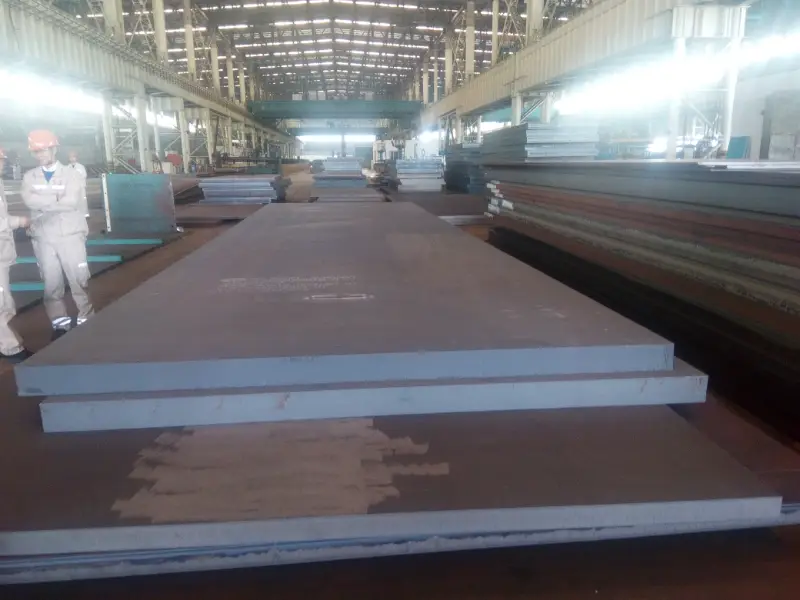
ASME SA283 Grade D Carbon Steel Plate
ASME SA283 Grade D Carbon Steel Plate: Comprehensive Material Data
Detailed material properties of ASME SA283 Grade D (SA283GRD) carbon steel plate, including chemical composition, mechanical and physical properties, international equivalents, and application guide for structural engineering.
Hot rolling, cold rolling (limited), cutting, welding, forming, machining, drilling, bending
- Phone : +8618037372205
- Email : [email protected]
- WhatsApp: Contact via Whtsapp
- WeChat: +8618037372205
ASME SA283 Grade D Carbon Steel Plate Introduction
ASME SA283 Grade D is a low-to-intermediate tensile strength carbon steel plate intended for general structural applications. It belongs to the ASME Boiler and Pressure Vessel Code, Section II, and is essentially identical to ASTM A283 Grade D. This grade offers improved strength compared to Grades A, B, and C of the same standard, with specified minimum yield strength of 33 ksi (230 MPa) and tensile strength ranging from 60 to 80 ksi (415–550 MPa). The material is easily weldable, formable, and machinable, making it suitable for a wide range of fabrication processes. It is commonly supplied in the as-rolled condition but can be normalized or stress-relieved upon agreement. SA283 Grade D is widely used in construction, bridges, storage tanks, and general structural fabrications where moderate strength and good ductility are required.
ASME SA283 Grade D Carbon Steel Plate Chemical Composition
The chemical requirements for ASME SA283 Grade D are specified in accordance with ASME SA283/SA283M. The maximum limits for carbon, phosphorus, and sulfur are mandatory. Manganese content varies with plate thickness to ensure adequate strength and ductility. Silicon is required only when the steel is to be cold bent; otherwise it is not normally specified, though residual silicon up to 0.40% may be present.
| Element | Standard Value | Remarks |
|---|---|---|
| Carbon (C) | ≤ 0.27% | Ladle analysis |
| Manganese (Mn) | ≤ 0.90% | For plate thickness ≤ 1 in. (25 mm) |
| Manganese (Mn) | ≤ 1.20% | For plate thickness > 1 in. to 2 in. (25–50 mm) |
| Manganese (Mn) | ≤ 1.20% | For plate thickness > 2 in. (50 mm) up to 4 in. (100 mm) |
| Phosphorus (P) | ≤ 0.030% | |
| Sulfur (S) | ≤ 0.030% | |
| Silicon (Si) | 0.15–0.40% | Required when the material is to be bent cold; may be specified by purchaser |
| Copper (Cu) (minimum when copper steel is specified) | ≥ 0.20% | Only applicable when copper-bearing steel is ordered |
ASME SA283 Grade D Carbon Steel Plate Thermal and Electrical Physical Properties
The following physical properties are typical for carbon steel comparable to ASME SA283 Grade D and are taken from published data for mild carbon steel. Actual values may vary slightly with exact composition and heat treatment. These properties are informative and not part of the material specification, but are useful for design and engineering calculations.
| Property | Typical Value | Unit | Test Condition / Remarks |
|---|---|---|---|
| Density (ρ) | 7.85 | g/cm³ | At room temperature |
| Elastic Modulus (E) | 200 (29,000) | GPa (ksi) | Tension, ambient temperature |
| Shear Modulus (G) | 80 | GPa | Estimated from E and ν |
| Poisson's Ratio (ν) | 0.26 – 0.30 | – | Typical for structural carbon steel |
| Thermal Expansion (α) | 12.1 (avg. 0–100°C) | µm/m·K | Linear expansion coefficient |
| Thermal Conductivity (λ) | 51.9 (at 100°C) | W/m·K | Typical for low-carbon steel |
| Specific Heat Capacity | 486 | J/kg·K | At 20 – 100°C |
| Electrical Resistivity (ρ_e) | ~ 0.16 | µΩ·m | At room temperature |
ASME SA283 Grade D Carbon Steel Plate Mechanical Properties
Mechanical properties are determined in accordance with ASME SA283/SA283M and the referenced test methods. Tensile and yield strength values apply to transverse specimens taken from the plate in the as-rolled or normalized condition. Elongation minimums are specified for standard gauge lengths. The bend test requirement applies when cold forming is intended; the core diameter depends on plate thickness and tensile strength. All values listed are minimum unless a range is given.
| Property | Standard Requirement | Unit | Test Condition / Remarks |
|---|---|---|---|
| Tensile Strength (Rm) | 60 – 80 | ksi | Transverse test, full thickness specimen |
| Tensile Strength (Rm) | 415 – 550 | MPa | Transverse test, full thickness specimen |
| Yield Strength (ReH) | ≥ 33 | ksi | 0.2% offset method (when yield point not distinct) |
| Yield Strength (ReH) | ≥ 230 | MPa | 0.2% offset method |
| Elongation (A) in 8 in. (200 mm) | ≥ 20 | % | Standard round specimen or proportional specimen |
| Elongation (A) in 2 in. (50 mm) | ≥ 23 | % | Standard round specimen or proportional specimen |
| Bend Test (Cold bend, 180°) | No cracks | – | Core diameter: 1×t for t ≤ 19 mm; 1.5×t for 19 < t ≤ 25 mm; 2.5×t for 25 < t ≤ 50 mm; 3×t for 50 < t ≤ 100 mm |
ASME SA283 Grade D Carbon Steel Plate Fully Equivalent Material Standards and Substitutable Grades
The following standards and grades are either technically identical to ASME SA283 Grade D (same composition and properties) or recognized as direct equivalents in cross-reference tables. These can be considered direct substitutes, though project-specific requirements should be verified.
| Country/Region | Standard | Grade | Remarks |
|---|---|---|---|
| USA | ASTM A283/A283M | Grade D | Identical chemical and mechanical requirements; often dual-certified |
| USA | UNS | K02702 | Unified Numbering System designation for A283 Grade D |
| International | ISO 630-2 (historical) | Fe430B | Old ISO standard with similar tensile range (420–540 MPa) but slightly different yield; check for current equivalence |
ASME SA283 Grade D Carbon Steel Plate Application Introduction
ASME SA283 Grade D is a versatile carbon steel intended for structural and general engineering applications. Its balanced combination of strength, ductility, and weldability makes it suitable for both static and dynamically loaded structures when used within its temperature and stress limitations. The material is easily processed by hot or cold forming, machining, and all common welding techniques. Below are typical industry sectors, end products, and components manufactured from this grade.
Product Applications: Structural steel beams and columns, Bridge girders and deck plates, Storage tanks and silos, Base plates and anchor plates, Skids, frames, and supports, Agricultural equipment frames, Bins, hoppers, and chutes, Ducts and casings
Processed into products: Welded and bolted structural connections, Flanges and stiffeners, Gusset plates, Brackets and cleats, Machine bases, Tank bottoms and shells, Conveyor structure components, Shims and spacer plates
Application industries: Building and Construction, Bridge and Highway Engineering, Storage Tank Fabrication, Shipbuilding (non-classed, secondary structures), Agricultural Machinery, Material Handling Equipment, Pressure Vessels (non-critical, low-pressure or atmospheric), General Steel Fabrication
ASME SA283 Grade D Carbon Steel Plate Similar or Closely Related Alternative Materials
The steels listed below have comparable strength and application fields but are not exact equivalents. Substitution should be based on a detailed comparison of mechanical properties and material thickness. Engineering approval is recommended.
| Country/Region | Standard | Grade | Remarks |
|---|---|---|---|
| USA | ASTM A36/A36M | A36 | Widely used structural carbon steel; yield ≥ 36 ksi (250 MPa), tensile 58–80 ksi (400–550 MPa) – slightly higher yield, similar tensile |
| USA | ASTM A283/A283M | Grade C | Lower carbon (max 0.24%) and lower Mn, tensile 55–75 ksi (380–515 MPa) – less strength |
| Europe | EN 10025-2 | S275JR (1.0044) | Yield ≥ 275 MPa, tensile 410–560 MPa; often considered a functional equivalent but yield strength is higher |
| Japan | JIS G3101 | SS400 | Tensile 400–510 MPa, yield ≥ 245 MPa (normal) – lower tensile maximum and no specified min for elongation at 200mm |
| China | GB/T 700 | Q235B | Yield ≥ 235 MPa (≤16mm), tensile 370–500 MPa – lower tensile strength range |
| India | IS 2062 | E250 (Fe 410W A/B/C) | Yield 250 MPa min (≤20mm), tensile 410 MPa min – slightly higher yield, but tensile minimum overlaps |
Notes:
- ASME SA283 Grade D plates are generally supplied with mill edges; trimmed edges are available upon request.
- Material may be ordered with additional tests such as Charpy V-notch impact testing for low-temperature service, though this is not a standard requirement. When required, test temperature and energy values must be agreed upon.
- The steel is not recommended for highly corrosive environments without protective coatings, as it offers limited atmospheric corrosion resistance.
- Maximum plate thickness under SA283 is 4 in. (100 mm) for Grade D, beyond which mechanical properties may not be guaranteed.
- Welding procedures should follow AWS D1.1 or equivalent; preheating may be necessary for thicker sections to avoid hydrogen cracking.
- Dual certification with ASTM A283 Grade D is common, facilitating international procurement.
- Share



