
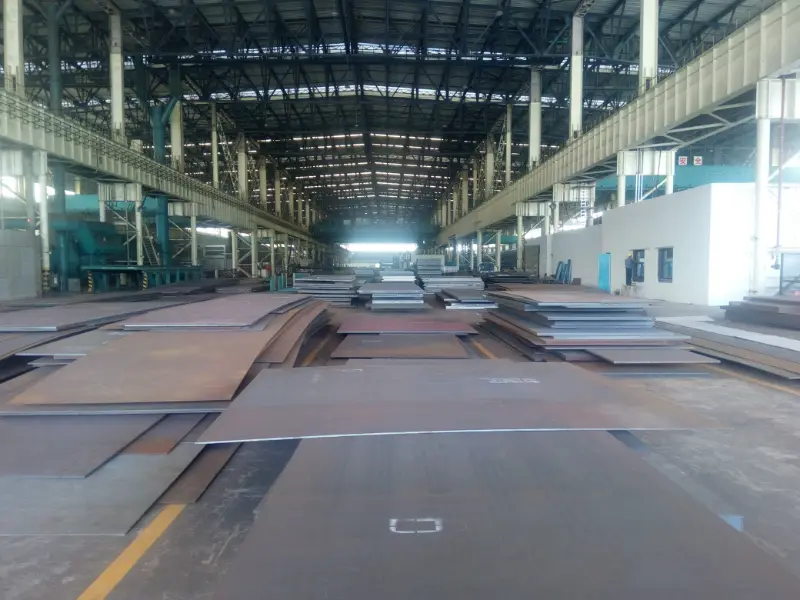
ASME SA283 Grade C Carbon Steel Plate
ASME SA283 Grade C Carbon Steel Plate – Reliable Structural Material for General Fabrication
Comprehensive technical data for ASME SA283 Grade C carbon steel plate including chemical composition, mechanical and physical properties, equivalent grades, and application guide.
Hot rolling, cold forming, cutting, welding, bending, drilling, machining
- Phone : +8618037372205
- Email : [email protected]
- WhatsApp: Contact via Whtsapp
- WeChat: +8618037372205
ASME SA283 Grade C Carbon Steel Plate Introduction
ASME SA283 Grade C (SA283GRC) is a low-carbon structural steel plate intended for general structural and welded construction applications. It exhibits moderate strength with a minimum yield of 205 MPa (30 ksi) and tensile strength between 380–515 MPa (55–75 ksi). The material offers good weldability, formability, and toughness at ambient conditions. Typical delivery condition is as-rolled or normalized. It is widely used in bridges, storage tanks, machinery, and building structures where conventional structural integrity is required without demanding impact toughness.
ASME SA283 Grade C Carbon Steel Plate Chemical Composition
The chemical composition limits for SA283 Grade C are specified in ASME SA283/SA283M. The steel is fully killed or semi-killed, with silicon added for deoxidation. Copper may be present as residual or specified. All values are maximum unless a range is given.
| Element | Content (%) | Remarks |
|---|---|---|
| Carbon (C) | ≤ 0.24 | per heat analysis |
| Manganese (Mn) | 0.60 – 0.90 | for thickness ≤ 40 mm |
| Phosphorus (P) | ≤ 0.035 | |
| Sulfur (S) | ≤ 0.040 | |
| Silicon (Si) | 0.15 – 0.40 | for plates over 40 mm, Si range may be 0.15–0.50 |
| Copper (Cu) | ≥ 0.20 (when specified) | residual element; if copper steel is required, minimum 0.20 |
ASME SA283 Grade C Carbon Steel Plate Thermal and Electrical Physical Properties
The data below represent typical physical properties for carbon steel comparable to SA283 Grade C at room temperature unless otherwise noted. These values are not mandatory per ASME SA283 but are commonly used for design calculations.
| Property | Value | Unit | Test Condition |
|---|---|---|---|
| Density (ρ) | 7.85 | g/cm³ | 20°C |
| Modulus of elasticity (E) | 200 | GPa | at room temperature |
| Shear modulus (G) | 80 | GPa | typical for steel |
| Poisson's ratio (ν) | 0.30 | – | ambient conditions |
| Coefficient of thermal expansion (α) | 12.0 × 10⁻⁶ | /K | 20–100°C |
| Thermal conductivity (λ) | 50 | W/(m·K) | at 20°C |
| Specific heat capacity (cₚ) | 486 | J/(kg·K) | at 20°C |
| Electrical resistivity (ρₑ) | 0.16 × 10⁻⁶ | Ω·m | at 20°C |
ASME SA283 Grade C Carbon Steel Plate Mechanical Properties
Tensile and elongation properties are based on standard test specimens taken from the plate in hot-rolled or normalized condition. Bend test requires crack-free 180° bending with an inside diameter up to 1½ times the plate thickness for thin plates.
| Property | Value (Min. – Max.) | Unit | Test Condition |
|---|---|---|---|
| Tensile strength (Rm) | 380 – 515 | MPa | transverse test piece, 8 in. (200 mm) gauge |
| Yield strength (ReH) | ≥ 205 (min. 30) | MPa (ksi) | 0.2% offset or 0.5% extension under load |
| Elongation in 200 mm (8 in.) | ≥ 25 | % | plate thickness ≤ 19 mm |
| Elongation in 50 mm (2 in.) | ≥ 22 | % | plate thickness ≤ 19 mm; for thicker plates, elongation may be slightly reduced |
| Bend test, 180° | d = 1.5a (no cracks) | – | a = plate thickness; for plates ≤ 20 mm |
ASME SA283 Grade C Carbon Steel Plate Full Equivalents or Direct Substitutes
| Country/Region | Standard | Grade | Remarks |
|---|---|---|---|
| USA | ASTM A283/A283M | Grade C | Identical technical requirements; ASTM A283 is the original base standard for ASME SA283 |
| Canada | CSA G40.21 | 38W | Close equivalent, minor differences in Mn and Si ranges; 38W is a structural grade |
| International | ISO 630-3 | Fe360C | Chemical and strength ranges compatible, but requires verification for specific applications |
| Europe | EN 10025-2 | S235JR | Widely accepted substitute, with similar tensile properties and slightly tighter C and Mn limits |
ASME SA283 Grade C Carbon Steel Plate Application Introduction
ASME SA283 Grade C is suitable for a variety of structural and engineering applications where mild strength and good weldability are needed. It is commonly selected for static load-bearing components and moderate-service environments. Because it does not have guaranteed impact properties, it is mainly used at ambient temperatures and in non-sour service.
Product Applications: Welded steel frames and columns, Bridge girders and deck plates, Atmospheric storage tanks (API 12B-type for oil/water), Machinery bases and supports, General structural platforms and walkways, Pressure boundary components (thick plate under ASME Section VIII, Div.1, when impact test is not required)
Processed into products: Plates cut and welded into stiffeners, brackets, and gussets, Flanges and gusset plates for structural connections, Base plates for columns and machinery, Shell plates for small, low-pressure vessels, Ductwork and hopper plates, Structural parts for construction equipment
Application industries: Construction & Infrastructure, Bridges & Highways, Storage Tanks & Vessels, Machinery & Equipment Manufacturing, Shipbuilding (non-critical parts), Power Generation (auxiliary structures)
ASME SA283 Grade C Carbon Steel Plate Similar or Alternative Materials
| Country/Region | Standard | Grade | Remarks |
|---|---|---|---|
| China | GB/T 700 | Q235B | Mechanical properties nearly match; P and S limits slightly different; frequently used as alternative in non-ASME projects |
| Japan | JIS G3101 | SS400 | General structural carbon steel with similar strength but wider composition ranges; check project specifications |
| Germany | DIN 17100 | St37-2 (RSt37-2) | Historical equivalent now replaced by S235JR; apply with caution for current designs |
| India | IS 2062 | E250 (Fe410) | Comparable grade for structural steel with similar yield and tensile strength |
Notes:
Material is typically supplied in the as-rolled condition. For thicknesses above 50 mm, supplementary requirements (e.g., S1.1 vacuum treatment, S2 product analysis) may be specified. When used in welded pressure vessels, Design margins per ASME BPVC must be met, and the material may need specific heat treatment to satisfy toughness requirements. Always confirm the exact specification revision and any supplementary requirements with the material test report.
- Share



