
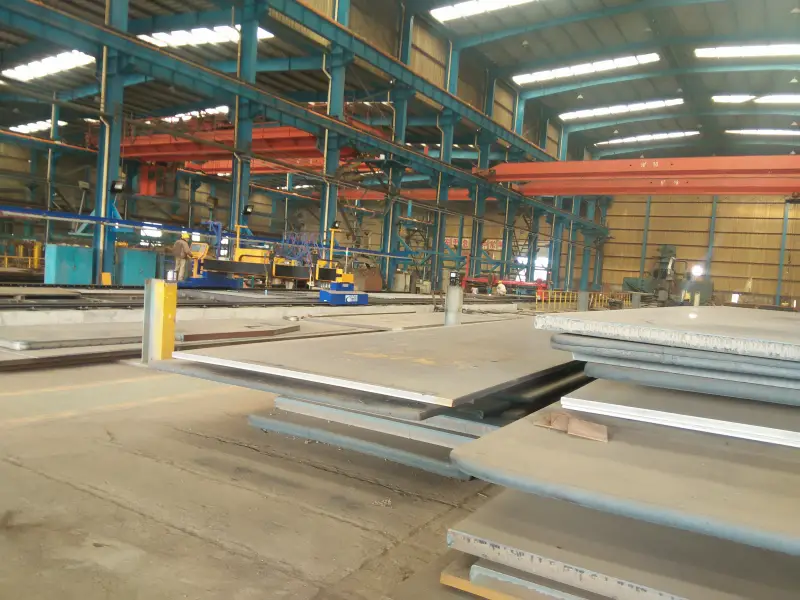
ASME SA514 Grade B High-Strength Quenched-Tempered Steel Plate
ASME SA514 Grade B High-Strength Quenched-Tempered Steel Plate Specifications
Explore the full material data sheet for ASME SA514 Grade B steel plate: chemical composition, mechanical and physical properties, international equivalents, and application guidelines for pressure vessels and heavy structures.
Hot rolling, quenching and tempering, flame/plasma/laser cutting, welding, cold forming, machining
- Phone : +8618037372205
- Email : [email protected]
- WhatsApp: Contact via Whtsapp
- WeChat: +8618037372205
ASME SA514 Grade B High-Strength Quenched-Tempered Steel Plate Introduction
ASME SA514 Grade B is a high-strength, quenched and tempered alloy steel plate specifically designed for welded pressure vessels and structural applications where weight savings and high strength are critical. This grade belongs to the ASTM A514/A514M family, adopted by ASME for boiler and pressure vessel construction. It offers a minimum yield strength of 690 MPa (100 ksi) and good notch toughness, making it suitable for demanding service conditions.
Key features of SA514 Grade B include:
- Quenched and tempered microstructure providing high strength and adequate ductility
- Microalloying with chromium, molybdenum, vanadium, titanium, and boron for deep hardenability
- Good weldability with low-hydrogen practices and preheat/postheat controls
- Available in plate thicknesses up to 50 mm (2 in.)
- Delivered in the quenched and tempered condition, ready for fabrication
This data sheet presents certified chemical composition limits, mechanical properties per ASME SA514/SA514M, and typical physical property values.
ASME SA514 Grade B High-Strength Quenched-Tempered Steel Plate Chemical Composition
The chemical composition of ASME SA514 Grade B steel is precisely controlled to achieve consistent hardenability and strength after quenching and tempering. It is a Cr-Mo-V-Ti-B microalloyed steel that relies on boron to enhance hardenability at low carbon equivalent. All values are percent by mass, as required by the standard.
| Element | Specified Value (wt%) | Remarks |
|---|---|---|
| Carbon (C) | 0.12 – 0.21 | Heat analysis |
| Manganese (Mn) | 0.70 – 1.00 | Heat analysis |
| Phosphorus (P) | 0.025 max | Heat analysis |
| Sulfur (S) | 0.025 max | Heat analysis |
| Silicon (Si) | 0.20 – 0.35 | Heat analysis |
| Chromium (Cr) | 0.40 – 0.65 | Heat analysis |
| Molybdenum (Mo) | 0.15 – 0.25 | Heat analysis |
| Vanadium (V) | 0.03 – 0.08 | Heat analysis |
| Titanium (Ti) | 0.01 – 0.03 | Heat analysis |
| Boron (B) | 0.0005 – 0.005 | Heat analysis |
ASME SA514 Grade B High-Strength Quenched-Tempered Steel Plate Thermal and Electrical Physical Properties
The following physical properties are typical for quenched and tempered Cr-Mo-V-B alloy steel of this strength class. They are provided for design calculations and should be used as approximate values at room temperature unless another temperature is indicated.
| Property | Typical Value | Unit | Test Condition |
|---|---|---|---|
| Density (ρ) | 7850 | kg/m³ | 20 °C |
| Modulus of elasticity (E) | 205 | GPa | 20 °C |
| Shear modulus (G) | 80 | GPa | 20 °C |
| Poisson's ratio (ν) | 0.30 | — | 20 °C |
| Thermal expansion coefficient (α) | 11.7 × 10⁻⁶ | K⁻¹ | 20–100 °C |
| Thermal conductivity (λ) | 42 | W/(m·K) | 100 °C |
| Specific heat capacity | 475 | J/(kg·K) | 20 °C |
| Electrical resistivity (ρₑ) | 0.23 × 10⁻⁶ | Ω·m | 20 °C |
ASME SA514 Grade B High-Strength Quenched-Tempered Steel Plate Mechanical Properties
Mechanical properties are determined in accordance with ASTM A370 on longitudinal test specimens taken from quenched and tempered plates. The values shown represent the minimum specified requirements and allowed ranges. No Charpy impact requirements are mandated by the base specification unless supplementary requirements are invoked.
| Property | Specified Value | Unit | Test Condition |
|---|---|---|---|
| Yield strength (ReH) | ≥ 690 | MPa | t ≤ 50 mm, longitudinal |
| Tensile strength (Rm) | 760 – 895 | MPa | t ≤ 50 mm |
| Elongation (A) | ≥ 18 | % | Gauge 50 mm, t ≤ 50 mm, longitudinal |
| Bend test (mandrel diameter) | 2t | — | t ≤ 19 mm, 180° bend, longitudinal |
| Bend test (mandrel diameter) | 3t | — | 19 < t ≤ 50 mm, 180° bend, longitudinal |
ASME SA514 Grade B High-Strength Quenched-Tempered Steel Plate Completely Equivalent Material Designations
| Country/Region | Standard | Grade/Designation | Remarks |
|---|---|---|---|
| USA | ASME SA514/SA514M | Grade B (SA514 GR B) | Original specification, identical |
| USA | ASTM A514/A514M | Grade B | Identical chemical and mechanical requirements |
| USA | UNS | K11630 | Unified Numbering System equivalent |
ASME SA514 Grade B High-Strength Quenched-Tempered Steel Plate Application Introduction
SA514 Grade B is widely used in heavy steel fabrications where high strength-to-weight ratio, good toughness, and reliable weldability are paramount. Its quenched and tempered condition permits immediate use in construction without further heat treatment, provided proper welding practices are followed.
- Pressure vessels operating at ambient or low temperatures (requires supplementary notch toughness testing)
- Bridges: girder flanges, truss members, and stiffeners
- Mining and earthmoving: dump truck bodies, shovel buckets, crusher frames
- Crane and lifting equipment: booms, outriggers, and heavy-lift structures
- Building and civil structures: high-rise columns, transfer girders
Product Applications: Welded pressure vessels and boilers, Bridge girders and box sections, Offshore platform components, Heavy-duty vehicle chassis, Lattice boom crane sections
Processed into products: Telescopic crane booms, Mining truck dump bodies, Bulldozer and excavator arms, Wind turbine tower flanges, Heavy weldments in machinery, Pin-connected structural plates
Application industries: Pressure vessel fabrication, Bridge construction, Mining and heavy equipment, Crane and lifting equipment, Offshore and marine structures, Structural engineering
ASME SA514 Grade B High-Strength Quenched-Tempered Steel Plate Similar Alternative Materials
| Country/Region | Standard | Grade/Designation | Remarks |
|---|---|---|---|
| USA | ASME SA517/SA517M | Grade B | Quenched & tempered for bridges; slight chemistry differences, similar strength |
| Europe | EN 10025-6 | S690Q (1.8928) | High-strength Q&T structural steel; not identical but functionally similar |
| Japan | JIS G 3128 | SHY685 | High yield strength steel for welded structures, comparable strength level |
| China | GB/T 16270 | Q690D / Q690E | High-strength structural steel plates with quenched & tempered condition |
| International | ISO 4950-2 | S690QL | High yield strength flat products; similar mechanical properties |
Notes:
Welding: Low-hydrogen electrodes and processes are mandatory. Maintain proper preheat (typically 100–200°C depending on thickness) and interpass temperature; post-weld heat treatment is not normally required.
Forming: Cold forming may cause significant springback due to high yield strength; hot forming should be followed by re-quenching and tempering.
Supplementary requirements: Charpy V-notch impact testing, ultrasonic examination, and through-thickness tensile testing (Z-quality) can be ordered when needed.
- Share



