
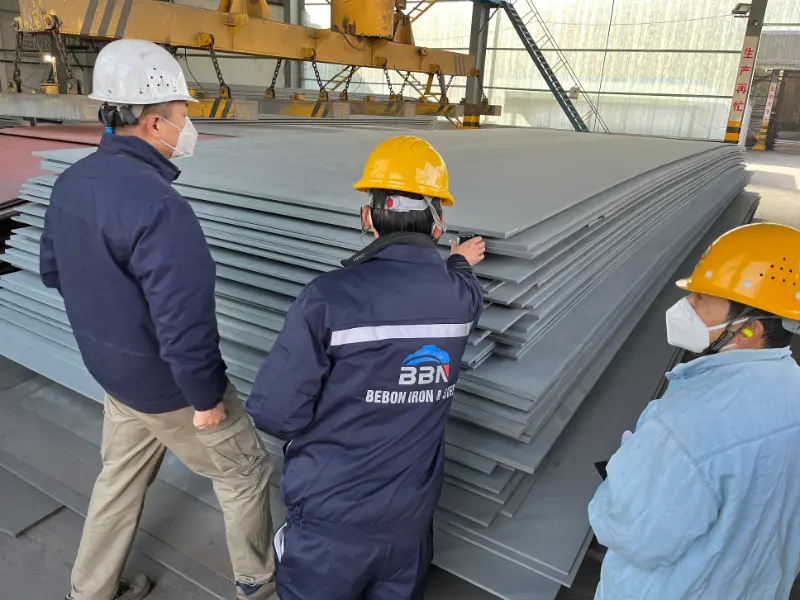
ASME SA514 Grade C (SA514GRC) High-Strength Quenched & Tempered Alloy Steel Plate
ASME SA514 Grade C (SA514GRC) High-Strength Quenched & Tempered Alloy Steel Plate
Comprehensive material data for ASME SA514 Grade C carbon steel plate used in heavy structural applications, including chemistry, mechanical and thermal properties, and international equivalents.
Welding, thermal cutting, cold forming, machining
- Phone : +8618037372205
- Email : [email protected]
- WhatsApp: Contact via Whtsapp
- WeChat: +8618037372205
ASME SA514 Grade C High-Strength Quenched & Tempered Alloy Steel Plate Introduction
ASME SA514 Grade C (SA514GRC) is a high-strength, low-alloy quenched and tempered steel plate intended for structural applications where weight saving, durability, and excellent notch toughness are required. With a minimum yield strength of 100 ksi (690 MPa) in thicknesses up to 2.5 in (63.5 mm), this grade offers superior weldability and formability compared to conventional carbon steels. The controlled chemistry with additions of Ni, Cr, Mo, and V ensures deep hardenability and uniform mechanical properties across the section. Typical uses include crane booms, heavy-duty truck frames, bridges, and pressure vessels. The plate is delivered in the quenched and tempered condition to achieve the specified strength and toughness.
ASME SA514 Grade C High-Strength Quenched & Tempered Alloy Steel Plate Chemical Composition
The chemical requirements for ASME SA514 Grade C are given below. All values are maximum unless a range is indicated.
- Carbon is kept low to enhance weldability.
- Nickel and chromium improve toughness and hardenability.
- Molybdenum and vanadium provide grain refinement and high-temperature strength.
- Boron significantly increases hardenability with minimal effect on other properties.
- Copper is optional and may be specified for improved atmospheric corrosion resistance.
| Chemical Element | Standard Value (wt%) | Remarks |
|---|---|---|
| Carbon (C) | 0.10–0.20 | Range |
| Manganese (Mn) | 1.10–1.50 | Range |
| Phosphorus (P) | ≤0.035 | Max |
| Sulfur (S) | ≤0.035 | Max |
| Silicon (Si) | 0.15–0.30 | Range |
| Nickel (Ni) | 1.20–1.50 | Range |
| Chromium (Cr) | 0.20–0.60 | Range |
| Molybdenum (Mo) | 0.20–0.60 | Range |
| Vanadium (V) | 0.03–0.08 | Range |
| Boron (B) | 0.001–0.005 | Range |
| Copper (Cu)* | 0.20–0.40 | Optional; when specified |
ASME SA514 Grade C High-Strength Quenched & Tempered Alloy Steel Plate Physical Properties
Physical properties are not mandated by ASME SA514 but are included as engineering reference. Values are typical for quenched and tempered low-alloy steels of this class.
- Density and elastic moduli are nearly invariant with thickness.
- Thermal expansion and thermal conductivity vary slightly with temperature; values given are for 20–100°C range.
- Electrical resistivity is typical for high-strength structural steel.
| Property | Typical Value | Unit | Condition / Reference Temp |
|---|---|---|---|
| Density (ρ) | 7850 | kg/m³ | Room temperature |
| Elastic modulus (E) | 200 | GPa | Room temperature |
| Shear modulus (G) | 77–80 | GPa | Estimated from E and ν |
| Poisson's ratio (ν) | 0.30 | – | Room temperature |
| Thermal expansion coefficient (α) | 11.7 | 10⁻⁶/K | 20–100 °C |
| Thermal conductivity (λ) | 42 | W/m·K | Room temperature |
| Specific heat capacity (c) | 475 | J/kg·K | Room temperature |
| Electrical resistivity (ρ_e) | 2.2×10⁻⁷ | Ω·m | Room temperature |
ASME SA514 Grade C High-Strength Quenched & Tempered Alloy Steel Plate Mechanical Properties
Tensile and bend properties are mandatory; impact toughness is subject to purchaser specification. Yield and tensile strengths decrease with increasing plate thickness. Elongation is measured in 2 in (50 mm) gauge length. Bend tests are performed on specimens with the axis of bend transverse to the rolling direction.
- For plate thickness ≤ 3/4 in (19 mm), tensile strength 110–130 ksi (760–895 MPa), yield 100 ksi min (690 MPa).
- For plate thickness > 3/4 in to 2.5 in (19–63.5 mm), tensile 100–130 ksi (690–895 MPa).
- For plate thickness > 2.5 in to 4 in (63.5–100 mm), tensile 90–130 ksi (620–895 MPa) and yield 90 ksi min (620 MPa).
| Property | Standard Value | Unit | Test Condition / Thickness Range |
|---|---|---|---|
| Yield Strength (ReH) | 690 min (100 ksi min) | MPa (ksi) | t ≤ 19 mm (3/4 in) |
| Yield Strength (ReH) | 690 min (100 ksi min) | MPa (ksi) | 19 mm < t ≤ 63.5 mm (3/4–2.5 in) |
| Yield Strength (ReH) | 620 min (90 ksi min) | MPa (ksi) | 63.5 mm < t ≤ 100 mm (2.5–4 in) |
| Tensile Strength (Rm) | 760–895 (110–130) | MPa (ksi) | t ≤ 19 mm (3/4 in) |
| Tensile Strength (Rm) | 690–895 (100–130) | MPa (ksi) | 19 mm < t ≤ 63.5 mm (3/4–2.5 in) |
| Tensile Strength (Rm) | 620–895 (90–130) | MPa (ksi) | 63.5 mm < t ≤ 100 mm (2.5–4 in) |
| Elongation (A) | 18 min | % | t ≤ 19 mm (3/4 in) [G.L. 50 mm] |
| Elongation (A) | 18 min | % | 19 mm < t ≤ 63.5 mm [G.L. 50 mm] |
| Elongation (A) | 18 min | % | 63.5 mm < t ≤ 100 mm [G.L. 50 mm] |
| Bend Test (Bend Diameter) | 2t | – | t ≤ 19 mm (3/4 in); 180° bend |
| Bend Test (Bend Diameter) | 2.5t | – | 19 mm < t ≤ 25.4 mm (3/4–1 in) |
| Bend Test (Bend Diameter) | 3t | – | 25.4 mm < t ≤ 38.1 mm (1–1.5 in) |
| Bend Test (Bend Diameter) | 3.5t | – | 38.1 mm < t ≤ 63.5 mm (1.5–2.5 in) |
| Bend Test (Bend Diameter) | 4t | – | 63.5 mm < t ≤ 100 mm (2.5–4 in) |
| Charpy Impact (KV) | ≥27 J @ -20°C (typical spec.) | J | Optional; by agreement (e.g., transverse, 10×10 mm) |
ASME SA514 Grade C High-Strength Quenched & Tempered Alloy Steel Plate Fully Equivalent Material Standards and Designations
| Country/Region | Standard | Designation | Remarks |
|---|---|---|---|
| USA | ASTM A514/A514M | Type C (Grade C) | Identical chemistry and mechanical requirements; dual-certified with ASME SA514 Grade C |
| International | ASME SA514/SA514M | Grade C | Same as above; the specification is co-branded |
ASME SA514 Grade C High-Strength Quenched & Tempered Alloy Steel Plate Application Introduction
Due to its high strength-to-weight ratio, excellent toughness, and good weldability, ASME SA514 Grade C is chosen for heavy-duty structures where material thickness can be reduced, lowering overall weight and cost.
- Service temperatures typically down to -50°C with appropriate impact specifications.
- Preheating and controlled heat input are recommended during welding to avoid hydrogen cracking.
- The steel can be cold formed with suitable radii, but hot forming or subsequent heat treatment should be avoided as it may alter the tempered condition.
Product Applications: Crane booms and lattice structures, Heavy-duty truck chassis and trailer frames, Bridge girders and structural supports, Offshore platform components, Mining dump bodies and shovel buckets, High-pressure storage vessels, Launch and recovery systems for marine applications
Processed into products: Welded box sections and built-up girders, Flanges and webs of plate girders, Boom foot and pivot castings (machined from plate), Reinforcement ribs and brackets, Load-carrying pads and wear plates, Telescopic boom segments, End plates and stiffeners in pressure vessels
Application industries: Heavy construction and civil engineering, Mining and earthmoving equipment, Offshore and marine structures, Crane and lifting equipment, Bridge building, Pressure vessel manufacturing, Military and armor applications (when supplemented with additional specifications)
ASME SA514 Grade C High-Strength Quenched & Tempered Alloy Steel Plate Similar or Alternative High-Strength Q&T Steels
| Country/Region | Standard | Designation | Remarks |
|---|---|---|---|
| European Union | EN 10025-6 | S690Q (1.8931) | Yield ≥690 MPa, similar strength but no requirement for B, V, or specific Ni/Cr/Mo ranges; may require qualification for substitution |
| Global | ISO 4950-2 | E690DD | High yield structural steel, similar strength; chemistry allows different microalloying approaches |
| Sweden | SSAB | Weldox 700 / Strenx 700 | Proprietary Q&T plate with min 700 MPa yield; often used as direct substitute for ASME SA514 Grade C in equivalent thicknesses |
| Germany | DIN | XABO 690 / Naxtra 70 | High-strength special structural steel; similar application range, but different supplier-specific composition |
Notes:
- Impact testing (Charpy V-notch) is not mandatory in the base specification but can be specified per Supplementary Requirement S5 or S8. Commonly requested values: 27 J min at -20°C or -40°C.
- Plates are normally supplied with mill edge or cut edge; ultrasonic examination can be agreed upon (e.g., ASTM A578).
- Maximum carbon equivalent (CE) is not explicitly limited by SA514 Grade C, but typically CE (IIW) ≤ 0.55 to ensure good field weldability.
- Post-weld heat treatment (PWHT) is generally not recommended as it may reduce toughness; if required, a thorough qualification is necessary.
- Share



