
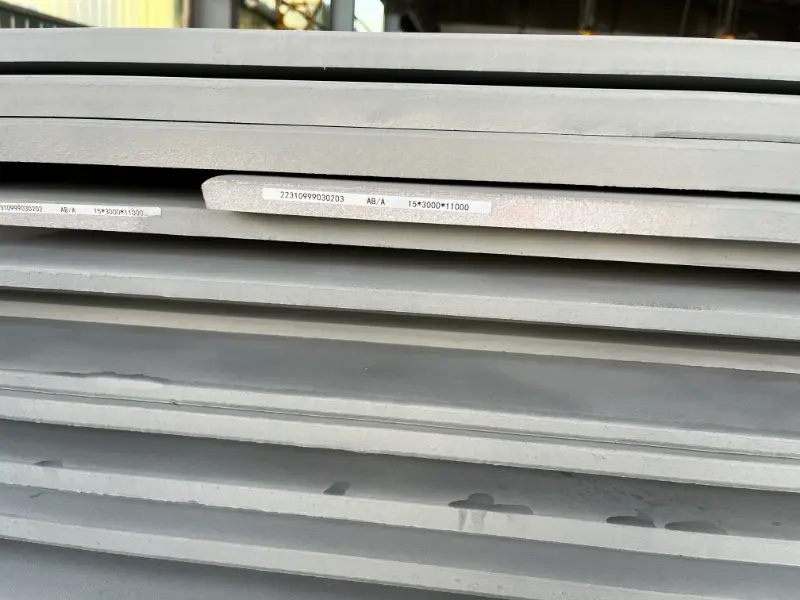
TStE255 Automobile Structure Steel Plate per DIN 17102
TStE255 Automobile Structure Steel Plate per DIN 17102 - Composition, Properties & Equivalents
Comprehensive material data for TStE255 steel according to DIN 17102, including chemical composition, mechanical and physical properties, international equivalents, and application guidance for automotive structural components.
Hot rolling, cold forming, welding, cutting, bending, deep drawing
- Phone : +8618037372205
- Email : [email protected]
- WhatsApp: Contact via Whtsapp
- WeChat: +8618037372205
TStE255 Automobile Structure Steel Plate per DIN 17102 Introduction
TStE255 is a weldable, normalized fine-grain structural steel specified in DIN 17102, designed primarily for automobile structural plate applications. It is characterized by a minimum yield strength of 255 MPa and guaranteed impact toughness at low temperatures (notched bar impact energy at -20°C). The steel is micro-alloyed with aluminium (≥0.020%) to ensure fine grain size, and often contains small additions of niobium, vanadium or titanium for improved strength and toughness.
- Good weldability – suitable for all common welding processes, with a maximum carbon equivalent value ensuring crack-free joining.
- Excellent formability – combines moderate strength with good elongation, allowing cold forming and deep drawing operations.
- Low-temperature toughness – the "T" grade provides guaranteed Charpy V-notch impact values at -20°C, making it reliable in dynamic and cyclic loads.
- Available in plates and wide flats – typical thicknesses from 5 mm up to 50 mm in normalized delivery condition.
TStE255 Automobile Structure Steel Plate per DIN 17102 Chemical Composition
The chemical composition of TStE255 is controlled to achieve the required mechanical properties and fine grain structure. The steel is fully killed (aluminum treated). Micro-alloying elements like Nb, V, or Ti may be added singly or in combination to refine the grain and improve strength/toughness. Carbon equivalent (CEV) is typically limited to ensure weldability.
| Element | Standard Value (%) | Remarks |
|---|---|---|
| C | ≤ 0.20 | Maximum |
| Si | ≤ 0.50 | Maximum |
| Mn | 0.50 – 1.50 | Range |
| P | ≤ 0.035 | Maximum |
| S | ≤ 0.030 | Maximum |
| Al (total) | ≥ 0.020 | Minimum for fine grain practice |
| N | ≤ 0.015 | Maximum |
| Nb | ≤ 0.05 | Optional grain refiner |
| V | ≤ 0.10 | Optional grain refiner |
| Ti | ≤ 0.10 | Optional grain refiner |
| CEV (CE) | ≤ 0.42 | Carbon equivalent max. for weldability |
TStE255 Automobile Structure Steel Plate per DIN 17102 Thermal and Electrical Physical Properties
The physical properties are typical values for fine-grain structural steel similar to TStE255 and are not explicitly specified in DIN 17102. They serve as design guidance at room temperature. Variations may occur depending on exact composition and heat treatment condition.
| Property | Typical Value | Unit | Test Condition |
|---|---|---|---|
| Density (ρ) | 7.85 | g/cm³ | 20°C |
| Elastic modulus (E) | 210 | GPa | 20°C |
| Shear modulus (G) | 81 | GPa | 20°C |
| Poisson's ratio (ν) | 0.3 | – | 20°C |
| Thermal expansion coefficient (α) | 11.7 – 12.5 | 10⁻⁶/K | 20 – 100°C |
| Thermal conductivity (λ) | 50 – 54 | W/(m·K) | 20°C |
| Specific heat capacity (cp) | 460 – 480 | J/(kg·K) | 20 – 100°C |
| Electrical resistivity (ρe) | 0.20 – 0.25 | μΩ·m | 20°C |
TStE255 Automobile Structure Steel Plate per DIN 17102 Mechanical Properties
Mechanical properties are guaranteed for TStE255 at room temperature in the normalized delivery condition. The values depend on product thickness; for thinner sections (≤16 mm) the full yield strength of 255 MPa applies. All tensile test pieces are taken in transverse direction. Impact tests are performed at -20°C on longitudinal Charpy V-notch specimens.
| Property | Standard Requirement | Unit | Test Condition |
|---|---|---|---|
| Yield strength (ReH) | ≥ 255 | MPa | Thickness ≤ 16 mm, transverse |
| Yield strength (ReH) | ≥ 235 | MPa | Thickness >16 mm ≤ 35 mm, transverse |
| Yield strength (ReH) | ≥ 215 | MPa | Thickness >35 mm ≤ 50 mm, transverse |
| Tensile strength (Rm) | 360 – 480 | MPa | All thicknesses, transverse |
| Elongation after fracture (A5) | ≥ 24 | % | Gauge length 5.65√So, transverse |
| Elongation after fracture (A5) | ≥ 23 | % | Thickness >16 mm, transverse |
| Charpy impact energy (KV) | ≥ 27 | J | Longitudinal, at -20°C, ISO-V specimen |
| Bending test | No cracks | – | Cold bend around mandrel d=2a (a = thickness) up to 180° |
TStE255 Automobile Structure Steel Plate per DIN 17102 Direct Equivalent Standard Grades and Replaceable Designations
| Country/Region | Standard | Grade | Remarks |
|---|---|---|---|
| Europe (EN) | EN 10025-3:2004 | S275N (1.0490) | Closest normalized fine grain steel; min. yield 275 MPa, similar chemical/purpose |
| International (ISO) | ISO 4950-2 | E 275 D | Yield strength class 275, delivery condition D (normalized or N) |
| Germany (DIN) | DIN 17102 | TStE255 | Original standard, still used in supply and drawings |
| Italy (UNI) | UNI 7382 | FeE 255 KG | Comparable grade with low-temperature impact properties |
| France (AFNOR) | NF A 36-201 | E 255 D | Weldable fine grain steel with similar strength level |
TStE255 Automobile Structure Steel Plate per DIN 17102 Application Introduction
TStE255 is an ideal material for welded structural components in the automotive industry and general engineering where a combination of moderate strength, excellent weldability, good cold formability, and resistance to brittle fracture at low temperatures is required. The guaranteed impact toughness at -20°C makes it suitable for dynamically loaded parts operating in cold climates. Typical processing includes cutting, cold bending, stamping, deep drawing, and welding without preheating for moderate thicknesses.
Product Applications: Automobile chassis and subframes, Truck side members and cross members, Suspension arms and brackets, Wheel rims and disc wheels, Pressed and welded parts for body-in-white car structures, Hitches and towing devices, Constructional steel frameworks with fatigue requirements
Processed into products: Chassis longitudinal beams, Engine and transmission mountings, Spring hangers and spring brackets, Control arm lower and upper plates, Boxed frame sections, Crossmembers with complex shapes, Welded assemblies for off-road vehicles
Application industries: Automotive and transportation manufacturing, Truck and trailer frame fabrication, Railway vehicle construction, Construction machinery and agricultural equipment, General heavy engineering and structural steel construction
TStE255 Automobile Structure Steel Plate per DIN 17102 Similar/Comparable Alternative Materials
| Country/Region | Standard | Grade | Remarks |
|---|---|---|---|
| Europe (EN) | EN 10025-2 | S235JR or S235J0 | Lower strength but widely available structural steel; not fine grain but sometimes substituted for non-critical parts |
| Europe (EN) | EN 10025-3 | S275NL (1.0491) | Low-temperature impact version (down to -50°C); slightly higher yield |
| USA (ASTM) | ASTM A572/A572M | Grade 42 (290) or Grade 45 (310) | HSLA steel; yield 290 MPa or 310 MPa, available in structural quality |
| Japan (JIS) | JIS G3113 | SAPH370 (min. 225 MPa yield) | Automobile structural hot-rolled steel; not directly equivalent but used in similar applications |
| China (GB) | GB/T 1591 | Q355D or Q355E | Low-alloy high-strength structural steel; yield 355 MPa, better in some uses but overstrength for direct substitution |
Notes:
Welding recommendations: TStE255 can be welded by all common processes (SMAW, MAG, SAW, etc.). Preheating is usually not required for thicknesses below 30 mm. Low-hydrogen consumables should be used. Forming: The fine grain structure permits tight bending radii; minimum recommended inside bend radius is 1.5–2 x plate thickness for cold forming. Surface condition: Plates are delivered as-rolled or descaled. For exposed automotive applications, pickled and oiled or primer-coated surfaces can be ordered by agreement. The steel is not intended for direct hardening; hardenability is low due to lean composition.
- Share



