
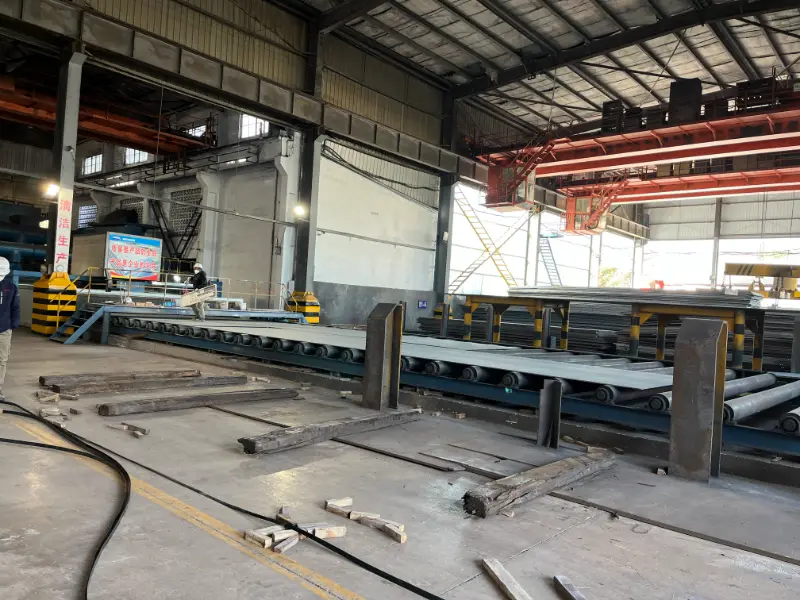
EN10025-4 S355ML Steel
EN10025-4 S355ML: High-Strength Thermomechanical Rolled Steel for Low-Temperature Service
S355ML steel plate is a thermomechanically rolled weldable fine-grain structural steel with minimum yield strength of 355 MPa, offering excellent toughness at -50°C, widely used in bridges, heavy structures, and offshore engineering.
Thermomechanical rolling, cold forming, welding, machining, flame cutting
- Phone : +8618037372205
- Email : [email protected]
- WhatsApp: Contact via Whtsapp
- WeChat: +8618037372205
EN10025-4 S355ML Steel Introduction
S355ML is a thermomechanically rolled (M) weldable fine-grain structural steel according to EN 10025-4, with specified minimum impact energy at -50°C (L). It belongs to the high-strength low-alloy (HSLA) category, delivering a minimum yield strength of 355 MPa for thickness ≤16 mm and good weldability due to a low carbon equivalent. The thermomechanical rolling process refines the grain structure, resulting in improved toughness and strength without additional heat treatment. Typical applications include heavy-duty welded structures, bridges, offshore platforms, and crane booms where both high load-bearing capacity and resistance to brittle fracture at low temperatures are required. The steel is usually supplied in the as-rolled condition (M) with mandatory impact testing at -50°C. Compared to normalized grades, S355ML provides better strength-to-weight ratios and can enable reduced section thicknesses in design.
EN10025-4 S355ML Steel Chemical Composition
The chemical composition of S355ML is controlled to ensure weldability, toughness, and mechanical properties. Maximum limits for alloying elements are defined in EN 10025-4:2019. The steel must contain grain-refining elements such as Nb, V, Ti, and a minimum aluminum content. Carbon equivalent (CEV) limits apply for weldability assurance, typically CEV ≤ 0.39% for thicknesses up to 30 mm, with higher limits for thicker plates.
| Element | Content (%) | Notes |
|---|---|---|
| Carbon (C) | ≤0.14 | Max |
| Silicon (Si) | ≤0.55 | Max |
| Manganese (Mn) | ≤1.70 | Max |
| Phosphorus (P) | ≤0.030 | Max |
| Sulfur (S) | ≤0.025 | Max |
| Niobium (Nb) | ≤0.05 | Max |
| Vanadium (V) | ≤0.12 | Max |
| Titanium (Ti) | ≤0.06 | Max |
| Aluminum (Al total) | ≥0.020 | Min (acid-soluble or total) |
| Nitrogen (N) | ≤0.015 | Max |
| Chromium (Cr) | ≤0.30 | Max |
| Nickel (Ni) | ≤0.30 | Max |
| Molybdenum (Mo) | ≤0.10 | Max |
| Copper (Cu) | ≤0.55 | Max |
EN10025-4 S355ML Steel Thermal and Electrical Physical Properties
The physical properties given below are typical for S355ML at room temperature and atmospheric pressure, based on general properties of comparable structural steels. These values are not specified as mandatory in EN 10025-4 but are useful for design calculations. Thermal expansion, thermal conductivity, and specific heat capacity vary with temperature.
| Property | Typical Value | Unit | Test Condition / Temperature |
|---|---|---|---|
| Density (ρ) | 7.85 | g/cm³ | 20°C |
| Elastic modulus (E) | 210 | GPa | 20°C |
| Shear modulus (G) | 80 | GPa | 20°C, typical for steel |
| Poisson's ratio (ν) | 0.3 | - | 20°C |
| Thermal expansion coefficient (α) | 12.0 × 10⁻⁶ | /K | 20 – 100°C |
| Thermal expansion coefficient (α) | 12.5 × 10⁻⁶ | /K | 20 – 200°C |
| Thermal expansion coefficient (α) | 13.0 × 10⁻⁶ | /K | 20 – 300°C |
| Thermal conductivity (λ) | 50 | W/(m·K) | 20°C |
| Thermal conductivity (λ) | 45 | W/(m·K) | 200°C |
| Thermal conductivity (λ) | 40 | W/(m·K) | 400°C |
| Specific heat capacity (c) | 460 | J/(kg·K) | 20 – 100°C |
| Specific heat capacity (c) | 500 | J/(kg·K) | 100 – 300°C |
| Electrical resistivity (ρ_e) | 0.20 × 10⁻⁶ | Ω·m | 20°C |
EN10025-4 S355ML Steel Mechanical Properties
Mechanical properties are specified according to EN 10025-4. The yield strength, tensile strength, elongation, and impact energy depend on product thickness and test direction (transverse or longitudinal). Values below apply to longitudinal test pieces unless otherwise noted. Impact energy is guaranteed at -50°C for the ML quality designation. Bending test is mandatory for verification of formability.
| Property | Value | Unit | Condition / Thickness (mm) |
|---|---|---|---|
| Yield strength (ReH) | ≥355 | MPa | t ≤ 16 |
| Yield strength (ReH) | ≥345 | MPa | 16 < t ≤ 40 |
| Yield strength (ReH) | ≥335 | MPa | 40 < t ≤ 63 |
| Yield strength (ReH) | ≥325 | MPa | 63 < t ≤ 80 |
| Yield strength (ReH) | ≥315 | MPa | 80 < t ≤ 100 |
| Yield strength (ReH) | ≥295 | MPa | 100 < t ≤ 150 |
| Tensile strength (Rm) | 470 – 630 | MPa | t ≤ 40 |
| Tensile strength (Rm) | 470 – 630 | MPa | 40 < t ≤ 63 |
| Tensile strength (Rm) | 470 – 630 | MPa | 63 < t ≤ 80 |
| Tensile strength (Rm) | 470 – 630 | MPa | 80 < t ≤ 100 |
| Tensile strength (Rm) | 450 – 600 | MPa | 100 < t ≤ 150 |
| Elongation (A) | ≥22 | % | t ≤ 40, longitudinal |
| Elongation (A) | ≥22 | % | 40 < t ≤ 63, longitudinal |
| Elongation (A) | ≥21 | % | 63 < t ≤ 100, longitudinal |
| Elongation (A) | ≥21 | % | 100 < t ≤ 150, longitudinal |
| Bend test (mandrel diameter a = thickness) | 2a | - | t ≤ 16, 180° bend |
| Bend test | 3a | - | 16 < t ≤ 100, 180° bend |
| Bend test | 4a | - | 100 < t ≤ 150, 180° bend |
| Impact energy (KV, longitudinal) | ≥27 (-50°C) | J | t ≤ 150, Charpy V-notch |
EN10025-4 S355ML Steel Fully Equivalent Material Standards and Replaceable Designations
| Country/Region | Standard | Designation | Notes |
|---|---|---|---|
| Europe | EN 10025-4:2019 | S355ML | Original European standard |
| United Kingdom | BS EN 10025-4:2019 | S355ML | Identically adopted |
| Germany | DIN EN 10025-4:2019 | S355ML | Identically adopted |
| France | NF EN 10025-4:2019 | S355ML | Identically adopted |
| Italy | UNI EN 10025-4:2019 | S355ML | Identically adopted |
| Spain | UNE EN 10025-4:2019 | S355ML | Identically adopted |
| Sweden | SS-EN 10025-4:2019 | S355ML | Identically adopted |
| International (withdrawn) | ISO 4950-2 | E355DD | Previous international equivalent; now replaced by EN 10025-4 |
EN10025-4 S355ML Steel Application Introduction
S355ML steel combines high strength, excellent low-temperature toughness, and good weldability, making it suitable for demanding structural applications. Typical usage covers heavy engineering where service temperatures may drop to -50°C and where thermomechanical rolling provides economic and technical benefits compared to normalised steels.
Product Applications: Bridge girders and box sections, Offshore platform decks and jackets, Crane booms and lattice masts, Welded structural hollow sections, Wind turbine tower shells, Heavy load-bearing beams and columns, Piling pipes and sheet piles, Pressure vessel shells
Processed into products: Welded built-up beams and columns, Tubular joints and node cans, Base plates and stiffeners, Fabricated crane arms, Transition pieces for monopiles, Shock-resistant structural elements, Anchor frames, Pump housings and supports
Application industries: Bridge construction, Offshore and marine engineering (platforms, wind turbine foundations), Heavy machinery and mobile cranes, Building and civil engineering (high-rise structures, stadiums), Pressure vessels and storage tanks, Shipbuilding (selected structural parts), Mining and earthmoving equipment, Renewable energy (wind tower tubular sections)
EN10025-4 S355ML Steel Similar or Alternative Material Recommendations
| Country/Region | Standard | Designation | Notes |
|---|---|---|---|
| Europe | EN 10025-4 | S355M | Thermomechanically rolled, minimum impact temperature -20°C; same strength, lower toughness requirement |
| Europe | EN 10025-3 | S355NL | Normalized/normalized rolled fine-grain steel, impact -50°C; suitable for similar applications with heat treatment |
| Europe | EN 10025-2 | S355J2+N | Normalized non-alloy structural steel, impact -20°C; less fine grain, often used as economical alternative where TMCP is not required |
| USA | ASTM A572/A572M | Grade 50 [345] (with supplementary impact requirement) | High-strength low-alloy, min YS 345 MPa; impact toughness must be agreed separately; no inherent -50°C guarantee |
| USA | ASTM A709/A709M | Grade 50T / 50F | Bridge steel with optional fracture-critical requirements; often supplied with Charpy testing at specified temperatures |
| Japan | JIS G 3106 | SM490B or SM490C (with Charpy at lower temperatures) | Welding structural steel, min YS 325-365 MPa; Charpy test temperature to be specified |
Notes:
- Weldability: S355ML is readily weldable by all common methods. Low carbon equivalent (typically CEV ≤ 0.39 for t ≤ 30 mm) minimizes cold cracking risk. Preheating may be required for thick sections or when hydrogen control is necessary.
- Formability: The steel can be cold-formed within limits given in EN 10025-4. Minimum bending radii depend on thickness and direction. Hot forming is not recommended as it may alter the thermomechanically refined properties.
- Corrosion resistance: As an unalloyed low-alloy steel, S355ML exhibits atmospheric corrosion behavior similar to carbon steel. Protective coatings or weathering steel alternatives should be considered for exposed environments.
- Certification: Inspection documents according to EN 10204 type 3.1 or 3.2 are typically issued. Impact testing at -50°C is mandatory for the L suffix and must be documented.
- Ultrasonic testing: Special requirements for internal soundness can be agreed, e.g., according to EN 10160. Common for critical structural applications.
- CE marking: Units placed on the European market must comply with the Construction Products Regulation (CPR) and be CE marked under the applicable harmonized standard (EN 10025-4).
- Share



