
S420ML Thermomechanical Steel Plate
S420ML Thermomechanical Steel Plate - EN 10025-4, 420 MPa Yield, -50°C Toughness
S420ML is a thermomechanically rolled fine-grain structural steel with minimum 420 MPa yield strength and excellent low-temperature impact toughness down to -50°C, specified in EN 10025-4. This high-strength, weldable plate is engineered for heavy-duty welded structures in demanding environments.
Thermomechanical rolling (TMCP), with optional normalizing or stress-relieving heat treatment; weldable by all common methods
- Phone : +8618037372205
- Email : [email protected]
- WhatsApp: Contact via Whtsapp
- WeChat: +8618037372205
S420ML Thermomechanical Steel Plate Introduction
S420ML is a high-strength, thermomechanically rolled weldable fine-grain structural steel defined by EN 10025-4. The designation 'S' indicates structural steel, '420' specifies the minimum yield strength of 420 MPa for thicknesses ≤ 16 mm, 'M' denotes thermomechanical rolling, and 'L' guarantees transverse impact energy of at least 27 J at -50°C. This grade offers exceptional notch toughness at low temperatures, making it ideal for Arctic and offshore applications. Its fine-grain microstructure and controlled rolling process deliver a superior combination of strength, ductility, and weldability. S420ML is widely used in bridges, pressure vessels, heavy machinery, and wind turbine towers, where safety and reliability under extreme conditions are paramount. Compared to normalized grades, thermomechanical rolling achieves the desired properties with lower alloying content, enhancing weldability and reducing preheat requirements. Delivery conditions typically include as-rolled or normalized-rolled options, with optional ultrasonic testing and impact testing at -50°C.
S420ML Thermomechanical Steel Plate Chemical Composition
Chemical composition limits for S420ML according to EN 10025-4. Values are maximum unless indicated as a range. The steel is fully killed and fine-grain treated with aluminium. Microalloying elements (Nb, V, Ti) are added singly or in combination to achieve strength and toughness. The carbon equivalent value (CEV) is controlled to ensure weldability and varies with product thickness.
| Element | Standard Value (max, %) | Remarks |
|---|---|---|
| Carbon (C) | ≤0.16 (t≤16 mm); ≤0.18 (16 | For thickness > 100 mm informed by agreement |
| Silicon (Si) | ≤0.50 | |
| Manganese (Mn) | ≤1.70 | For long products, values may be relaxed by agreement |
| Phosphorus (P) | ≤0.025 | |
| Sulfur (S) | ≤0.020 | |
| Nitrogen (N) | ≤0.015 | For thermomechanically rolled products. Higher values allowed if sufficient Al present. |
| Aluminium total (Al) | ≥0.020 | Minimum for fine-grain treatment |
| Niobium (Nb) | ≤0.05 | |
| Vanadium (V) | ≤0.12 | |
| Titanium (Ti) | ≤0.05 | |
| Chromium (Cr) | ≤0.30 | Optional, may be present; higher limits by agreement |
| Nickel (Ni) | ≤0.30 | Optional |
| Molybdenum (Mo) | ≤0.10 | Optional |
| Copper (Cu) | ≤0.20 | Optional; can be higher for thickness > 50 mm |
| CEV | ≤0.43 (t≤16 mm); ≤0.45 (16 | Carbon equivalent = C + Mn/6 + (Cr+Mo+V)/5 + (Ni+Cu)/15 |
S420ML Thermomechanical Steel Plate Thermal and Electrical Physical Properties
The following physical data are typical for low-alloy carbon-manganese structural steels such as S420ML. They are not specified in EN 10025-4 but serve as reliable guidance for design and engineering calculations. Values may vary slightly with exact composition and temperature.
| Property | Typical Value | Unit | Test Condition / Notes |
|---|---|---|---|
| Density (ρ) | 7850 | kg/m³ | At 20°C |
| Elastic modulus (E) | 210 | GPa | At 20°C, longitudinal |
| Shear modulus (G) | 81 | GPa | Calculated from E and ν |
| Poisson's ratio (ν) | 0.3 | — | Elastic range, room temperature |
| Thermal expansion coefficient (α) | 12.0 | 10⁻⁶/K | 20–100°C |
| Thermal expansion coefficient (α) | 12.5 | 10⁻⁶/K | 20–200°C |
| Thermal expansion coefficient (α) | 13.0 | 10⁻⁶/K | 20–300°C |
| Thermal conductivity (λ) | 50 | W/(m·K) | At 20°C |
| Specific heat capacity (c) | 460 | J/(kg·K) | At 20°C |
| Electrical resistivity (ρₑ) | 0.22 | μΩ·m | At 20°C |
S420ML Thermomechanical Steel Plate Mechanical Properties
Minimum mechanical properties for S420ML according to EN 10025-4. The values depend on product thickness and test direction. Tensile tests are performed on transverse specimens unless otherwise agreed. Impact energy is measured on Charpy-V specimens (longitudinal or transverse) at -50°C. Bending tests are carried out on samples from the as-delivered condition.
| Property | Standard Requirement | Unit | Test Condition / Thickness Range |
|---|---|---|---|
| Yield strength (ReH) | 420 | MPa | t ≤ 16 mm |
| Yield strength (ReH) | 400 | MPa | 16 mm < t ≤ 40 mm |
| Yield strength (ReH) | 390 | MPa | 40 mm < t ≤ 63 mm |
| Yield strength (ReH) | 370 | MPa | 63 mm < t ≤ 80 mm |
| Yield strength (ReH) | 360 | MPa | 80 mm < t ≤ 100 mm |
| Yield strength (ReH) | 340 | MPa | 100 mm < t ≤ 120 mm |
| Yield strength (ReH) | 330 | MPa | 120 mm < t ≤ 150 mm |
| Yield strength (ReH) | 320 | MPa | 150 mm < t ≤ 200 mm |
| Yield strength (ReH) | 310 | MPa | 200 mm < t ≤ 250 mm |
| Tensile strength (Rm) | 520–680 | MPa | t ≤ 40 mm |
| Tensile strength (Rm) | 500–660 | MPa | 40 mm < t ≤ 63 mm |
| Tensile strength (Rm) | 480–640 | MPa | 63 mm < t ≤ 80 mm |
| Tensile strength (Rm) | 470–630 | MPa | 80 mm < t ≤ 100 mm |
| Tensile strength (Rm) | 460–620 | MPa | 100 mm < t ≤ 120 mm |
| Tensile strength (Rm) | 450–600 | MPa | 120 mm < t ≤ 150 mm |
| Tensile strength (Rm) | 440–580 | MPa | 150 mm < t ≤ 200 mm |
| Tensile strength (Rm) | 430–570 | MPa | 200 mm < t ≤ 250 mm |
| Elongation after fracture (A) | 19 | % | t ≤ 40 mm, L₀ = 5.65√S₀ |
| Elongation after fracture (A) | 19 | % | 40 mm < t ≤ 63 mm |
| Elongation after fracture (A) | 18 | % | 63 mm < t ≤ 100 mm |
| Elongation after fracture (A) | 18 | % | 100 mm < t ≤ 150 mm |
| Elongation after fracture (A) | 17 | % | 150 mm < t ≤ 250 mm |
| Impact energy (KV, Charpy-V) | ≥27 | J | At -50°C; thickness ≥ 10 mm; longitudinal specimen (standard) or transverse (by agreement) |
| Bending test, 180° | Mandrel diameter = 2 × t | mm (mandrel dia.) | t ≤ 16 mm |
| Bending test, 180° | Mandrel diameter = 3 × t | mm | 16 mm < t ≤ 100 mm |
| Bending test, 180° | Mandrel diameter = 4 × t | mm | 100 mm < t ≤ 200 mm |
| Bending test, 180° | Mandrel diameter = 5 × t | mm | 200 mm < t ≤ 250 mm |
S420ML Thermomechanical Steel Plate Fully Equivalent Material Standards and Substitute Grades
| Country / Region | Standard | Designation | Remarks |
|---|---|---|---|
| Europe | EN 10025-4:2019 | S420ML | Thermomechanically rolled, low-temperature impact at -50°C |
| Europe | EN 10025-4:2004 | S420ML | Superseded by 2019 edition, but widely referenced |
| Germany | DIN EN 10025-4 | S420ML | Identical to EN 10025-4 |
| United Kingdom | BS EN 10025-4 | S420ML | Identical to EN 10025-4 |
| France | NF EN 10025-4 | S420ML | Identical to EN 10025-4 |
| Italy | UNI EN 10025-4 | S420ML | Identical to EN 10025-4 |
| Spain | UNE EN 10025-4 | S420ML | Identical to EN 10025-4 |
S420ML Thermomechanical Steel Plate Application Introduction
S420ML is engineered for heavy-duty welded structures requiring high strength and ductility at low ambient temperatures. Its fine-grain thermomechanically rolled microstructure ensures good through-thickness properties and excellent resistance to brittle fracture. The steel is suited for components operating in Arctic, offshore, and general cold-climate conditions. Designers benefit from reduced structural weight while maintaining safety margins for dynamic loads.
Product Applications: Welded bridge box girders, Offshore platform topside modules and jacket legs, Wind turbine tower shells (tubular sections), Pressure vessels and process columns for petrochemical plants, Low-temperature storage tanks (double-wall tank inner vessels), Ship longitudinal stiffeners and deck plating, Heavy-duty crane main chords and jib sections, Mining dump truck body frames
Processed into products: Flame-cut structural plates and profiles, Cold-formed and roll-formed tubular sections, Welded I-beams, H-piles, and box columns, Stiffening ribs and diaphragm plates for bridges, Flanges and nozzles for pressure vessels, Bending-resistant chassis rails for off-highway vehicles, Spliced and welded nodes for offshore jacket structures, Prepared edge plates for submerged arc welding in spiral pipe production
Application industries: Civil and structural engineering (bridges, high-rise buildings, stadiums), Offshore and marine (platforms, jack-up rigs, FPSO modules, ship hull stiffeners), Wind energy (turbine towers, foundations, transition pieces), Mining and earthmoving (dump truck frames, excavator booms, crusher bodies), Pressure vessel and storage tank fabrication (for low-temperature service, e.g., LNG, ammonia), Heavy lifting and transport equipment (crane lattice booms, mobile crane chassis), Railway and infrastructure (bridge girders, tunnel linings)
S420ML Thermomechanical Steel Plate Similar / Near-Equivalent Alternative Materials
| Country / Region | Standard | Designation | Comparison Remarks |
|---|---|---|---|
| Europe | EN 10025-4 | S420M | Same base grade but impact only down to -20°C. Suitable for less severe low-temperature environments. |
| Europe | EN 10025-4 | S460ML | Higher yield strength (460 MPa min) with similar low-temperature toughness. For weight-critical designs. |
| Europe | EN 10025-4 | S355ML | Lower strength (355 MPa min) with identical -50°C impact. Alternative when lower strength is acceptable. |
| Europe | EN 10025-3 | S420N/NL | Normalised rolled fine grain steels with similar strength and toughness (NL at -50°C). Slightly different weldability and grain size. |
| USA | ASTM A572/A572M | Grade 60 [415] | High-strength low-alloy structural steel with min 415 MPa yield. No low-temperature impact guarantee; different rolling process. |
| USA | ASTM A709/A709M | Grade 50 [345] | Structural steel for bridges; lower strength. Not directly equivalent, but bridges often use S420ML. |
| China | GB/T 1591 | Q420E | High-strength low-alloy structural steel with impact at -40°C, similar yield but slightly higher temperature. Not thermomechanical rolled per se. |
Notes:
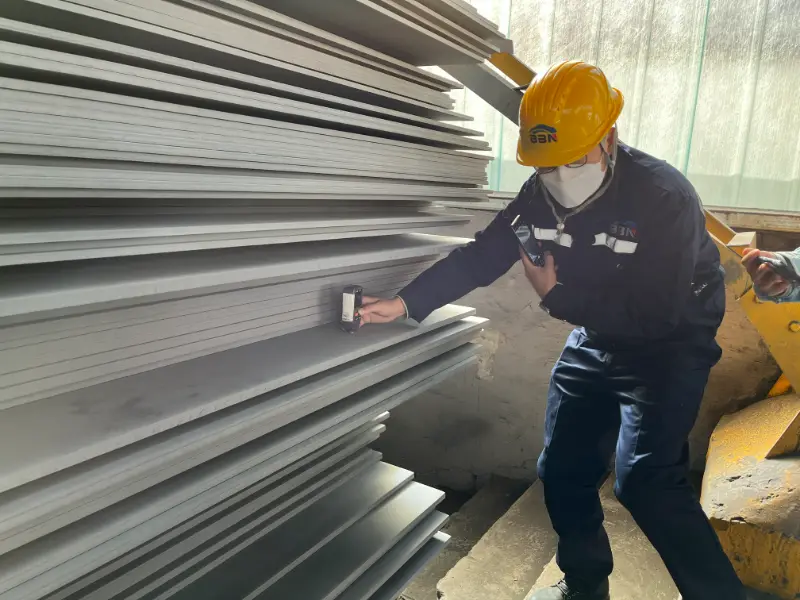
- Official testing and certification: Delivery usually includes EN 10204 Inspection Certificate 3.1 or 3.2, with optional low-temperature Charpy impact certificates at -50°C.
- Weldability: Carbon equivalent (CEV) limits ensure good cold-cracking resistance; preheat may be needed for thicker sections or high restraint joints. Standard welding procedures for fine-grain steels apply (MAG, SAW, SMAW, FCAW).
- Quality options: Improved through-thickness properties (Z-quality) per EN 10164; ultrasonic testing per EN 10160; higher impact energies (e.g., 40 J) by agreement.
- Processing: The steel is suitable for cold forming (up to limited radii) and hot forming with subsequent heat treatment if strength properties are to be retained.
- Share



