
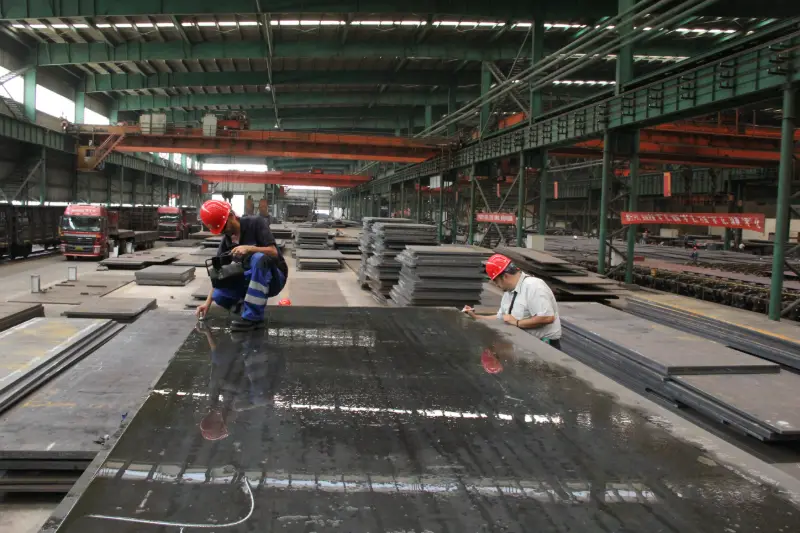
EN10025-4 S355M Structural Steel Plate
EN 10025-4 S355M Steel: High-Strength Structural Plate for Welded Construction
Comprehensive data on S355M structural steel plate under EN 10025-4, including chemical composition, mechanical and physical properties, equivalent grades, and application guidance.
Welding, cold and hot forming, machining, cutting (oxy-fuel, plasma, laser)
- Phone : +8618037372205
- Email : [email protected]
- WhatsApp: Contact via Whtsapp
- WeChat: +8618037372205
EN10025-4 S355M Structural Steel Plate Introduction
S355M is a thermomechanically rolled, weldable fine-grain structural steel according to EN 10025-4. It offers a minimum yield strength of 355 MPa (for thickness ≤ 16 mm) and excellent toughness at low temperatures. The 'M' designation indicates delivery in the thermomechanical rolled condition, which provides a favorable balance of strength, formability, and weldability without the need for subsequent normalizing. Typical applications include bridges, steel structures in buildings, offshore platforms, and heavy-duty machinery components. The steel is supplied as plate, strip, and wide flats, and it is suitable for cold forming and all common welding processes.
EN10025-4 S355M Structural Steel Plate Chemical Composition
The following chemical limits apply for thermomechanical rolled grade S355M. Carbon content depends on product thickness to maintain weldability. For thicknesses > 40 mm, slightly higher carbon is permitted. Microalloying elements such as niobium, vanadium, and titanium are added singly or in combination to achieve the required strength and toughness. The sum of Nb+V+Ti is restricted to ensure a fine grain structure and good formability.
| Element | Limit Value (%) | Remarks |
|---|---|---|
| Carbon (C) | ≤ 0.14 (t ≤ 40 mm) / ≤ 0.16 (40 < t ≤ 100 mm) | Thickness dependent; max. C for t ≤150 mm is 0.18 |
| Silicon (Si) | ≤ 0.50 | |
| Manganese (Mn) | ≤ 1.60 | |
| Phosphorus (P) | ≤ 0.030 | |
| Sulfur (S) | ≤ 0.025 | |
| Aluminium (Al total) | ≥ 0.020 | Minimum Al to ensure fine grain size |
| Niobium (Nb) | ≤ 0.05 | May be present |
| Vanadium (V) | ≤ 0.10 | May be present |
| Titanium (Ti) | ≤ 0.05 | May be present |
| Chromium (Cr) | ≤ 0.30 | Residual element limit |
| Nickel (Ni) | ≤ 0.30 | Residual element limit |
| Molybdenum (Mo) | ≤ 0.10 | Residual element limit |
| Copper (Cu) | ≤ 0.55 | Residual element limit; higher for weathering variants not applicable |
| Nitrogen (N) | ≤ 0.015 | Bound nitrogen is acceptable |
| Nb+V+Ti | ≤ 0.22 | Combined microalloying element restriction |
EN10025-4 S355M Structural Steel Plate Typical Thermal and Electrical Physical Properties at 20°C
The physical property values provided are typical for carbon-manganese structural steels and apply to S355M. Actual values may vary slightly with composition and temperature. These properties are relevant for thermal analysis, weight calculations, and structural design.
| Property | Typical Value | Unit | Test Condition |
|---|---|---|---|
| Density (ρ) | 7.85 | g/cm³ | at 20°C |
| Modulus of elasticity (E) | 210 | GPa | at 20°C |
| Shear modulus (G) | 81 | GPa | at 20°C |
| Poisson ratio (ν) | 0.3 | – | ambient temperature |
| Coefficient of thermal expansion (α) | 12 | ×10⁻⁶ /K | between 20°C and 100°C |
| Coefficient of thermal expansion (α) | 13 | ×10⁻⁶ /K | between 20°C and 200°C |
| Thermal conductivity (λ) | 50 | W/(m·K) | at 20°C |
| Specific heat capacity (cp) | 460 | J/(kg·K) | at 20°C |
| Electrical resistivity (ρ_e) | 0.15 – 0.25 | µΩ·m | at 20°C |
EN10025-4 S355M Structural Steel Plate Mechanical Properties at Room Temperature
The mechanical properties of S355M are guaranteed after thermomechanical rolling. The values depend on the product thickness. Impact energy is measured on Charpy-V specimens at -20°C. The bending test is carried out with a specified mandrel diameter to check ductility. For all thicknesses, the yield to tensile ratio is typically between 0.70 and 0.85, reflecting good plastic deformation capacity before fracture.
| Property (Metric) | Standard Requirement | Unit | Test Condition / Thickness Range |
|---|---|---|---|
| Yield strength ReH (minimum) | 355 | MPa | Nominal thickness t ≤ 16 mm |
| Yield strength ReH (minimum) | 345 | MPa | 16 < t ≤ 40 mm |
| Yield strength ReH (minimum) | 335 | MPa | 40 < t ≤ 63 mm |
| Yield strength ReH (minimum) | 325 | MPa | 63 < t ≤ 80 mm |
| Yield strength ReH (minimum) | 315 | MPa | 80 < t ≤ 100 mm |
| Yield strength ReH (minimum) | 295 | MPa | 100 < t ≤ 150 mm |
| Tensile strength Rm | 470 – 630 | MPa | t ≤ 40 mm |
| Tensile strength Rm | 470 – 630 | MPa | 40 < t ≤ 63 mm |
| Tensile strength Rm | 470 – 610 | MPa | 63 < t ≤ 80 mm |
| Tensile strength Rm | 450 – 590 | MPa | 80 < t ≤ 100 mm |
| Tensile strength Rm | 440 – 580 | MPa | 100 < t ≤ 150 mm |
| Elongation A (minimum) | 22 | % | Gauge length 5.65√S₀, t ≤ 40 mm |
| Elongation A (minimum) | 21 | % | 40 < t ≤ 63 mm |
| Elongation A (minimum) | 20 | % | 63 < t ≤ 100 mm |
| Elongation A (minimum) | 18 | % | 100 < t ≤ 150 mm |
| Charpy impact energy KV (minimum, longitudinal) | 40 | J | Test temperature -20°C; t ≥ 12 mm (sub-size specimens adjusted) |
| Bending test (mandrel diameter) | 1.0 × thickness (≤ 20 mm); 2.0 × thickness (> 20 mm) | – | 180° bend, crack-free |
EN10025-4 S355M Structural Steel Plate Fully Equivalent Material Standards and Replaceable Grades
| Country/Region | Standard | Grade | Remarks |
|---|---|---|---|
| Europe (CEN) | EN 10025-4 | S355M / 1.8823 | Identical base grade |
| Germany | DIN EN 10025-4 | S355M | Former DIN designation StE 355 TM (historical) |
| France | NF EN 10025-4 | S355M | |
| United Kingdom | BS EN 10025-4 | S355M | Previous BS 4360 Grade 50EE (historical) |
| Italy | UNI EN 10025-4 | S355M | |
| Spain | UNE EN 10025-4 | S355M | |
| International (ISO) | ISO 4950‑2 (similar) | E 355 DD (historical) | Not fully identical; S355M is preferred |
EN10025-4 S355M Structural Steel Plate Application Introduction
S355M steel is designed for highly stressed welded structures where weight savings, good weldability, and reliable low-temperature toughness are essential. It is extensively used in structural engineering, heavy machinery, and transport equipment. The thermomechanical rolling process yields a fine grain structure, eliminating the need for normalizing and achieving a favorable carbon equivalent (CEV typically 0.35–0.40), which facilitates welding without expensive preheating. The material can be cold formed up to limit bending radii and is suitable for drilling, flame cutting, and submerged arc welding with matching consumables.
Product Applications: Welded bridge girders and box sections, Building columns and trusses for high-rise or industrial buildings, Offshore platform decks, modules, and flare booms, Mobile crane booms and chassis frames, Heavy-duty trailers and transport frames, Earthmoving equipment booms and arms, Wind turbine tower sections, Pressure vessel shells (non-standard code, general industrial)
Processed into products: Welded I-beams and H-profiles (fabricated), Stiffened plate panels, Crane runway beams, Heavy machinery base frames and supports, Reinforcement flanges and gusset plates, Hollow structural sections (cold formed or press-braked from plate), Rolled structural tees and angles (by splitting beams)
Application industries: Civil and structural engineering, Bridge construction, Offshore and marine structures (topsides, substructures), Mechanical engineering, Heavy transport and lifting equipment, Energy industry (wind turbine towers, power plant structures), Shipbuilding (limited hull applications, primarily decks and superstructure)
EN10025-4 S355M Structural Steel Plate Similar / Closely Matching Alternative Materials
| Country/Region | Standard | Grade | Remarks |
|---|---|---|---|
| USA | ASTM A572 / A572M | Grade 50 (Type 1) | Yield 345 MPa, similar strength but different delivery condition (as-rolled/normalized); Charpy requirements not directly matched. |
| USA | ASTM A709 / A709M | Grade 50 | Bridges; equivalent to A572 Grade 50. |
| Japan | JIS G 3106 | SM490A/B/C | Yield 325-365 MPa; toughness classes (B, C) may approach S355M properties. |
| China | GB/T 1591 | Q355D / Q355E (Q355NH) | 355 MPa yield; D/E quality with improved impact ( -20°C / -40°C), hot-rolled or normalized. |
| Europe | EN 10025-4 | S355ML | Low temperature grade (M, L for -50°C impact). Same strength, better toughness. |
| Europe | EN 10025-2 | S355J2 / S355K2 | Similar strength, but non-TM rolled (J2: -20°C, K2: -40°C). Not direct TM process. |
Notes:
S355M must be ordered with the CE-marked product standard (EN 10025-4) and the specific delivery condition (M). Supplementary requirements, such as improved through-thickness properties (Z-quality according to EN 10164), ultrasonic testing (EN 10160), or restricted chemical composition, should be agreed upon at the time of enquiry and order. The steel is not intended for prolonged service at temperatures above 400°C. For welded structures subject to fatigue, the design must consider the fatigue strength categories given in EN 1993-1-9. The typical CEV (IIW) is ≤0.39%, which allows welding without preheat for moderate thicknesses and hydrogen levels.
- Share



