
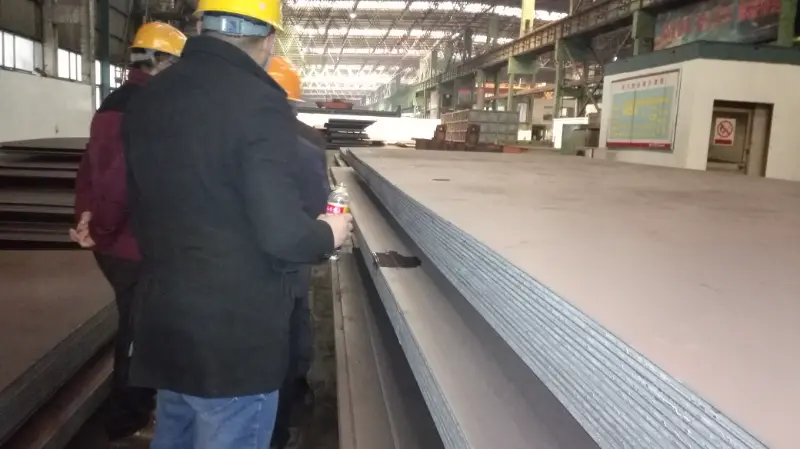
EN10025-2 S275J2 Structural Steel
EN10025-2 S275J2 Structural Steel: Properties, Equivalents & Applications
Comprehensive guide to S275J2 carbon steel to EN 10025-2: low-temperature toughness, guaranteed impact energy at -20°C, and broad application in welded structures.
Arc Welding (SMAW, GMAW, SAW), Resistance Welding, Bolting, Riveting, Cold Bending, Hot-Dip Galvanizing
- Phone : +8618037372205
- Email : [email protected]
- WhatsApp: Contact via Whtsapp
- WeChat: +8618037372205
EN10025-2 S275J2 Structural Steel Introduction
S275J2 is a hot-rolled, weldable structural steel grade defined by the European standard EN 10025-2. It represents a non-alloy quality steel with a minimum yield strength of 275 MPa for thicknesses up to 16 mm. Distinguished by the 'J2' designation, it guarantees a minimum impact energy of 27 Joules at a test temperature of -20°C, ensuring reliable performance against brittle fracture in low-temperature environments. This grade is the successor to the former S275J2G3 designation under EN 10025:1993. It exhibits excellent cold-forming properties and is fully suitable for welding, making it a versatile choice for general steel construction. It is delivered in a normalized or normalized rolled condition.
EN10025-2 S275J2 Structural Steel Chemical Composition
The chemical composition is defined in accordance with EN 10025-2:2019 for S275J2 steel. These limits apply to heat analysis and are designed to ensure the specified mechanical properties, particularly weldability and low-temperature toughness. The grain-refining elements, such as aluminum, play a crucial role in achieving the fine-grained structure necessary for the J2 quality. Based on thickness and CEV requirements, additions of niobium, vanadium, and titanium may also be present.
| Chemical Element | Standard Value (Heat Analysis, Max %) | Notes |
|---|---|---|
| Carbon (C) | 0.18 | Nominal thickness ≤ 40 mm |
| Carbon (C) | 0.20 | Nominal thickness > 40 mm |
| Manganese (Mn) | 1.50 | Long products may have up to 1.60% by agreement |
| Silicon (Si) | 0.55 | |
| Phosphorus (P) | 0.025 | J2 quality requires lower P content for improved toughness |
| Sulfur (S) | 0.025 | J2 quality requires lower S content for improved toughness |
| Nitrogen (N) | 0.015 | Must be bound by sufficient amounts of grain-refining elements (e.g., Al, V, Nb) |
| Aluminum (Al, total) | ≥ 0.020 | Minimum soluble aluminum content, or equivalent grain-refining elements must be present |
| Carbon Equivalent Value (CEV) | 0.41 (t ≤ 40 mm) | CEV = C + Mn/6 + (Cr+Mo+V)/5 + (Ni+Cu)/15 |
| Carbon Equivalent Value (CEV) | 0.44 (40 < t ≤ 150 mm) | Based on ladle analysis, for weldability assessment |
EN10025-2 S275J2 Structural Steel Thermal and Electrical Physical Properties
These physical properties are typical values for S275J2 non-alloy structural steel at ambient temperature (20°C) and are not part of the mandatory delivery specifications of EN 10025-2. They are provided for engineering design calculations, such as thermal expansion analysis, heat transfer modeling, and structural analysis where dead-weight or elastic deformation is considered. Values may vary slightly depending on the exact chemical composition and manufacturing process.
| Property | Typical Value | Unit | Condition / Temperature |
|---|---|---|---|
| Density (ρ) | 7.85 | kg/dm³ | At 20°C |
| Modulus of Elasticity (E) | 210 | GPa | At 20°C, static load |
| Shear Modulus (G) | 81 | GPa | At 20°C, calculated from E and ν |
| Poisson's Ratio (ν) | 0.3 | — | At 20°C, static load |
| Thermal Expansion Coefficient (α) | 12 | 10⁻⁶/K | Mean value, 20-100°C |
| Thermal Expansion Coefficient (α) | 13 | 10⁻⁶/K | Mean value, 20-200°C |
| Thermal Conductivity (λ) | 54 | W/(m·K) | At 20°C |
| Thermal Conductivity (λ) | 51 | W/(m·K) | At 100°C |
| Specific Heat Capacity | 460 - 480 | J/(kg·K) | At 20°C to 100°C |
| Electrical Resistivity (ρ_e) | 0.18 - 0.22 | µΩ·m | At 20°C |
EN10025-2 S275J2 Structural Steel Mechanical Properties
The mechanical properties of S275J2 are guaranteed at the specified ambient temperature. These values are mandatory for delivery according to EN 10025-2:2019. The transverse impact properties at -20°C are the defining feature of this J2 grade, providing assurance against brittle fracture under dynamic loading in cold conditions. The tensile test values apply to the longitudinal direction for flat products.
| Property | Standard Requirement Value | Unit | Test Condition |
|---|---|---|---|
| Minimum Yield Strength (ReH) | 275 | MPa | Nominal Thickness ≤ 16 mm, Longitudinal |
| Minimum Yield Strength (ReH) | 265 | MPa | Nominal Thickness 16 < t ≤ 40 mm, Longitudinal |
| Minimum Yield Strength (ReH) | 255 | MPa | Nominal Thickness 40 < t ≤ 63 mm, Longitudinal |
| Minimum Yield Strength (ReH) | 245 | MPa | Nominal Thickness 63 < t ≤ 80 mm, Longitudinal |
| Minimum Yield Strength (ReH) | 235 | MPa | Nominal Thickness 80 < t ≤ 100 mm, Longitudinal |
| Minimum Yield Strength (ReH) | 225 | MPa | Nominal Thickness 100 < t ≤ 150 mm, Longitudinal |
| Tensile Strength (Rm) | 410 - 560 | MPa | Nominal Thickness < 3 mm |
| Tensile Strength (Rm) | 410 - 560 | MPa | Nominal Thickness 3 ≤ t ≤ 100 mm |
| Tensile Strength (Rm) | 400 - 540 | MPa | Nominal Thickness 100 < t ≤ 150 mm |
| Minimum Elongation (A) | 23 | % | Gauge length L0 = 80 mm, thickness 3 ≤ t ≤ 40 mm |
| Minimum Elongation (A) | 22 | % | Gauge length L0 = 80 mm, thickness 40 < t ≤ 63 mm |
| Minimum Elongation (A) | 21 | % | Gauge length L0 = 80 mm, thickness 63 < t ≤ 100 mm |
| Minimum Impact Work (KV) | 27 | J | Test temperature -20°C, Transverse (Charpy V-notch) |
EN10025-2 S275J2 Structural Steel Fully Equivalent Material Standards & Replaceable Grade Designations
| Country/Region | Standard | Grade Designation | Remarks |
|---|---|---|---|
| European Union | EN 10025-2:2019 | S275J2 (+N) | Definitive standard. Formerly S275J2G3 per EN 10025:1993. |
| United Kingdom | BS EN 10025-2:2019 | S275J2 | Identical standard adopted by BSI. |
| Germany | DIN EN 10025-2:2019 | S275J2 | Identical standard adopted by DIN. Replaced DIN 17100 St 44-3 N concept. |
| France | NF EN 10025-2:2019 | S275J2 | Identical standard adopted by AFNOR. |
| Italy | UNI EN 10025-2:2019 | S275J2 | Identical standard adopted by UNI. |
| Spain | UNE EN 10025-2:2019 | S275J2 | Identical standard adopted by UNE. |
EN10025-2 S275J2 Structural Steel Application Introduction
S275J2 provides an excellent balance of strength, ductility, and toughness for structural applications, particularly where service temperatures drop below freezing. Its guaranteed -20°C impact energy makes it superior to S275JR (room temperature) and S275J0 (0°C) grades for critical structural components. Key application areas focus on welded structures subjected to dynamic loading and low-temperature service conditions, ensuring safety and durability.
Product Applications: Multi-story building frames and columns, Highway and railway bridges, Offshore platform decks, modules, and flare booms, Ship hulls and superstructures, Freight wagon and passenger coach underframes, Tower cranes, mobile crane booms, and mast sections, Wind turbine towers (structural shell sections), Pressure vessels designed for low-stress applications
Processed into products: Fabricated box columns and girders, Lattice mast and truss elements (angles, channels), Endplates, stiffeners, and gusset plates, Heavy-duty dumper bodies and earthmoving equipment buckets, Machinery base frames and engine supports, Dished ends and rolled shells for storage tanks, Piling and foundation casing (non-aqueous)
Application industries: Civil Engineering and Building Construction, Bridge and Highway Construction, Offshore and Marine Engineering (topsides, not immersed zones without specific corrosion allowances), Shipbuilding (secondary and tertiary structures), Railway Vehicle Manufacturing, Crane and Heavy Lifting Equipment, Machinery and Plant Construction
EN10025-2 S275J2 Structural Steel Similar/Comparable Substitute Material Grades
| Country/Region | Standard | Grade Designation | Remarks / Comparison |
|---|---|---|---|
| China | GB/T 1591-2018 | Q275D | Closest Chinese grade with -20°C impact guarantee. Verify full chemistry match for weldability. |
| Japan | JIS G 3106:2015 | SM400B | Yield strength is lower (min 235 MPa), but impact tested at 0°C. SM490A has higher strength. |
| USA | ASTM A572/A572M-21 | Grade 42 [290] | Yield strength is 290 MPa, impact testing optional supplementary requirement. Not a direct equivalent. |
| International | ISO 630-2:2011 | S275J0 | Identical mechanical properties except the impact temperature is 0°C instead of -20°C. Can be upgraded if verified. |
| Russia | GOST R 55374-2012 | S275J2 | Direct adoption of European standard. Also compare with GOST 19281 St3sp5 for chemistry, but different standard system. |
| India | IS 2062:2011 | E275C | Fe 410 WC Grade is similar in strength but has a 0°C impact rating. E275C with -20°C impact can be a match. |
Notes:
Weldability: S275J2 has a controlled Carbon Equivalent Value (CEV) ensuring good arc weldability with conventional methods without preheating for moderate thicknesses, but preheating may be required for thicker sections or low-hydrogen welding demands to prevent cold cracking. Cold Forming: Suitable for cold bending and profiling with appropriate bend radii; flanging and hemming should consider the guaranteed minimum elongation. Corrosion Resistance: As an unalloyed steel, it has poor atmospheric corrosion resistance and requires protective coatings (painting, thermal spraying, hot-dip galvanizing) for service in exposed environments. Inspection and Testing: Standard inspection documents 2.2 or certification 3.1 per EN 10204 should be specified for all critical applications, confirming traceability to the heat analysis and mechanical test results, particularly the -20°C impact test.
- Share



