
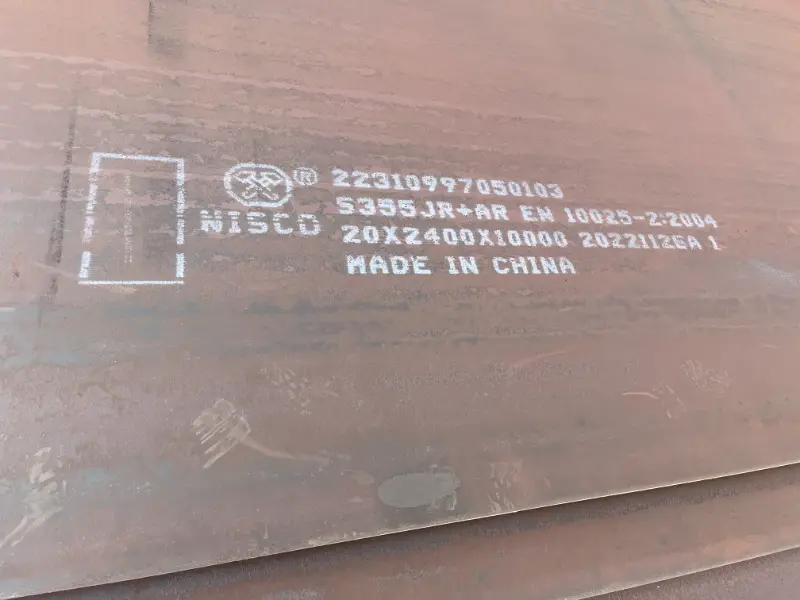
S355JR Carbon Steel Plate
S355JR Carbon Steel Plate | EN 10025-2 Structural Steel Properties & Equivalents
Complete material data for S355JR low-carbon structural steel plate according to EN 10025-2, including chemical composition, mechanical properties, thermal properties, and international equivalents.
Welding, hot forming, cold forming, bending, cutting, drilling, machining
- Phone : +8618037372205
- Email : [email protected]
- WhatsApp: Contact via Whtsapp
- WeChat: +8618037372205
S355JR Carbon Steel Plate Introduction
S355JR is a hot-rolled, non-alloy structural steel grade defined in EN 10025-2:2019. It belongs to the S355 strength class with a minimum yield strength of 355 MPa (for thickness ≤ 16 mm) and a minimum impact energy of 27 J at +20 °C (quality JR).
Key features:
- Good weldability thanks to low carbon content and controlled carbon equivalent value (CEV).
- Excellent strength-to-weight ratio, enabling lightweight yet robust structures.
- Wide range of available thicknesses (up to 150 mm) and delivery conditions (as-rolled or normalized).
- Cost-effective solution for general structural engineering, compatible with standard fabrication methods.
S355JR is widely used in bridges, buildings, offshore structures, machinery, and transportation equipment where reliable toughness at ambient temperatures is required.
S355JR Carbon Steel Plate Chemical Composition
The following table lists the ladle analysis limits for S355JR according to EN 10025-2:2019, Table 2. The steel is non-alloy and may be supplied as rimmed, capped, semi-killed or fully killed. Carbon equivalent value (CEV) based on ladle analysis is ≤ 0.45 % for thicknesses ≤ 30 mm, and ≤ 0.47 % for thicknesses > 30 mm ≤ 150 mm.
| Element | Standard Value (max %) | Remarks |
|---|---|---|
| Carbon (C) | 0.24 | t ≤ 30 mm; 0.24 % for 30 < t ≤ 100 mm |
| Silicon (Si) | 0.55 | For killed steels a minimum Si of 0.10 % may be requested |
| Manganese (Mn) | 1.70 | Applies to all thicknesses |
| Phosphorus (P) | 0.035 | |
| Sulfur (S) | 0.035 | |
| Nitrogen (N) | 0.012 | 0.014 % if not aluminium-killed |
| Copper (Cu) | 0.55 | Optional; if present, maximum content applies |
| Carbon Equivalent (CEV) | 0.45 | For t ≤ 30 mm; 0.47 % for 30 < t ≤ 150 mm (based on ladle analysis) |
S355JR Carbon Steel Plate Thermal and Electrical Physical Properties
Physical properties are typical for non-alloy structural steel at room temperature unless otherwise stated. These values are not part of EN 10025-2 but represent accepted engineering data for S355JR type carbon steels. They may vary slightly with composition and heat treatment.
| Property | Typical Value | Unit | Test Condition / Remarks |
|---|---|---|---|
| Density (ρ) | 7.85 | g/cm³ | At 20 °C |
| Elastic modulus (E) | 210 | GPa | At 20 °C, tensile modulus |
| Shear modulus (G) | 81 | GPa | At 20 °C, calculated from E and ν |
| Poisson's ratio (ν) | 0.30 | – | At 20 °C |
| Thermal expansion coefficient (α) | 12.0 | 10⁻⁶/K | Temperature range 20 – 100 °C |
| Thermal expansion coefficient (α) | 13.0 | 10⁻⁶/K | Temperature range 20 – 200 °C |
| Thermal expansion coefficient (α) | 14.0 | 10⁻⁶/K | Temperature range 20 – 400 °C |
| Thermal conductivity (λ) | 53 | W/(m·K) | At 20 °C |
| Thermal conductivity (λ) | 51 | W/(m·K) | At 200 °C |
| Thermal conductivity (λ) | 45 | W/(m·K) | At 400 °C |
| Specific heat capacity (c) | 460 | J/(kg·K) | Room temperature to 100 °C |
| Electrical resistivity (ρₑ) | 0.15 | 10⁻⁶ Ω·m | At 20 °C |
S355JR Carbon Steel Plate Mechanical Properties
Mechanical properties of S355JR at ambient temperature according to EN 10025-2:2019, Table 6. Properties are valid for products in the as-rolled or normalized condition. Impact test temperature is +20 °C; minimum absorbed energy is 27 J. Elongation values are for longitudinal test pieces using gauge length L₀ = 5.65√S₀.
| Property | Required Value | Unit | Test Condition |
|---|---|---|---|
| Yield strength (ReH) | ≥ 355 | MPa | t ≤ 16 mm |
| Yield strength (ReH) | ≥ 345 | MPa | 16 < t ≤ 40 mm |
| Yield strength (ReH) | ≥ 335 | MPa | 40 < t ≤ 63 mm |
| Yield strength (ReH) | ≥ 325 | MPa | 63 < t ≤ 80 mm |
| Yield strength (ReH) | ≥ 315 | MPa | 80 < t ≤ 100 mm |
| Yield strength (ReH) | ≥ 295 | MPa | 100 < t ≤ 150 mm |
| Tensile strength (Rm) | 470 – 630 | MPa | t ≤ 100 mm |
| Tensile strength (Rm) | 450 – 600 | MPa | 100 < t ≤ 150 mm |
| Elongation (A) | ≥ 22 | % | t ≤ 40 mm, L₀ = 5.65√S₀ |
| Elongation (A) | ≥ 21 | % | 40 < t ≤ 63 mm, L₀ = 5.65√S₀ |
| Elongation (A) | ≥ 20 | % | 63 < t ≤ 100 mm, L₀ = 5.65√S₀ |
| Elongation (A) | ≥ 18 | % | 100 < t ≤ 150 mm, L₀ = 5.65√S₀ |
| Bending test (bend angle 180°) | D = 2a | – | t ≤ 16 mm |
| Bending test (bend angle 180°) | D = 3a | – | 16 < t ≤ 100 mm |
| Bending test (bend angle 180°) | D = 4a | – | 100 < t ≤ 150 mm |
| Impact energy (KV, longitudinal) | ≥ 27 | J | at +20 °C |
S355JR Carbon Steel Plate Fully Equivalent Material Standards and Replacement Grades
| Country / Region | Standard | Grade | Remarks |
|---|---|---|---|
| Europe | EN 10025-2:2019 | S355JR | Original designation |
| International | ISO 630-2:2024 | Fe355B | Identical strength and impact class (+20 °C / 27 J) |
| United Kingdom | BS EN 10025-2:2019 | S355JR | Adopted European standard |
| China | GB/T 1591-2018 | Q355B | Comparable yield strength and 20 °C impact energy; minor C & Mn differences |
S355JR Carbon Steel Plate Application Introduction
S355JR steel plate is widely chosen for welded structures that require good strength and toughness at ambient temperatures. Its excellent formability, machinability, and weldability enable cost-effective fabrication. It is not intended for elevated-temperature service or severe chemical environments without protective coatings.
Typical applications include:
Product Applications: Steel plates for welded structures, Heavy and medium sections, Hot-rolled strips and wide flats, Circular and rectangular hollow sections, Laser-cut and flame-cut blanks, Welded structural assemblies
Processed into products: Bridge girders and cross-beams, Building columns and trusses, Offshore platform braces and legs, Wind turbine tower shells and flanges, Excavator buckets and booms, Trailer chassis and load-bearing beams, Ship stiffeners and bulkheads, Machine frames and support structures
Application industries: Building and civil engineering: columns, beams, frames, base plates, Bridge construction: stiffeners, girders, deck plates, Offshore and marine: structural members of platforms, ship hulls (with appropriate approval), Wind energy: tower sections, transition pieces, Transportation: trailer frames, rail wagon components, Machinery and industrial equipment: crane booms, excavator arms, pressure vessel casings (limited)
S355JR Carbon Steel Plate Similar / Substitute Materials Recommendations
| Country / Region | Standard | Grade | Remarks |
|---|---|---|---|
| USA | ASTM A572/A572M | Grade 50 [345] | Yield strength 345 MPa (t ≤ 100 mm); impact test not mandatory unless specified; CEV may differ |
| Japan | JIS G3106 | SM490A | Yield ≥ 325-355 MPa; impact test at 0 °C (27 J), slightly tougher than JR |
| Germany (superseded) | DIN 17100 | St52-3 | Former German grade, equivalent strength; impact at +20 °C |
| Russia | GOST 27772 | C355 | Structural steel for building structures; similar strength and toughness |
Notes:
Welding guidelines: S355JR can be welded by all common arc welding processes (SMAW, GMAW, SAW, FCAW). Preheat and interpass temperatures should be selected based on thickness and CEV. Post-weld heat treatment (PWHT) is usually not required for thicknesses below 30 mm, but may be applied to relieve residual stresses in heavy sections.
CEV control: The carbon equivalent value is restricted to ≤ 0.45 % (t ≤ 30 mm) to ensure good weldability. For improved cold formability in tight radii, a fully killed fine-grain practice variant (e.g., S355J2) may be preferred.
Coating performance: The surface can be primed, hot-dip galvanized, or painted. When hot-dip galvanizing, silicon content must be controlled to avoid excessive coating thickness; a bath consultation is recommended for Si > 0.25 %.
- Share



