
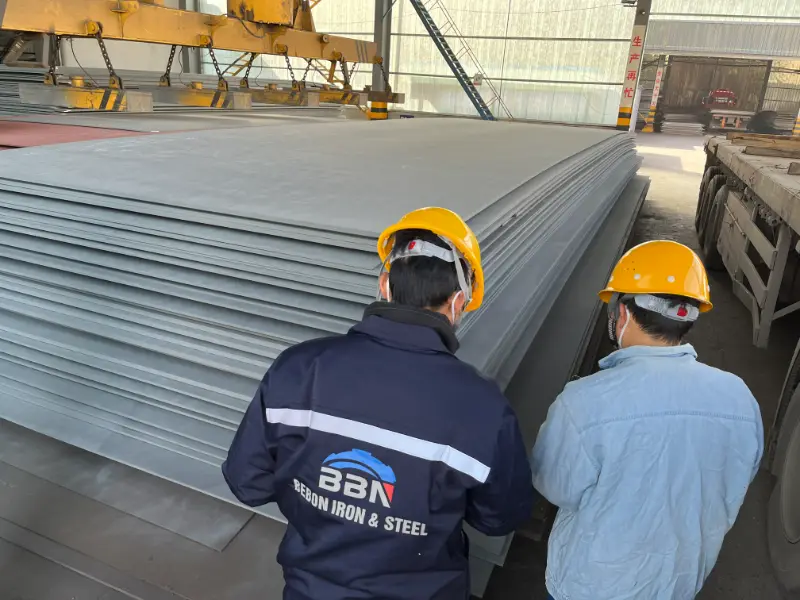
EN 10025-2 S355J0
EN 10025-2 S355J0 Steel: Chemical, Mechanical, Thermal Properties & Equivalent Grades
Comprehensive data sheet for S355J0 carbon and low-alloy high-strength steel plate according to EN 10025-2. Includes chemical composition, mechanical and physical properties, equivalent standards, and application guidance.
Hot rolling, cold forming, welding, machining, drilling, punching, cutting (flame, plasma, laser)
- Phone : +8618037372205
- Email : [email protected]
- WhatsApp: Contact via Whtsapp
- WeChat: +8618037372205
EN 10025-2 S355J0 Introduction
EN 10025-2 S355J0 is a hot-rolled structural steel grade within the European standard for non-alloy and low-alloy steels. It offers a minimum yield strength of 355 MPa and is characterized by good weldability, moderate toughness at 0°C (J0 quality), and excellent formability.
- S355J0 is widely used in welded, bolted, and riveted structures.
- It provides a balanced combination of strength and ductility, suitable for general construction and engineering applications.
- Delivery condition is typically hot-rolled, and the steel can be supplied as plates, sheets, bars, and structural sections.
EN 10025-2 S355J0 Chemical Composition
Composition limits according to EN 10025-2:2019 for grade S355J0. The values are maxima unless a range is specified. The steel is killed and fine-grained; nitrogen-binding elements are added to ensure mechanical properties.
- Cu content may exceed 0.40% if agreed at the time of enquiry and order.
- CEV limits apply depending on thickness to ensure weldability.
| Element | Maximum value (wt%) | Remarks |
|---|---|---|
| Carbon (C) | ≤ 0.20 (for t ≤ 16 mm) ≤ 0.22 (for t > 16 mm) | Thickness-dependent |
| Silicon (Si) | ≤ 0.55 | Deoxidation element |
| Manganese (Mn) | ≤ 1.60 | Increases strength |
| Phosphorus (P) | ≤ 0.030 | For long products ≤ 0.035 |
| Sulfur (S) | ≤ 0.030 | For long products ≤ 0.035 |
| Copper (Cu) | ≤ 0.55 | Residual or agreed addition |
| Nitrogen (N) | ≤ 0.012 | Fine grain practice |
| Aluminium (Al) | ≥ 0.015 total aluminium or sufficient other N-binding elements | Grain refinement |
| Carbon Equivalent Value (CEV) | max. 0.45 (typical for t ≤ 30 mm) | Formula: CEV=C+Mn/6+(Cr+Mo+V)/5+(Ni+Cu)/15 |
EN 10025-2 S355J0 Physical and Thermal Properties
S355J0 exhibits physical properties typical of structural carbon-manganese steels. Data are representative for room temperature unless otherwise noted.
- Values may vary slightly with heat treatment and composition within the grade limits.
- Thermal conductivity and specific heat decrease slightly with increasing temperature.
| Property | Typical Value | Unit | Test Condition / Remarks |
|---|---|---|---|
| Density (ρ) | ~ 7850 | kg/m³ | At 20 °C |
| Modulus of elasticity (E) | ~ 210 | GPa | 20 °C |
| Shear modulus (G) | ~ 81 | GPa | Calculated; ν ~ 0.30 |
| Poisson's ratio (ν) | 0.30 | — | At ambient temperature |
| Thermal expansion coefficient (α) | ~ 11.5 × 10⁻⁶ (20–100 °C) ~ 12.5 × 10⁻⁶ (20–300 °C) | K⁻¹ | Linear expansion |
| Thermal conductivity (λ) | ~ 50 (at 20 °C) | W/(m·K) | Decreases to ~ 40 W/(m·K) at 300 °C |
| Specific heat capacity (c) | ~ 460 | J/(kg·K) | At 20 °C; increases to ~ 530 J/(kg·K) at 300 °C |
| Electrical resistivity (ρₑ) | ~ 0.20 × 10⁻⁶ | Ω·m | At 20 °C |
EN 10025-2 S355J0 Mechanical Properties
Specified mechanical properties for S355J0 in the hot-rolled condition. Test pieces are taken in the longitudinal direction.
- Impact test (KV) at 0 °C applies to thicknesses ≥ 6 mm; values are minimum.
- Bend test mandrel diameter refers to a 180° bend test (in some cases 90° for thicknesses > 100 mm).
| Property | Specified Value | Unit | Test Condition |
|---|---|---|---|
| Yield strength (ReH) | ≥ 355 ≥ 345 ≥ 335 ≥ 325 ≥ 315 ≥ 295 ≥ 285 ≥ 275 | MPa | Thickness ≤ 16 mm Thickness 16 < t ≤ 40 mm Thickness 40 < t ≤ 63 mm Thickness 63 < t ≤ 80 mm Thickness 80 < t ≤ 100 mm Thickness 100 < t ≤ 150 mm Thickness 150 < t ≤ 200 mm Thickness 200 < t ≤ 250 mm |
| Tensile strength (Rm) | 470 – 630 470 – 630 470 – 630 470 – 630 470 – 630 450 – 600 450 – 600 450 – 600 | MPa | t ≤ 100 mm (all ranges) t ≤ 100 mm t ≤ 100 mm t ≤ 100 mm t ≤ 100 mm 100 < t ≤ 150 mm 150 < t ≤ 200 mm 200 < t ≤ 250 mm |
| Elongation (A) | ≥ 22 ≥ 22 ≥ 21 ≥ 20 ≥ 20 ≥ 18 ≥ 17 ≥ 17 | % | Gauge length L₀ = 5.65√S₀ t ≤ 16 mm 16 < t ≤ 40 mm 40 < t ≤ 63 mm 63 < t ≤ 80 mm 80 < t ≤ 100 mm 100 < t ≤ 150 mm 150 < t ≤ 200 mm 200 < t ≤ 250 mm |
| Impact energy (KV) | ≥ 27 J at 0 °C | J | Longitudinal, V-notch, average of 3 tests; individual min. 20 J |
| Bend test (mandrel diameter) | d = 3t (t ≤ 16 mm) d = 3t (16 < t ≤ 100 mm) d = 4t (100 < t ≤ 200 mm) | — | 180° bend (thickness < 100 mm); 90° bend (t ≥ 100 mm) according to EN 10025-2 |
EN 10025-2 S355J0 Direct Equivalent Standards and Replaceable Grades
| Country/Region | Standard | Grade | Remarks |
|---|---|---|---|
| European Union | EN 10027-1 / EN 10025-2 | S355J0 | Base designation |
| International | ISO 630-2 | S355J0 | Identical chemical and mechanical requirements |
| Germany | DIN EN 10025-2 | S355J0 | National adoption of EN |
| France | NF A35-501 / NF EN 10025-2 | S355J0 / E36-2 | E36-2 is historical designation |
| Italy | UNI EN 10025-2 | S355J0 | National adoption |
| Spain | UNE EN 10025-2 | S355J0 | National adoption |
| Japan | JIS G3106 | SM490A | Comparable weldable structural steel; need to verify impact temperature |
| USA | ASTM A572/A572M | Grade 50 [345] | Yield 345 MPa; 0 °C impact can be specified by supplementary requirement S5 |
| China | GB/T 1591 | Q355D (Q345D) | 355 MPa yield, -20 °C impact; J0 corresponds to 0 °C; Q355C is closer at 0 °C |
EN 10025-2 S355J0 Application Introduction
S355J0 is a versatile structural steel employed across a wide spectrum of industries where moderate strength and 0 °C toughness are necessary. Its good weldability (CEV typically ≤ 0.45) and formability make it cost-effective for welded fabrication.
- Commonly used in heavy civil engineering and industrial construction.
- Appropriate for static and dynamic loads, provided design temperature is not lower than 0 °C.
- Available in various delivery forms, enabling manufacturing of beams, columns, box girders, and complex welded assemblies.
Product Applications: Welded beams and columns, Structural hollow sections (tubes and pipes), Crane runways and gantry girders, Bridge plates and box girders, Offshore platform decks and modules, Pressure vessel shells (limited to moderate pressure and temperature), Wind turbine tower sections (inner platforms, access structures), Railway vehicle underframes, Trailer chassis and truck frames, Silos, tanks, and hoppers
Processed into products: Base plates and stiffener plates, Flanges and webs for built-up sections, Brackets and gussets, Bearing plates, Connection plates and splice plates, Lifting lugs and padeyes, Frame components for heavy machinery, Excavator booms and dipper arms, Agricultural implements
Application industries: Civil Engineering and Infrastructure, Building Construction (commercial, industrial, high-rise), Bridge Building, Offshore and Marine Structures (deck plates, stiffeners, not primary structural members in harsh low temperatures), Mechanical Engineering, Transportation and Heavy Vehicle Manufacturing, Power Generation (support structures, platforms), Mining and Earthmoving Equipment, Agricultural Machinery, Shipbuilding (internal stiffeners, superstructures)
EN 10025-2 S355J0 Similar / Alternative Structural Steel Grades
| Country/Region | Standard | Grade | Remarks |
|---|---|---|---|
| Europe | EN 10025-2 | S355JR | Same strength, impact test at 20 °C (less demanding) |
| Europe | EN 10025-2 | S355J2 | Same strength, impact test at -20 °C (better toughness) |
| Europe | EN 10025-2 | S355K2 | Same strength, impact test at -20 °C with higher guaranteed impact energy (40 J) |
| Europe | EN 10025-2 | S275J0 | Lower yield strength (275 MPa), same 0 °C impact class; suitable for less loaded structures |
| Europe | EN 10025-3 | S355N / S355NL | Normalised fine-grain steel; better toughness, NL variant with low-temperature impact |
| USA | ASTM A572 | Grade 55 | Higher yield (380 MPa); may be used where S355J0 strength margin is exceeded |
| Japan | JIS G3106 | SM490B | Impact test at 0 °C, similar chemical composition; weldable structural steel |
| China | GB/T 1591 | Q355C | 355 MPa yield, 0 °C impact; closer to S355J0 than Q355D |
Notes:
Additional Remarks:
- For thicknesses above 250 mm, properties may be agreed at the time of ordering; the values given are applicable up to 250 mm.
- Impact tests (KV) are mandatory for S355J0 with test temperature 0 °C; for thickness below 6 mm, impact testing is not required unless agreed.
- The CEV limits should be closely followed to guarantee successful welding without preheating under normal conditions.
- Ultrasonic testing (UT) and other non-destructive examinations can be specified according to EN 10160 or other relevant standards.
- This data sheet is based on EN 10025-2:2019; for older versions (e.g., EN 10025:1990) some limits may differ slightly.
- Share



