
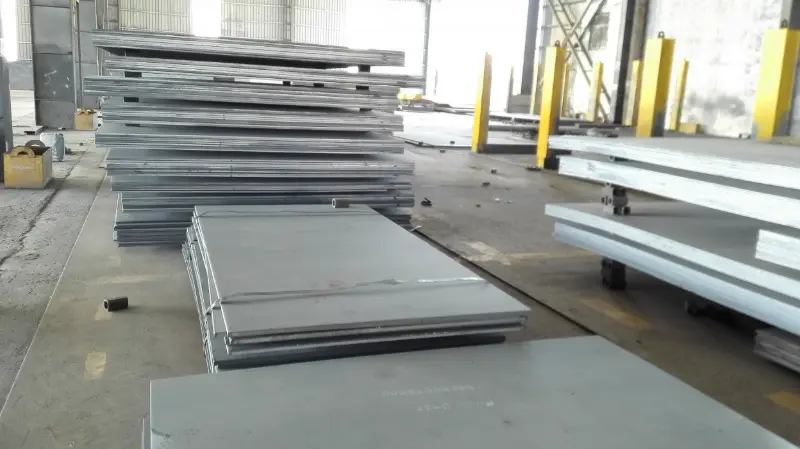
S355J2 Carbon & Low-alloy High-strength Steel Plate
S355J2 Carbon & Low-alloy High-strength Steel Plate - EN10025-2 Complete Data
Full material data sheet for S355J2 steel according to EN10025-2. Chemical composition, mechanical & thermal properties, international equivalents, and application guide.
Hot rolling with subsequent normalizing rolling (+N) or thermomechanical rolling (+M); suitable for cutting, bending, cold forming, welding, and machining.
- Phone : +8618037372205
- Email : [email protected]
- WhatsApp: Contact via Whtsapp
- WeChat: +8618037372205
S355J2 Carbon & Low-alloy High-strength Steel Plate Introduction
S355J2 is a hot-rolled, non-alloy fine-grain structural steel specified in EN 10025-2:2004. It offers minimum yield strength of 355 MPa and guaranteed impact toughness of 27 J at -20 °C. The steel is supplied in normalized rolling (+N) or thermomechanical rolling (+M) condition, providing excellent weldability, uniform mechanical properties, and good resistance to brittle fracture. Typical applications include heavy welded structures, bridges, offshore platforms, and high-rise buildings.
- 355 MPa minimum yield strength
- Excellent low-temperature toughness (KV 27 J @ -20 °C)
- Good weldability (CEV typically ≤0.45)
- Fine-grain fully killed steel
S355J2 Carbon & Low-alloy High-strength Steel Plate Chemical Composition
Ladle analysis according to EN 10025-2 Table 3 (S355J2). Maximum limits unless a range is given. The steel is fully killed and may contain grain-refining elements such as Al, Nb, V or Ti.
- Carbon equivalent (CEV) ≤0.45 for t≤30 mm; ≤0.47 for 30 < t ≤ 150 mm
- Fine-grain practice through Al≥0.020% or other grain-refining additions
| Element | Standard Value (max %) | Remarks |
|---|---|---|
| Carbon (C) | 0.22 (t≤40 mm) / 0.24 (40<t≤150 mm) | Ladle analysis; thickness dependent |
| Silicon (Si) | 0.55 | Ladle analysis |
| Manganese (Mn) | 1.60 | For long products: 1.65 max |
| Phosphorus (P) | 0.035 | For S355J2 the lower P limit applies |
| Sulfur (S) | 0.035 | Same as P — guaranteed for cleanliness |
| Copper (Cu) | 0.55 | May also include other elements for atmospheric corrosion resistance |
| Aluminium (Al) – soluble | ≥0.020 | Minimum for fine-grain practice (if used alone) |
| Nitrogen (N) | 0.012 | Maximum unless bound by Al, V, Nb or Ti |
| CEV (typical) | ≤0.45 (t≤30) / ≤0.47 (30<t≤150) | Carbon equivalent calculated as CEV = C + Mn/6 + (Cr+Mo+V)/5 + (Ni+Cu)/15 |
S355J2 Carbon & Low-alloy High-strength Steel Plate Thermal & Electrical Physical Properties
The following properties are not specified in EN 10025-2 but represent typical values for non-alloy fine-grain structural steels at room temperature. They may vary with actual chemical composition, heat treatment and temperature.
- Density is calculated as ≈7850 kg/m³.
- Thermal expansion coefficient refers to the range 20°C to 300°C.
| Property | Typical Value | Unit | Test Condition / Remarks |
|---|---|---|---|
| Density (ρ) | 7850 | kg/m³ | Room temperature |
| Modulus of Elasticity (E) | 210 | GPa | At 20°C; decreases at higher temperatures |
| Shear Modulus (G) | ≈ 81 | GPa | Calculated from E and ν |
| Poisson's Ratio (ν) | 0.3 | – | Elastic range |
| Thermal Expansion Coefficient (α) | 12 × 10⁻⁶ | /K | 20°C to 300°C |
| Thermal Conductivity (λ) | 50 – 52 | W/(m·K) | At 20°C, typical for carbon steel |
| Specific Heat Capacity (cp) | 460 – 480 | J/(kg·K) | At 20°C |
| Electrical Resistivity (ρe) | 0.15 – 0.20 | Ω·mm²/m | At 20°C |
S355J2 Carbon & Low-alloy High-strength Steel Plate Mechanical Properties
Minimum values for longitudinal test pieces at ambient temperature unless otherwise stated. For flat products, the yield strength decreases with increasing thickness.Impact toughness is validated at -20 °C with Charpy V-notch specimens.
- Bend test: mandrel diameter = 3t for t≤16 mm, 2t for t>16 mm (180° bend, no cracks)
- Properties in the transverse direction may be 80-90% of the tabulated values
| Property | Standard Requirement | Unit | Test Condition / Thickness |
|---|---|---|---|
| Yield Strength (ReH) | 355 | MPa | t ≤ 16 mm |
| Yield Strength (ReH) | 345 | MPa | 16 mm < t ≤ 40 mm |
| Yield Strength (ReH) | 335 | MPa | 40 mm < t ≤ 63 mm |
| Yield Strength (ReH) | 325 | MPa | 63 mm < t ≤ 80 mm |
| Yield Strength (ReH) | 315 | MPa | 80 mm < t ≤ 100 mm |
| Yield Strength (ReH) | 295 | MPa | 100 mm < t ≤ 150 mm |
| Tensile Strength (Rm) | 510 – 680 | MPa | t < 3 mm (plates & strips) |
| Tensile Strength (Rm) | 470 – 630 | MPa | 3 mm ≤ t ≤ 100 mm |
| Tensile Strength (Rm) | 450 – 600 | MPa | 100 mm < t ≤ 150 mm |
| Elongation (A, 5.65√S0) | ≥ 22 | % | 3 mm ≤ t ≤ 40 mm (longitudinal) |
| Elongation (A) | ≥ 21 | % | 40 mm < t ≤ 63 mm |
| Elongation (A) | ≥ 20 | % | 63 mm < t ≤ 100 mm |
| Elongation (A) | ≥ 18 | % | 100 mm < t ≤ 150 mm |
| Charpy Impact (KV, −20°C) | ≥ 27 | J | Longitudinal, 10×10 mm specimen; mean of 3 tests, one individual ≥70% of mean |
| Bend Test (180°) | No cracks | – | Mandrel diameter 3×t (t≤16); 2×t (t>16) |
S355J2 Carbon & Low-alloy High-strength Steel Plate Complete Equivalent Material Standards & Replaceable Grades
| Country/Region | Standard | Grade | Remarks |
|---|---|---|---|
| Europe | EN 10025-2 | S355J2 | Original standard; fully killed fine-grain, 27J @ -20°C |
| International | ISO 630-2 | S355J2 | Identical technical delivery conditions to EN 10025-2 |
| USA | ASTM A572/A572M | Grade 50 (Type 1) | Yield 50 ksi ≈345 MPa; Charpy at -20°C must be added as supplementary requirement S5 |
| USA | ASTM A992/A992M | Grade 50 | Building structural steel; impact at 21°C 27 J average; often used interchangeably with S355J2 when -20°C toughness is not mandatory |
| China | GB/T 1591-2018 | Q355D | 355 MPa yield, min 34 J at -20°C; slightly higher impact requirement, widely accepted equivalent |
| Japan | JIS G 3106 | SM490D | Yield 325 MPa for t≤16 mm; 27 J at -20°C (10×10 mm); strength slightly lower but comparable in structural applications |
| Russia | GOST 19281 | 17G1S-U / 17GS | Not fully identical; often used for similar strength levels with cold-resisting properties |
S355J2 Carbon & Low-alloy High-strength Steel Plate Application Introduction
S355J2 is widely used in heavy-duty structural applications where good weldability, high strength, and low-temperature toughness are required. Its ability to maintain ductility at -20°C makes it suitable for exposed outdoor structures and cold climates.
- Typical fabrication: welding (SMAW, GMAW, SAW), thermal cutting, cold bending, machining.
- Preheating usually not required up to 50 mm thickness for low-hydrogen processes.
Product Applications: Structural frameworks of high-rise buildings, Welded bridge girders and box sections, Offshore platform decks, legs, and nodes, Crane booms and crawler crane frames, Wind turbine tower segments and foundations, Pressure vessel shells and heads (non-high temperature), Heavy-duty truck chassis and tipper bodies, Excavator booms, arms, and buckets
Processed into products: Beams, columns, and truss members, Welded I‑girders and plate girders, Base plates, stiffeners, and gusset plates, Flanges and web plates for built-up sections, Crane rail beams and runway girders, Roller tracks and slewing rings, Excavator bucket skins and cutting edges, Heavy machine frames and press bodies
Application industries: Construction & Civil Engineering, Bridge Building, Offshore & Marine, Heavy Machinery & Equipment, Power Generation (Wind, Hydro, Thermal), Transport & Automotive (Heavy Trucks, Trailers), Mining & Earthmoving
S355J2 Carbon & Low-alloy High-strength Steel Plate Recommendations for Similar / Alternative Materials
| Country/Region | Standard | Grade | Remarks |
|---|---|---|---|
| Europe | EN 10025-2 | S355JR | Lower toughness guarantee: 27 J at +20°C; otherwise similar mechanical properties |
| Europe | EN 10025-2 | S355J0 | 27 J at 0°C; suitable for less demanding low-temperature applications |
| Europe | EN 10025-2 | S355K2 | 40 J at -20°C; higher resistance to brittle fracture |
| Europe | EN 10025-3 | S355N / S355NL | Normalized fine-grain steel; guaranteed properties at -20°C (N) and -50°C (NL) |
| USA | ASTM A572/A572M | Grade 50 (without Charpy) | Most common high-strength structural grade; no impact specification; needs verification for dynamic loads |
| Japan | JIS G 3106 | SM490B / SM490C | 490 MPa tensile class; SM490B impact 0°C, SM490C 0°C minimum; slightly lower yield |
| Worldwide | API 2W | Grade 50 | For offshore applications; controlled rolling and toughness at low temperatures |
Notes:
Welding Considerations: S355J2 has low carbon equivalent (CEV ≤0.45) and minimal risk of cold cracking. For manual metal arc or submerged arc welding, use low-hydrogen electrodes (e.g., E5018, E7018). No preheat is generally needed for thicknesses below 50 mm at ambient temperature > 5°C. Post-weld heat treatment (PWHT) is not mandatory for structural applications.
Forming: Suitable for cold bending with a minimum inner radius of 2×t for thick plates. Hot forming may alter mechanical properties; re-normalizing is recommended if properties must be restored.
Certification: S355J2 is routinely supplied with EN 10204 3.1 inspection certificate upon request.
- Share



