
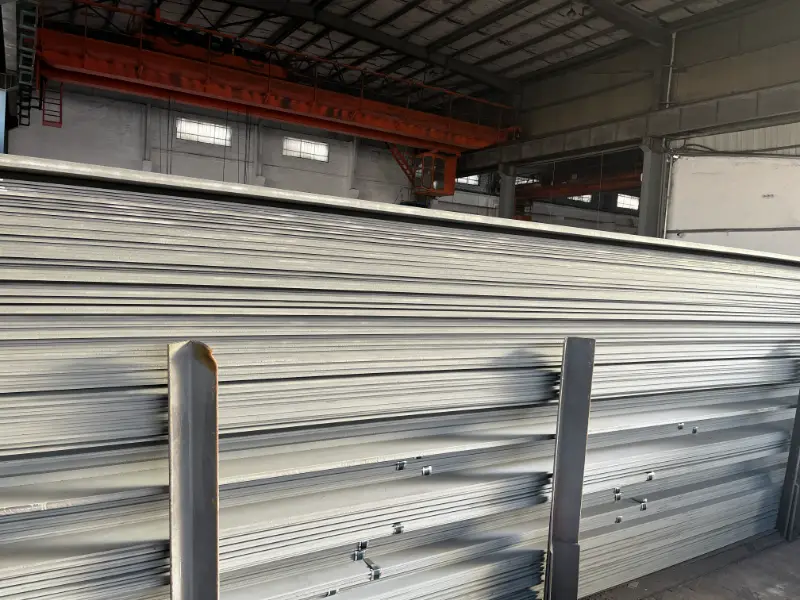
EN 10025-2 S355K2 Steel Plate
EN 10025-2 S355K2 Steel Plate: Properties, Equivalents & Chemical Data
Detailed datasheet for S355K2 low-alloy structural steel plate under EN 10025-2: chemical composition, mechanical properties, thermal & electrical data, international equivalents, and applications in bridges, offshore, and machinery.
Hot rolling, normalizing rolling, thermomechanical rolling, cold forming, machining, welding
- Phone : +8618037372205
- Email : [email protected]
- WhatsApp: Contact via Whtsapp
- WeChat: +8618037372205
EN 10025-2 S355K2 Steel Plate Introduction
S355K2 is a non-alloy and fine-grain structural steel grade defined in EN 10025-2, offering a minimum yield strength of 355 MPa and guaranteed Charpy impact energy of 40 J at -20 °C (K2 quality class). It belongs to the carbon and low-alloy high-strength steel category, widely used in welded, bolted, and riveted structures. Key features include:
- Good weldability, with controlled carbon equivalent (CEV typically ≤0.45)
- Fine-grain structure ensuring good toughness at sub-zero temperatures
- Excellent formability and machinability for structural components
- Suitable for hot-dip galvanizing and other corrosion protection
This grade is available in various product forms and is supplied mainly in the as-rolled or normalized condition. Its balanced composition and mechanical properties make it a versatile material for building, bridge engineering, offshore structures, and heavy machinery.
EN 10025-2 S355K2 Steel Plate Chemical Composition
The chemical composition conforms to EN 10025-2:2019, Table 3 for fine-grain steels. Values are maximum unless a range is given. Fine-grain practice is ensured by a minimum aluminium content or by the addition of other grain-refining elements (Nb, V, Ti), either singly or in combination. The carbon equivalent CEV is typically ≤0.45% for thicknesses ≤30 mm to ensure good weldability.
| Chemical Element | Standard Value (wt%) | Remarks |
|---|---|---|
| Carbon (C) | ≤0.20 (t≤30 mm); ≤0.22 (t>30 mm) | Heat analysis |
| Silicon (Si) | ≤0.55 | Heat analysis |
| Manganese (Mn) | ≤1.60 | Heat analysis |
| Phosphorus (P) | ≤0.030 | Heat analysis |
| Sulfur (S) | ≤0.030 | Heat analysis |
| Nitrogen (N) | ≤0.012 | Heat analysis |
| Copper (Cu) | ≤0.55 | Heat analysis |
| Aluminium (Al total) | ≥0.020 | Minimum for fine-grain practice if no other grain-refining elements are added |
| Niobium (Nb) | ≤0.05 | Optional grain refiner; max value if added |
| Vanadium (V) | ≤0.12 | Optional; max value if added |
| Titanium (Ti) | ≤0.05 | Optional; max value if added |
| Chromium (Cr) | ≤0.30 | Residual element, unless otherwise agreed |
| Nickel (Ni) | ≤0.30 | Residual |
| Molybdenum (Mo) | ≤0.10 | Residual |
| CEV (typical) | ≤0.45 (t≤30 mm) | CEV = C + Mn/6 + (Cr+Mo+V)/5 + (Ni+Cu)/15 |
EN 10025-2 S355K2 Steel Plate Thermal and Electrical Physical Properties
Physical properties are not specified in EN 10025-2 but are typical for low-alloy structural steels with similar composition. Values are provided for reference in design calculations. The density and elastic moduli are valid at room temperature; thermal expansion and conductivity vary with temperature.
| Property | Typical Value | Unit | Test Condition |
|---|---|---|---|
| Density (ρ) | 7.85 | g/cm³ | At 20 °C |
| Elastic Modulus (E) | 210 | GPa | At 20 °C |
| Shear Modulus (G) | 81 | GPa | At 20 °C |
| Poisson's Ratio (ν) | 0.30 | - | At 20 °C |
| Thermal Expansion Coefficient (α) | 11.1 | 10⁻⁶/K | 20 – 100 °C |
| Thermal Expansion Coefficient (α) | 11.9 | 10⁻⁶/K | 20 – 200 °C |
| Thermal Expansion Coefficient (α) | 13.0 | 10⁻⁶/K | 20 – 400 °C |
| Thermal Expansion Coefficient (α) | 13.9 | 10⁻⁶/K | 20 – 600 °C |
| Thermal Conductivity (λ) | 51 | W/(m·K) | At 20 °C |
| Thermal Conductivity (λ) | 49 | W/(m·K) | At 100 °C |
| Thermal Conductivity (λ) | 45 | W/(m·K) | At 200 °C |
| Specific Heat Capacity (c_p) | 460 | J/(kg·K) | At 20 °C |
| Electrical Resistivity (ρ_e) | 0.20 | μΩ·m | At 20 °C |
EN 10025-2 S355K2 Steel Plate Mechanical Properties
Mechanical properties are according to EN 10025-2:2019, Tables 6 & 7. Values apply to longitudinal test pieces for plate, strip, and wide flats. Transverse properties may be lower by approximately 20 MPa for yield strength and show slightly lower impact energy. Impact toughness is verified at -20 °C (K2 quality).
| Property | Standard Requirement Value | Unit | Test Condition |
|---|---|---|---|
| Yield Strength (ReH) | ≥355 | MPa | Thickness ≤16 mm |
| Yield Strength (ReH) | ≥345 | MPa | 16 < t ≤40 mm |
| Yield Strength (ReH) | ≥335 | MPa | 40 < t ≤63 mm |
| Yield Strength (ReH) | ≥325 | MPa | 63 < t ≤80 mm |
| Yield Strength (ReH) | ≥315 | MPa | 80 < t ≤100 mm |
| Yield Strength (ReH) | ≥295 | MPa | 100 < t ≤150 mm |
| Tensile Strength (Rm) | 470 - 630 | MPa | Thickness ≤100 mm |
| Tensile Strength (Rm) | 450 - 600 | MPa | 100 < t ≤150 mm |
| Elongation (A) | ≥22 | % | Thickness ≤40 mm, L₀=5.65√S₀ |
| Elongation (A) | ≥21 | % | 40 < t ≤63 mm, L₀=5.65√S₀ |
| Elongation (A) | ≥20 | % | 63 < t ≤100 mm, L₀=5.65√S₀ |
| Elongation (A) | ≥18 | % | 100 < t ≤150 mm, L₀=5.65√S₀ |
| Charpy Impact Energy (KV₂) | ≥40 | J | At -20 °C, longitudinal, 10×10 mm specimen |
| Bend Test (180°) | No cracks | - | Mandrel diameter: 2t (t≤16 mm), 3t (16 |
EN 10025-2 S355K2 Steel Plate Exact Equivalent Material Standards & Substitute Grades
| Country / Region | Standard | Grade | Remarks |
|---|---|---|---|
| European Union | EN 10025-2:2019 | S355K2 | Original standard, hot-rolled structural steel |
| International | ISO 630-2:2011 | S355K2 | Direct adoption of EN 10025-2 |
| United Kingdom | BS EN 10025-2 | S355K2 | Identical to EN standard |
| Germany | DIN EN 10025-2 | S355K2 | Identical |
| France | NF EN 10025-2 | S355K2 | Identical |
| Italy | UNI EN 10025-2 | S355K2 | Identical |
| Spain | UNE EN 10025-2 | S355K2 | Identical |
| Sweden | SS-EN 10025-2 | S355K2 | Identical |
| Poland | PN-EN 10025-2 | S355K2 | Identical |
EN 10025-2 S355K2 Steel Plate Application Introduction
S355K2 is tailored for welded structures operating at low ambient temperatures. Its fine-grain structure and guaranteed toughness at -20 °C allow reliable service in cold climates without brittle fracture. Typical applications span a wide range of industries where high strength and good weldability are required.
- Commonly used in heavy-duty structural frameworks and bridges subjected to dynamic loads.
- Suitable for offshore platforms, ship hulls, and wind turbine towers requiring tough steel in sub-zero conditions.
- Used for earthmoving equipment, crane booms, and mining machinery components.
- Ideal for bolted and riveted connections in multi-story buildings and industrial halls.
Product Applications: Welded steel bridges, Offshore platform jackets, Wind turbine tubular towers, Ship hull plates and stiffeners, Heavy-duty crane girders, Pressure vessel shells (with supplementary requirements), Structural steel frames for high-rise buildings, Excavator booms and arms, Railway carriage underframes
Processed into products: Bridge box girders and trusses, Tubular tower flange and shell sections, Base columns & anchor boxes for wind turbines, Deck plating and bulkheads in shipbuilding, Lifting lugs and heavy shackles, Pin-jointed structural nodes, Hydraulic cylinder mounting plates, Base frames for large rotating machinery, Welded I-beams and H-piles
Application industries: Civil engineering & construction, Bridge and highway infrastructure, Offshore & marine engineering, Wind energy (tower manufacturing), Shipbuilding & port equipment, Mining and heavy machinery, Transportation (railcar, trailer frames)
EN 10025-2 S355K2 Steel Plate Similar / Substitute Materials
| Country / Region | Standard | Grade | Remarks |
|---|---|---|---|
| China | GB/T 1591-2018 | Q355D | Similar yield strength; impact 47 J at -20 °C; delivery condition may differ |
| Japan | JIS G3106:2015 | SM490B | Yield ~355 MPa (t≤16 mm) but impact tested at 0 °C (27 J); SM490C has 0 °C impact, not equivalent at -20 °C |
| USA | ASTM A572/A572M | Grade 50 [345] with CVN -20 °C | Grade 50 has 345 MPa min yield; Charpy at -20 °C only with supplementary requirement S5; not fully equivalent |
| India | IS 2062:2011 | E350 BR / E350 C | E350 BR is fine-grain quality but impact may be at 0 °C or -20 °C depending on designation |
| Russia | GOST 27772-88 | C345-3 | Approximate equivalent for structural steel with -20 °C impact |
Notes:
Welding and fabrication: S355K2 exhibits good weldability. Preheating is generally not required when the carbon equivalent CEV ≤0.45 and combined thickness is moderate. Low-hydrogen welding processes are recommended to avoid cold cracking. Post-weld heat treatment may be applied depending on application codes.
Corrosion protection: The steel can be painted or hot-dip galvanized. For improved atmospheric corrosion resistance, weathering grades (e.g., S355K2W under EN 10025-5) may be an alternative.
Supply conditions: Products are typically normalized or normalized rolled. Thermomechanical rolling (+M) is an option for achieving fine-grain properties with leaner chemistry. The CEV maximum of 0.45% (for ≤30 mm) ensures suitability for most arc welding methods.
- Share



