
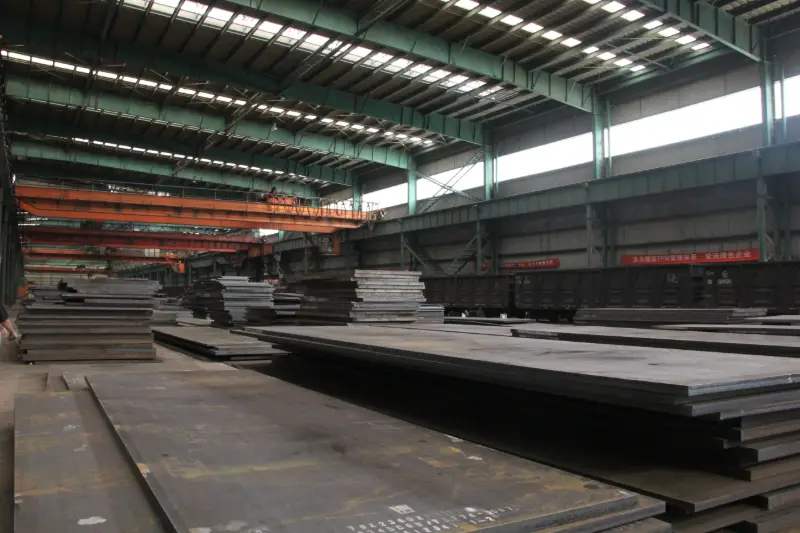
EN 10025-2 S420J0 Steel
EN10025-2 S420J0 High-Strength Structural Steel Plate – Properties & Equivalents
Comprehensive material data for EN10025-2 S420J0 carbon and low-alloy high-strength structural steel plate: chemical composition, mechanical and physical properties, equivalent standards, and application guidance.
Hot rolling, normalizing (N), thermomechanical rolling (M), cold forming, welding, machining
- Phone : +8618037372205
- Email : [email protected]
- WhatsApp: Contact via Whtsapp
- WeChat: +8618037372205
EN 10025-2 S420J0 Steel Introduction
EN10025-2 S420J0 is a weldable fine-grain structural steel with a minimum yield strength of 420 MPa at 16 mm thickness. It belongs to the European standard for hot-rolled products of structural steels, delivered in normalized or thermomechanically rolled condition. This grade guarantees Charpy impact energy of at least 27 J at 0 °C, making it suitable for moderately low-temperature service.
- High strength combined with good weldability and ductility
- Used in heavily loaded steel structures, bridges, and offshore platforms
- Available as plates, sections, bars, and wide flats
EN 10025-2 S420J0 Steel Chemical Composition
Typical ladle analysis limits according to EN 10025-2:2019 Table 4. For S420J0, grain-refining elements such as Al, Nb, V or Ti are added singly or in combination to achieve the required strength and toughness. Maximum contents of residual elements are also indicated.
| Element | Standard Value (max) % | Remarks |
|---|---|---|
| C | ≤0.22 (t≤16) / ≤0.22 (16 | For normalized or thermomechanical product; lower C may be used for better weldability |
| Mn | ≤1.70 | High Mn content helps strength and toughness |
| Si | ≤0.60 | Deoxidation element |
| P | ≤0.035 | Maximum content |
| S | ≤0.035 | Maximum content |
| N | ≤0.015 | Maximum; if sufficient N-binding elements are present, higher N may be allowed |
| Cu | ≤0.60 | Residual element; if specified as alloy, higher permitted |
| Al (total) | ≥0.020 | Minimum required or equivalent grain-refining effect |
| Nb | ≤0.05 | Optional microalloy, singly or in combination |
| V | ≤0.12 | Optional microalloy, singly or in combination |
| Ti | ≤0.05 | Optional microalloy, singly or in combination |
EN 10025-2 S420J0 Steel Thermal and Electrical Physical Properties
Typical physical properties for carbon-manganese structural steel at ambient temperature, unless stated otherwise. These values are not part of the direct product standard but are widely accepted reference data derived from EN 1993-1-1 and other sources for similar steel grades.
| Property | Typical Value | Unit | Test Conditions / Remarks |
|---|---|---|---|
| Density (ρ) | 7850 | kg/m³ | At 20°C |
| Modulus of elasticity (E) | 210 | GPa | At 20°C |
| Shear modulus (G) | ≈ 81 | GPa | Calculated from E and ν |
| Poisson's ratio (ν) | 0.3 | – | Ambient temperature |
| Thermal expansion coefficient (α) | 11.1 | 10⁻⁶/K | 20–100°C |
| Thermal expansion coefficient (α) | 12.1 | 10⁻⁶/K | 20–200°C |
| Thermal expansion coefficient (α) | 12.9 | 10⁻⁶/K | 20–300°C |
| Thermal conductivity (λ) | ≈ 52 | W/(m·K) | At 20°C |
| Thermal conductivity (λ) | ≈ 51 | W/(m·K) | At 100°C |
| Thermal conductivity (λ) | ≈ 44 | W/(m·K) | At 300°C |
| Specific heat capacity (c) | ≈ 460 | J/(kg·K) | 20–100°C |
| Electrical resistivity (ρ_e) | ≈ 0.22 | ×10⁻⁶ Ω·m | At 20°C |
EN 10025-2 S420J0 Steel Mechanical Properties
Room-temperature tensile and Charpy impact properties according to EN 10025-2:2019 Table 7 (longitudinal). Properties depend on thickness range and delivery condition. All values are minimum unless stated otherwise.
| Property | Standard Required Value | Unit | Test Conditions / Thickness Range |
|---|---|---|---|
| Yield strength (ReH) | 420 | MPa | t ≤ 16 mm |
| Yield strength (ReH) | 400 | MPa | 16 < t ≤ 40 mm |
| Yield strength (ReH) | 390 | MPa | 40 < t ≤ 63 mm |
| Yield strength (ReH) | 370 | MPa | 63 < t ≤ 80 mm |
| Yield strength (ReH) | 360 | MPa | 80 < t ≤ 100 mm |
| Yield strength (ReH) | 340 | MPa | 100 < t ≤ 150 mm |
| Tensile strength (Rm) | 520 – 680 | MPa | t ≤ 40 mm |
| Tensile strength (Rm) | 500 – 660 | MPa | 40 < t ≤ 100 mm |
| Tensile strength (Rm) | 480 – 620 | MPa | 100 < t ≤ 150 mm |
| Elongation (A) | ≥ 19 | % | t ≤ 40 mm, longitudinal, proportional test piece |
| Elongation (A) | ≥ 18 | % | 40 < t ≤ 100 mm |
| Elongation (A) | ≥ 17 | % | 100 < t ≤ 150 mm |
| Charpy impact (KV, 0°C) | ≥ 27 | J | Longitudinal, 10×10 mm² test piece |
| Bending (mandrel diameter) | 2t | – | t ≤ 16 mm, longitudinal, 180° bend |
| Bending (mandrel diameter) | 3t | – | 16 < t ≤ 100 mm, longitudinal, 180° bend |
| Bending (mandrel diameter) | 4t | – | 100 < t ≤ 150 mm, longitudinal, 180° bend |
EN 10025-2 S420J0 Steel Fully Equivalent Standards and Substitutable Grades
| Country/Region | Standard | Grade | Remarks |
|---|---|---|---|
| International (ISO) | ISO 630-2 | S420J0 | Identical technical requirements, aligned with EN 10025-2 |
| EU / UK | BS EN 10025-2 | S420J0 | British adoption of EN standard |
| China | GB/T 1591 | Q420C | Yield ≥420MPa, 0°C impact ≥27J, comparable chemistry with microalloying (Nb, V, Ti) |
| Germany | DIN EN 10025-2 | S420J0 | German version, identical |
| France | NF EN 10025-2 / NF A 35-501 | E420C | Historical national designation for equivalent grade |
EN 10025-2 S420J0 Steel Application Introduction
S420J0 is designed for heavy structural applications where weight savings, high strength, and reliable impact toughness at 0°C are essential. It is widely used in welded structures subjected to static and dynamic loads. The fine-grain structure ensures good ductility and weldability, compatible with common welding processes when proper preheat and interpass control are applied.
Product Applications: Welded steel frameworks for industrial and commercial buildings, Bridge girders, box girders, and orthotropic decks, Offshore platform topsides and jacket structures, Mobile crane telescopic booms and outriggers, Heavy stamped and formed components for mining equipment, Structural hollow sections (circular, rectangular) for architectural and structural use
Processed into products: Columns, beams, and truss members in building systems, Boom sections and lattice masts for crawler cranes, Flanges and webs of plate girders, Base frames and slew rings for heavy excavators, Support brackets and stiffeners in pressure vessels, Connection nodes and gusset plates in tubular structures, Railroad bridge crossbeams and diaphragms
Application industries: Civil engineering and construction (high-rise buildings, stadiums, bridges), Offshore and marine (platform decks, helidecks, subsea templates), Heavy machinery (crane booms, excavator arms, bulldozer frames), Transportation (railway bridges, wagon bodies, truck chassis), Pressure vessel and storage tank fabrication (with supplementary requirements), Energy (wind turbine towers, penstocks)
EN 10025-2 S420J0 Steel Similar or Substitutional Material Recommendations
| Country/Region | Standard | Grade | Remarks |
|---|---|---|---|
| EU | EN 10025-3 | S420N / S420NL | Normalized fine-grain steel, impact down to -20°C / -50°C, slightly different delivery condition |
| EU | EN 10149-2 | S420MC | Thermomechanically rolled high-strength steel for cold forming, min yield 420MPa, typical for sheet/coil |
| USA | ASTM A572 / A572M | Grade 60 [415] (Type 1 with CVN) | Min yield 415MPa, optional 0°C impact; strength slightly lower, chemical difference but acceptable substitution often |
| Japan | JIS G3106 | SM490B / SM490C | Min yield 325–365MPa, lower strength but good weldability; not direct substitute but potential for less demanding applications |
| India | IS 2062 | E420C | Yield ≥420MPa, 0°C impact, similar microalloy concept; may replace S420J0 in Indian market |
Notes:
- Weldability: Low carbon equivalent (CEV) design in S420J0 ensures good weldability without excessive preheat, but welding procedure should follow EN 1011-2 recommendations. Typically CEV ≤ 0.45 (typical value for thickness ≤ 16 mm).
- Cold formability: Suitable for cold bending with inside radius ≥ 2t, provided edges are free from defects. Hot-dip galvanizing is possible with adequate surface preparation.
- Inspection documents: Delivered with EN 10204 inspection certificate 3.1 as standard; 3.2 upon agreement.
- Tolerances: Thickness tolerances according to EN 10029; flatness according to EN 10029 or EN 10163-2.
- Impact test: Unless otherwise agreed, Charpy impact test is performed on longitudinal specimens; transverse testing requires special order.
- Share



