
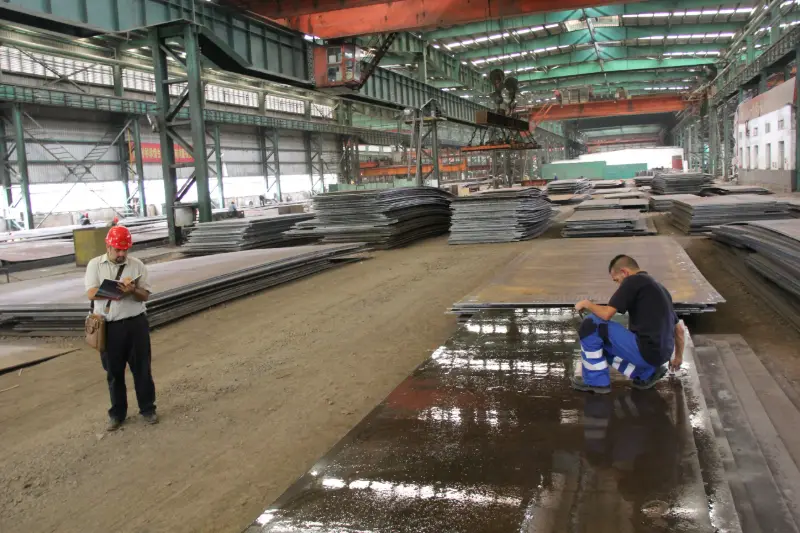
ASME SA656 Grade 50 High-Strength Low-Alloy Steel Plate
ASME SA656 Grade 50 High-Strength Low-Alloy Steel Plate for Pressure Vessels & Structural Use
Analysis of chemical composition, mechanical and physical properties, international equivalents and applications of ASME SA656 Grade 50 carbon and low-alloy high-strength steel plate
Hot rolling, controlled rolling, thermomechanical rolling, normalizing, cutting, cold forming, welding, machining
- Phone : +8618037372205
- Email : [email protected]
- WhatsApp: Contact via Whtsapp
- WeChat: +8618037372205
ASME SA656 Grade 50 High-Strength Low-Alloy Steel Plate Introduction
ASME SA656 Grade 50 (SA656GR50) is a hot-rolled, high-strength low-alloy (HSLA) carbon steel plate with improved formability, adopted from ASTM A656/A656M for use in pressure vessel and structural fabrication under the ASME Boiler and Pressure Vessel Code. It offers a minimum yield strength of 50 ksi (345 MPa) and tensile strength of 70 ksi (485 MPa), combined with excellent weldability and notch toughness when specified.
Key characteristics:
- Microalloyed with niobium, vanadium or titanium for grain refinement and precipitation strengthening
- Low carbon equivalent (typically ≤0.40) ensures good cold forming and welding performance
- Available in thicknesses up to 1.5 in. (38 mm) in as-rolled, controlled-rolled or normalized condition
- Suitable for moderate-temperature service and dynamic loading
ASME SA656 Grade 50 High-Strength Low-Alloy Steel Plate Chemical Composition per ASME SA-656/SA-656M
The steel is low-carbon, microalloyed with one or more of niobium (columbium), vanadium, titanium, etc., to achieve the required strength and formability. Maximum limits are specified; actual contents are adjusted by the manufacturer to meet mechanical properties and weldability requirements. Fine grain practice is mandatory, typically achieved through microalloy additions.
| Element | Maximum Limit (wt%) | Remarks |
|---|---|---|
| Carbon (C) | 0.18 | Max. |
| Manganese (Mn) | 1.60 | Max. |
| Phosphorus (P) | 0.025 | Max. |
| Sulfur (S) | 0.035 | Max. |
| Silicon (Si) | 0.60 | Max. |
| Niobium (Nb, Cb) | By agreement | Optional microalloying element; typical addition 0.005-0.05% |
| Vanadium (V) | By agreement | Optional; typical 0.01-0.15% |
| Titanium (Ti) | By agreement | Optional; typical 0.005-0.05% |
| Other microalloys (Mo, Ni, Cr, Cu) | By agreement | May be added for specific properties |
ASME SA656 Grade 50 High-Strength Low-Alloy Steel Plate Thermal, Electrical and Physical Properties
These values are not part of the standard specification but represent typical engineering data for high-strength low-alloy carbon-manganese steel of this grade. Actual values may vary slightly with precise chemistry and processing. They are suitable for design calculations and material comparison.
| Property | Typical Value | Unit | Test Condition / Temperature |
|---|---|---|---|
| Density (ρ) | 7.85 | g/cm³ | At 20 °C |
| Modulus of Elasticity (E) | 205 | GPa | At 20 °C |
| Shear Modulus (G) | 80 | GPa | At 20 °C |
| Poisson's Ratio (ν) | 0.30 | - | - |
| Thermal Expansion Coefficient (α) | 11.7 | µm/m·°C | 20 - 100 °C |
| Thermal Expansion Coefficient (α) | 12.2 | µm/m·°C | 20 - 200 °C |
| Thermal Expansion Coefficient (α) | 12.8 | µm/m·°C | 20 - 300 °C |
| Thermal Conductivity (λ) | 51.9 | W/m·K | At 20 °C |
| Thermal Conductivity (λ) | 48.1 | W/m·K | At 100 °C |
| Thermal Conductivity (λ) | 44.8 | W/m·K | At 200 °C |
| Specific Heat Capacity (c) | 470 | J/kg·°C | At 20 °C |
| Electrical Resistivity (ρe) | 0.23 | μΩ·m | At 20 °C |
ASME SA656 Grade 50 High-Strength Low-Alloy Steel Plate Mechanical Properties per ASME SA-656/SA-656M
Tensile properties are tested on full-thickness specimens or standard round specimens. Yield strength and tensile strength apply to all thicknesses; elongation requirements vary with plate thickness and specimen gauge length (50 mm or 200 mm). A 180° cold bend test is a fabricability requirement, not a mandatory test, but plates shall be capable of bending without cracking under the stated conditions.
| Property | Required Value | Unit | Test Condition |
|---|---|---|---|
| Yield Strength (ReH) | ≥ 345 | MPa | All thicknesses |
| Tensile Strength (Rm) | ≥ 485 | MPa | All thicknesses |
| Elongation (A) in 50 mm gauge | ≥ 21 | % | Thickness 4.57 - 5.81 mm (0.180-0.229 in.) |
| Elongation (A) in 50 mm gauge | ≥ 22 | % | Thickness 5.84 - 6.32 mm (0.230-0.249 in.) |
| Elongation (A) in 50 mm gauge | ≥ 23 | % | Thickness 6.35 - 7.82 mm (0.250-0.308 in.) |
| Elongation (A) in 50 mm gauge | ≥ 24 | % | Thickness 7.85 - 9.50 mm (0.309-0.374 in.) |
| Elongation (A) in 200 mm gauge | ≥ 16 | % | Thickness 9.52 - 12.7 mm (0.375-0.499 in.) |
| Elongation (A) in 200 mm gauge | ≥ 14 | % | Thickness > 12.7 - 25.4 mm (0.500-0.999 in.) |
| Elongation (A) in 200 mm gauge | ≥ 12 | % | Thickness > 25.4 - 38.1 mm (1.000-1.499 in.) |
| Cold bend (180°) | No cracks outside bent portion | - | Bend pin dia. = 2t for t ≤ 12.7 mm; 3t for t > 12.7 - 25.4 mm |
ASME SA656 Grade 50 High-Strength Low-Alloy Steel Plate Exact Equivalent Material Standards and Substitute Designations
| Country / Region | Standard | Designation / Grade | Remarks |
|---|---|---|---|
| USA | ASTM A656/A656M | Grade 50 | Identical technical requirements; ASME SA656 is derived from ASTM A656 |
| USA | ASME SA-656/SA-656M | Grade 50 (SA656GR50) | Primary designation; used for pressure vessels under ASME BPVC |
ASME SA656 Grade 50 High-Strength Low-Alloy Steel Plate Application Introduction
ASME SA656 Grade 50 is designed for applications requiring high strength, good formability, and reliable weldability. It is extensively used in both pressure-retaining and structural components where moderate service temperatures and dynamic loading are present.
Product Applications: Pressure vessels and autoclaves, Water/chemical storage tanks, Heavy-duty truck frames and cross-members, Crane booms and lifting equipment, Excavator buckets and arms, Welded structural sections and columns, Cold-formed profiles and tubular products
Processed into products: Boiler drums and steam separators, Heat exchanger shells, Tank shell plates and bottom plates, Chassis rails and reinforcements, Support brackets and gussets, Flanges and stiffeners, Agricultural tillage tools (plow beams, subsoiler shanks)
Application industries: Pressure vessel and boiler fabrication, Storage tank (API 650, ASME VIII-1) construction, Heavy machinery and earthmoving equipment, Truck and trailer chassis manufacturing, Structural engineering (buildings, bridges), Shipbuilding and offshore structures, Railway rolling stock
ASME SA656 Grade 50 High-Strength Low-Alloy Steel Plate Similar/Comparable Materials with Close Properties
| Country / Region | Standard | Designation / Grade | Remarks |
|---|---|---|---|
| USA | ASTM A572/A572M | Grade 50 [345] | Similar yield strength (345 MPa), but Mn and C limits differ; slightly lower formability than A656 |
| USA | ASTM A709/A709M | Grade 50 | Structural steel for bridges; chemistry and mechanical properties overlap with A656 Grade 50 |
| EU | EN 10025-2 | S355JR, S355J0, S355J2 | 355 MPa minimum yield, similar carbon-manganese HSLA steel; impact properties vary |
| Japan | JIS G3106 | SM490A, SM490B, SM490C | Yield 325-365 MPa depending on thickness; used for welded structures |
| China | GB/T 1591-2018 | Q355B, Q355C, Q355D | Replaces Q345; minimum yield 355 MPa, good weldability, widely equivalent in structural use |
| International | ISO 4950-2 | FeE355 | High yield strength structural steel (355 MPa), similar application fields |
Notes:
Supplementary Requirements: ASME SA656 Grade 50 may be ordered with additional tests such as Charpy V-notch impact testing (S5), vacuum carbon-deoxidized steel (S1), or product analysis (S2). The steel is typically supplied in the as-rolled condition unless otherwise specified; thermomechanical rolling or normalizing can enhance toughness and uniformity.
Welding: Preheating is generally not required for thicknesses up to 25 mm if ambient temperature is above 5°C; low-hydrogen electrodes/practices are recommended. The material has a carbon equivalent typically ≤0.40, making it readily weldable by all standard arc processes.
Forming: The improved formability allows cold bending to tight radii; hot forming should be carried out at temperatures between 850–1000°C followed by normalizing if properties are to be fully restored.
- Share



