
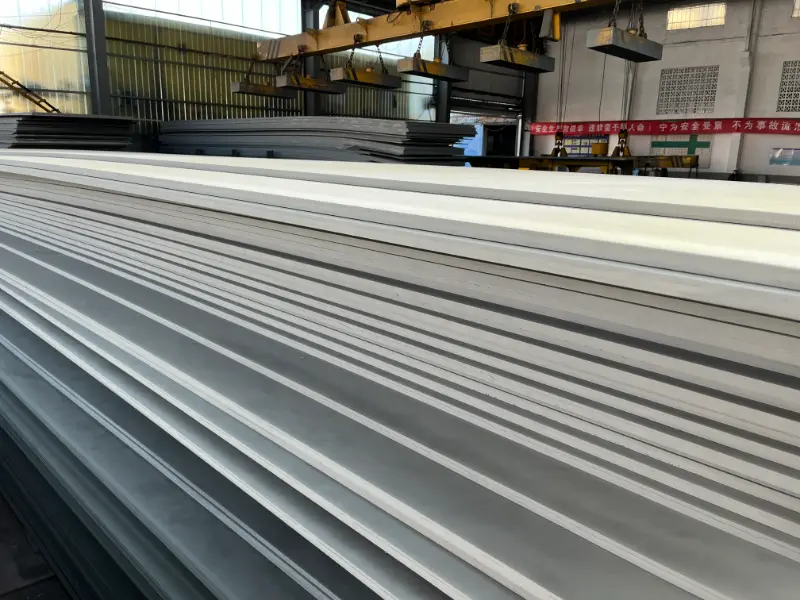
ASME SA633 Grade E (SA633GrE) Carbon Steel Plate
ASME SA633 Grade E (SA633GrE) Carbon & Low-Alloy High-Strength Steel Plate for Structural Engineering
Comprehensive technical data for ASME SA633 Grade E low-alloy steel: chemical composition, mechanical properties, thermal-electrical physical properties, international equivalents, and application guide.
Normalized, weldable, formable, suitable for cold bending, flame cutting, and machining after delivery.
- Phone : +8618037372205
- Email : [email protected]
- WhatsApp: Contact via Whtsapp
- WeChat: +8618037372205
ASME SA633 Grade E Carbon Steel Plate Introduction
ASME SA633 Grade E (SA633GrE) is a normalized low-alloy high-strength structural steel plate specifically designed for welded construction in bridges, buildings, and heavy machinery where superior notch toughness is essential. It combines a minimum yield strength of 415 MPa (for thicknesses up to 40 mm) with excellent weldability and formability. Key features:
- Microalloyed with vanadium and/or niobium for grain refinement and precipitation strengthening, enabling high strength without compromising toughness.
- Delivered in normalized condition, ensuring uniform mechanical properties and fine-grained microstructure.
- Excellent low-temperature impact toughness can be ordered via supplementary requirements (e.g., Charpy V-notch ≥27 J at -20°C).
- Available in plates typically up to 100 mm thick, with adjusted strength levels for thicker sections.
This material is widely adopted for critical load-bearing components subjected to dynamic and static loads.
ASME SA633 Grade E Carbon Steel Plate Chemical Composition as per ASME SA633/SA633M
The steel is a low-carbon, manganese-vanadium/niobium microalloyed grade. Sulfur and phosphorus are strictly controlled to enhance cleanliness and toughness. Copper may be specified when improved atmospheric corrosion resistance is required.
- Carbon is limited to ensure good weldability.
- Manganese provides solid-solution strengthening and increases hardenability.
- Vanadium and niobium refine grain size and provide precipitation strengthening.
| Element | Content (%) | Remarks |
|---|---|---|
| Carbon (C) | 0.22 max | Essential for strength; low max. for weldability |
| Manganese (Mn) | 1.15 - 1.50 | Primary strengthener and deoxidizer |
| Phosphorus (P) | 0.025 max | Residual element; low level for toughness |
| Sulfur (S) | 0.025 max | Residual element; minimized for ductility |
| Silicon (Si) | 0.15 - 0.50 | Deoxidizer and strength contributor |
| Copper (Cu)* | 0.35 max | Optional when corrosion resistance is required |
| Nickel (Ni) | 0.25 max | Residual element |
| Chromium (Cr) | 0.25 max | Residual element |
| Molybdenum (Mo) | 0.08 max | Residual element |
| Vanadium (V) | 0.04 - 0.11 | Grain refiner and precipitation strengthener |
| Niobium (Nb) | 0.01 - 0.05 | Alternative/combined microalloying element (columbium) |
ASME SA633 Grade E Carbon Steel Plate Thermal and Electrical Physical Properties
The following values are representative for normalized carbon-manganese-vanadium steel similar to SA633 Grade E. Properties vary slightly with temperature and composition. These data are suitable for engineering calculations, thermal stress analysis, and electrical applications.
| Property | Typical Value | Unit | Condition / Remarks |
|---|---|---|---|
| Density (ρ) | 7850 | kg/m³ | At room temperature |
| Elastic Modulus (E) | 205 | GPa | Tension, room temperature |
| Shear Modulus (G) | 80 | GPa | Calculated from E and ν |
| Poisson's Ratio (ν) | 0.3 | – | Elastic range, room temperature |
| Thermal Expansion Coefficient (α) | 12.1 × 10⁻⁶ /K | 1/K | Range 20°C to 100°C |
| Thermal Conductivity (λ) | 52 | W/(m·K) | At 20°C |
| Specific Heat Capacity | 475 | J/(kg·K) | At 20°C–100°C |
| Electrical Resistivity (ρ_e) | 0.16 | µΩ·m | At 20°C |
ASME SA633 Grade E Carbon Steel Plate Mechanical Properties – Transverse Specimens
Properties are valid for normalized plates. Yield and tensile strengths are thickness-dependent. Elongation is measured on a 200 mm (8 in.) or 50 mm (2 in.) gauge length. Bend test capability is inherent; specific bend diameters may apply when ordered.
- Charpy impact toughness (when required) is normally specified per Supplementary Requirement S5, with common values of 27 J at -20°C for Grade E.
- Through-thickness properties (Z-direction) can be ordered per Supplementary Requirement S2.
| Property | Standard Requirement Value | Unit | Condition / Remarks |
|---|---|---|---|
| Yield Strength (ReH) (thk ≤ 40 mm) | ≥ 415 | MPa | Normalized, transverse specimen |
| Yield Strength (ReH) (40 < thk ≤ 65 mm) | ≥ 380 | MPa | Normalized, transverse specimen |
| Yield Strength (ReH) (65 < thk ≤ 100 mm) | ≥ 345 | MPa | Normalized, transverse specimen |
| Tensile Strength (Rm) (thk ≤ 40 mm) | 550 – 690 | MPa | Normalized, transverse specimen |
| Tensile Strength (Rm) (40 < thk ≤ 65 mm) | 515 – 655 | MPa | Normalized, transverse specimen |
| Tensile Strength (Rm) (65 < thk ≤ 100 mm) | 485 – 620 | MPa | Normalized, transverse specimen |
| Elongation in 200 mm (8 in.) (all thicknesses) | ≥ 18 | % | Transverse specimen |
| Elongation in 50 mm (2 in.) (all thicknesses) | ≥ 23 | % | Transverse specimen |
| Bend Test (typical diameters when specified) | 2t (t ≤ 20 mm); 2.5t (20 < t ≤ 25 mm); 3t (t > 25 mm) | – | 180° bend, no cracks; optional supplementary requirement |
| Charpy V-notch Impact Energy (when SR S5 applied) | ≥ 27 (typical minimum) | J | At -20°C (or other agreed temperature), longitudinal or transverse |
ASME SA633 Grade E Carbon Steel Plate Identical or Fully Equivalent Standard Grades
| Country/Region | Standard | Grade | Remarks |
|---|---|---|---|
| USA | ASTM A633/A633M | Grade E | Identical to ASME SA633 Gr.E |
| Europe (EN) | EN 10025-3:2019 | S420N (1.8902) | Normalized, fine grain steel. Mn and microalloying differ slightly; yield ≥420 MPa for t≤40 mm. |
| Germany (DIN) | DIN 17102 | StE420 | Historical equivalent, comparable chemical and strength, often substituted by S420N today. |
| International (ISO) | ISO 4950-2:1995 | E420DD | High yield strength flat products, normalized, very similar chemistry and properties. |
| Japan (JIS) | JIS G3106 (2008) | SM490C | Applicable when low temperature impact toughness required (27J at 0°C). Strength slightly lower for thinner plates; check thickness. |
ASME SA633 Grade E Carbon Steel Plate Application Introduction
ASME SA633 Grade E is intended for welded load-bearing structures where a combination of high strength, good toughness, and reliable weldability is required.
- Typical service temperatures down to -20°C when Charpy supplementary requirement S5 is invoked.
- Used extensively in heavy construction and transportation fields.
- Can be designed according to AISC, Eurocode, or other international structural design codes.
Product Applications: Welded built-up bridge girders and box sections, Structural columns and beams for industrial buildings, Offshore topside module main frames and transition pieces, Crane booms, jibs, and crawler frames, Heavy-duty truck chassis and trailer beams, Earthmoving equipment structural components, Wind turbine tower flanges and shell plates (in thicknesses up to 100 mm)
Processed into products: Flanges and webs of plate girders, Stiffeners, splice plates, and gusset plates, Base plates and moment connections, Welded box sections for columns and truss chords, Load-bearing pads and anchor brackets, Reinforcement pads for nozzles and openings in pressure vessels
Application industries: Bridge construction (road, railway, pedestrian bridges), Building and civil engineering (high-rise columns, heavy trusses), Offshore and marine structures (platform modules, deck beams), Mining and earthmoving equipment (dump truck frames, shovel booms), Heavy machinery and crane manufacturing (telescopic booms, lattice structures), Pressure vessel and storage tank construction (when toughness requirements governed by ASME BPVC Sec. VIII)
ASME SA633 Grade E Carbon Steel Plate Similar or Closely Related Structural Steel Grades
| Country/Region | Standard | Grade | Remarks |
|---|---|---|---|
| USA | ASTM A572/A572M | Grade 60 [415] (Type 5) | As-rolled or normalized; may contain Nb/V. Yield ≥415 MPa for ≤32 mm. Not all types guarantee same toughness. |
| USA | ASTM A573/A573M | Grade 70 | Carbon-manganese-silicon steel, improved toughness. Yield 290 MPa, significantly lower strength; not a direct substitute. |
| China (GB/T) | GB/T 1591-2018 | Q420D | Low alloy high strength structural steel, normalized or TMCP. Impact at -20°C available. Comparable strength with some composition differences. |
| Europe (EN) | EN 10025-3 | S420NL (1.8912) | Normalized, low-temperature impact (NL) at -50°C. Tougher variant of S420N, useful when higher impact properties are needed. |
| Europe (EN) | EN 10025-4 | S420M/ML (1.8825/1.8836) | Thermomechanical rolled. Similar strength, but different delivery condition; may require welding procedure adjustments. |
Notes:
Welding and Fabrication: SA633 Grade E possesses excellent weldability using common processes (SMAW, SAW, GMAW, FCAW). Low hydrogen practices and appropriate preheat/interpass temperatures are recommended, especially for thick sections (>40 mm). Post-weld heat treatment (PWHT) may be required according to the applicable construction code to relieve residual stresses. Heat Treatment: The steel is supplied in the normalized condition; it can be subjected to subsequent hot forming or stress-relieving without significant loss of properties. However, temperatures above the original normalizing temperature should be avoided. Inspection and Testing: Plates can be ordered with additional tests such as ultrasonic examination (ASME SA578/SA578M), through-thickness tensile testing (Z-quality per SA770/SA770M), and specific notch toughness requirements (Charpy V-notch at temperatures ranging from +20°C down to -50°C). Corrosion Protection: When copper is specified (0.20 min), the steel has improved atmospheric corrosion resistance, making it suitable for unpainted applications in some environments.
- Share



