
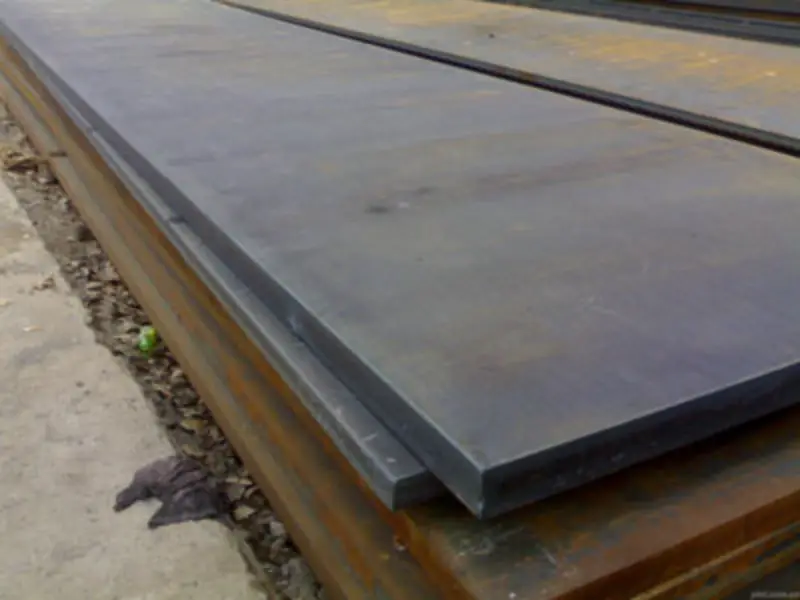
ASME SA633 Grade D (SA633GRD) Carbon and Low-Alloy High-Strength Steel Plate
ASME SA633 Grade D (SA633GRD) Normalized HSLA Steel Plate Data Sheet
Complete technical data for ASME SA633 Grade D high-strength low-alloy steel plate: chemical composition, mechanical and thermal properties, international equivalents, and application guidelines.
Normalizing, hot rolling, welding, cutting, cold forming, machining
- Phone : +8618037372205
- Email : [email protected]
- WhatsApp: Contact via Whtsapp
- WeChat: +8618037372205
ASME SA633 Grade D Carbon and Low-Alloy High-Strength Steel Plate Introduction
ASME SA633 Grade D (SA633GRD) is a normalized high-strength low-alloy (HSLA) structural steel plate intended for welded construction where superior notch toughness and strength are required at low ambient temperatures. Governed by the ASME Boiler and Pressure Vessel Code SA-633/SA-633M, this grade offers a minimum yield strength of 50 ksi (345 MPa) in thicknesses up to 2.5 in. (63.5 mm) and a tensile strength range of 70–90 ksi (485–620 MPa). The chemical composition is microalloyed with vanadium and niobium to promote fine grain structure and enhanced mechanical properties after normalizing. Typical applications include pressure vessels, bridges, heavy machinery, offshore platforms, and transport equipment. The steel is supplied in the normalized condition, ensuring uniform mechanical properties throughout the plate. It exhibits good weldability with appropriate procedures and can be formed and machined using standard practices for low-alloy steels.
ASME SA633 Grade D Carbon and Low-Alloy High-Strength Steel Plate Chemical Composition
The chemical requirements specified per ASME SA-633 Grade D are listed below, differentiated by product thickness. Two sets of limits apply: one for plates up to 1.5 in. (38.1 mm) thick and another for plates over 1.5 in. up to 2.5 in. (63.5 mm). All values are maximum unless a range is given. Residual elements such as copper, nickel, chromium, and molybdenum are controlled to preserve weldability and toughness.
| Element | Composition (≤ 1.5 in / 38.1 mm) | Composition (> 1.5 in to 2.5 in) | Notes |
|---|---|---|---|
| Carbon (C) | 0.20 max | 0.20 max | |
| Manganese (Mn) | 0.70–1.35 | 1.00–1.60 | Depending on thickness |
| Phosphorus (P) | 0.030 max | 0.030 max | |
| Sulfur (S) | 0.030 max | 0.030 max | |
| Silicon (Si) | 0.15–0.50 | 0.15–0.50 | |
| Copper (Cu) | 0.35 max | 0.35 max | |
| Nickel (Ni) | 0.25 max | 0.25 max | |
| Chromium (Cr) | 0.25 max | 0.25 max | |
| Molybdenum (Mo) | 0.08 max | 0.08 max | |
| Vanadium (V) | 0.01–0.08 | 0.02–0.12 | Grain refinement |
| Niobium (Nb/Cb) | 0.01–0.05 | 0.02–0.05 | Columbium |
| Nitrogen (N) | 0.03 max | 0.03 max | Residual |
ASME SA633 Grade D Carbon and Low-Alloy High-Strength Steel Plate Thermal and Electrical Physical Properties
The following physical properties are typical for normalized low-alloy HSLA steel of this class. They are not mandatory per the material standard but provide useful design data. Values are representative for room temperature unless otherwise noted.
| Property | Typical Value | Unit | Test Condition |
|---|---|---|---|
| Density (ρ) | 7.85 | g/cm³ | 20°C (68°F) |
| Elastic Modulus (E) | 205 | GPa | Tension, 20°C |
| Shear Modulus (G) | 80 | GPa | 20°C |
| Poisson's Ratio (ν) | 0.29 | – | – |
| Thermal Expansion Coefficient (α) | 11.7 | 10⁻⁶/K | 20–100°C (68–212°F) |
| Thermal Expansion Coefficient (α) | 12.5 | 10⁻⁶/K | 20–300°C (68–572°F) |
| Thermal Conductivity (λ) | 52 | W/(m·K) | 20°C |
| Specific Heat Capacity (c) | 460 | J/(kg·K) | 20°C |
| Electrical Resistivity (ρₑ) | 0.15 | µΩ·m | 20°C |
ASME SA633 Grade D Carbon and Low-Alloy High-Strength Steel Plate Mechanical Properties
Mechanical properties are determined on transverse test specimens taken from normalized plates. Values are minimum unless a range is given. Tensile test requirements vary with plate thickness. Charpy V-notch impact values are optional and depend on the supplementary requirement ordered; typical minimum average energy is 20 ft·lbf (27 J) at -20°F (-29°C) for standard applications.
| Property | Standard Requirement | Unit | Test Condition / Thickness |
|---|---|---|---|
| Yield Strength (ReH) | 345 min (50 ksi) | MPa (ksi) | Plates ≤ 2.5 in (63.5 mm) |
| Yield Strength (ReH) | 315 min (46 ksi) | MPa (ksi) | Plates 2.5–4 in (63.5–101.6 mm) |
| Tensile Strength (Rm) | 485–620 (70–90) | MPa (ksi) | All thicknesses |
| Elongation (A) in 8 in (200 mm) | 18 min | % | Plates 0.75 in (19 mm) and under |
| Elongation (A) in 2 in (50 mm) | 23 min | % | Plates over 0.75 in (19 mm) |
| Bend Test (Bend Diameter) | 1.5t | – | Thickness ≤ 0.75 in (19 mm) |
| Bend Test (Bend Diameter) | 2t | – | Thickness 0.75–1.5 in (19–38.1 mm) |
| Bend Test (Bend Diameter) | 2.5t | – | Thickness 1.5–2.5 in (38.1–63.5 mm) |
| Charpy V-notch (KV) (optional) | 27 min (20 ft·lbf) | J (ft·lbf) | Longitudinal specimens @ -20°F (-29°C) |
ASME SA633 Grade D Carbon and Low-Alloy High-Strength Steel Plate Fully Equivalent Material Standards and Replaceable Grades
| Country/Region | Standard | Grade | Remarks |
|---|---|---|---|
| USA | ASTM A633/A633M | Grade D | Identical chemistry and mechanical properties; direct equivalent. |
| USA | ASME SA-633/SA-633M | Grade D | Same as the subject standard (for pressure vessel applications). |
ASME SA633 Grade D Carbon and Low-Alloy High-Strength Steel Plate Application Introduction
ASME SA633 Grade D is designed for heavy welded structural components requiring high strength, good low-temperature toughness, and resistance to brittle fracture. Typical industries and applications include:
Product Applications: Welded plate girders for bridges, Pressure vessel shells and heads, Jack-up rig legs and offshore nodes, Excavator booms and crane bases, Rail car frames and bolster plates, Truck frames and trailer components, Structural columns and beams in high-rise buildings
Processed into products: Flanges and webs of built-up members, Stiffened panels and bulkheads, Precision cut and welded parts for machinery, Cold-formed channels and angles (suitable thicknesses), Machined base plates and mounting brackets, Transition pieces in tower cranes, Bolted and welded connections requiring high bearing strength
Application industries: Pressure Vessel and Boiler Fabrication, Bridge Construction, Offshore Oil and Gas Platforms, Heavy Machinery and Mining Equipment, Railroad Cars and Locomotive Components, Construction and Earthmoving Equipment, Storage Tanks and Hoppers
ASME SA633 Grade D Carbon and Low-Alloy High-Strength Steel Plate Closely Similar / Alternative Material Recommendations
| Country/Region | Standard | Grade | Remarks |
|---|---|---|---|
| European Union | EN 10025-3 | S355N | Normalized fine-grain steel with minimum 355 MPa yield; similar weldable structural material. |
| European Union | EN 10025-3 | S355NL | Low-temperature notch toughness version; suitable for comparable structural applications. |
| Japan | JIS G3106 | SM490B | High-strength welded structural steel with minimum 490 MPa tensile; used in similar applications. |
| International | ISO 4950-2 | E355DD | High yield strength structural steel plates; normalized or TMCP; close mechanical match. |
| Canada | CSA G40.21 | 350W | Structural quality steel; 350 MPa yield, widely used in bridges and buildings; not identical but commonly cross-referenced. |
Notes:
- For improved atmospheric corrosion resistance, consider copper-modified grades or supplementary coatings.
- Weldability is generally good with low-hydrogen practices; preheat may be required based on thickness and diffusible hydrogen control.
- Post-weld heat treatment (PWHT) can be applied, but the normalizing treatment already provides a fine-grained structure; verify toughness requirements after PWHT.
- Charpy impact values are normally specified as per project requirements; standard tests at -20°F (-29°C) are common for bridge and offshore applications.
- Plates can be ultrasonically tested to SA-578 or SA-435 for internal soundness when specified.
- Thickness range typically supplied is 3/16 in (4.8 mm) to 4 in (101.6 mm), subject to mill capabilities.
- Share



