
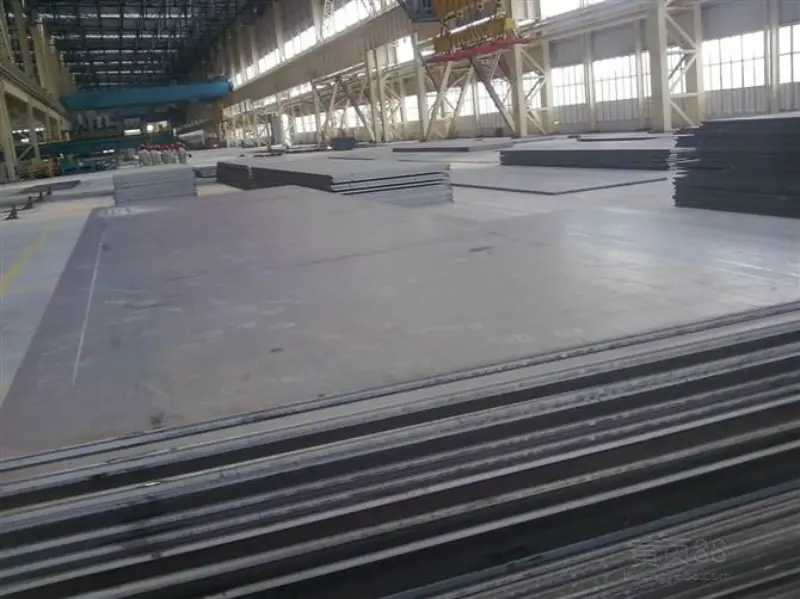
ASME SA633 Grade C High-Strength Low-Alloy Steel Plate
ASME SA633 Grade C High-Strength Low-Alloy Steel Plate for Pressure Vessels & Structural Use
ASME SA633 Grade C (SA633GRC) is a normalized high-strength low-alloy structural steel plate with minimum yield strength of 345 MPa (50 ksi), excellent notch toughness, and good weldability. Ideal for low-temperature pressure vessels, bridges, and heavy machinery.
Hot rolling followed by normalizing; further processing includes cutting, milling, drilling, bending, welding, and machining.
- Phone : +8618037372205
- Email : [email protected]
- WhatsApp: Contact via Whtsapp
- WeChat: +8618037372205
ASME SA633 Grade C High-Strength Low-Alloy Steel Plate Introduction
ASME SA633 Grade C (SA633GRC) is a carbon and low-alloy high-strength structural steel plate produced under the ASME SA-633/SA-633M specification. It is supplied in the normalized condition, which refines the grain structure, ensuring excellent notch toughness, especially at low temperatures down to -50 °C (-58 °F) when tested. The steel is fully killed and made to fine grain practice, often microalloyed with niobium, vanadium, or a combination of both. Typical chemical composition features a moderate carbon content (≤0.20%) and a manganese range of 1.15–1.50%, giving the plate a good balance of strength, ductility, and weldability. Minimum yield strength is 345 MPa (50 ksi) in thicknesses up to 100 mm, and tensile strength ranges from 485 to 620 MPa (70–90 ksi). With an elongation of at least 23% in 50 mm gauge length, the material is highly formable and suitable for cold bending operations. SA633GRC is widely used in the fabrication of pressure vessels, storage tanks, bridge structures, offshore platforms, and heavy-duty machinery operating at ambient and moderately low temperatures. Its combination of strength, toughness, and atmospheric corrosion resistance makes it a reliable choice for welded constructions in civil engineering, shipbuilding, and energy sectors. The steel can be further processed by cutting, machining, drilling, and welding without significant loss of mechanical properties, provided proper welding procedures are followed.
ASME SA633 Grade C High-Strength Low-Alloy Steel Plate Chemical Composition
Chemical composition limits as per ASME SA-633/SA-633M for Grade C. The steel is fully killed and fine grain; microalloying elements such as niobium (columbium) and vanadium may be added singly or in combination to meet strength and toughness requirements. Silicon is added for deoxidation. Low phosphorus and sulfur levels enhance notch toughness. Note: For product analysis, permissible variations apply as given in the standard.
| Element | Composition (%) | Remarks |
|---|---|---|
| Carbon (C) | ≤ 0.20 | Ladle analysis; max applicable to plates ≤ 4 in. (100 mm) thick |
| Manganese (Mn) | 1.15 – 1.50 | For all thicknesses; acts as strength enhancer and deoxidizer |
| Phosphorus (P) | ≤ 0.035 | Max. for heat analysis; lower values improve toughness |
| Sulfur (S) | ≤ 0.040 | Max. for heat analysis; controlled for formability and toughness |
| Silicon (Si) | 0.15 – 0.50 | Deoxidizing element; contributes to strength |
| Copper (Cu) | ≤ 0.35 (if specified) | Optional; may be reported if intentionally added for atmospheric corrosion resistance |
| Nickel (Ni) | ≤ 0.25 | Residual or unspecified addition |
| Chromium (Cr) | ≤ 0.25 | Residual or unspecified addition |
| Molybdenum (Mo) | ≤ 0.08 | Residual or unspecified addition |
| Vanadium (V) | 0.01 – 0.08 | Optional microalloying; used to refine grain and enhance strength |
| Columbium (Nb/Cb) | 0.01 – 0.05 | Optional microalloying; grain refinement and precipitation hardening |
ASME SA633 Grade C High-Strength Low-Alloy Steel Plate Thermal and Electrical Properties
Physical properties are not mandated by ASME SA-633/SA-633M but are provided here as typical values for normalized carbon-manganese high-strength low-alloy steel. These data are derived from published literature and typical metal handbooks for similar compositions. They serve as a useful guide for design calculations involving thermal expansion, heat transfer, and electrical resistivity. Actual values may vary slightly with production conditions and specific microalloying.
| Property | Typical Value | Unit | Test Conditions / Remarks |
|---|---|---|---|
| Density (ρ) | 7.85 | g/cm³ | Room temperature (20 °C) |
| Modulus of Elasticity (E) | 205 | GPa | Tension, at room temperature |
| Shear Modulus (G) | 80 | GPa | Calculated from E and ν, at room temperature |
| Poisson's Ratio (ν) | 0.29 – 0.30 | — | Typical range for structural steels |
| Thermal Expansion Coefficient (α) | 11.7 – 12.5 | µm/m·°C | From 20 °C to 100 °C; average value 12.0 µm/m·°C |
| Thermal Expansion Coefficient (α) | 12.5 – 13.2 | µm/m·°C | From 20 °C to 200 °C |
| Thermal Expansion Coefficient (α) | 13.5 – 14.2 | µm/m·°C | From 20 °C to 300 °C |
| Thermal Conductivity (λ) | 48 – 52 | W/m·K | At 20 °C |
| Thermal Conductivity (λ) | 45 – 48 | W/m·K | At 100 °C |
| Specific Heat Capacity (cp) | 450 – 490 | J/kg·K | At 20 °C; average ~470 J/kg·K |
| Electrical Resistivity (ρe) | 0.18 – 0.22 | µΩ·m | At 20 °C; typical for low-alloy steel |
ASME SA633 Grade C High-Strength Low-Alloy Steel Plate Mechanical Properties
Mechanical properties as required by ASME SA-633/SA-633M for Grade C plates in the normalized condition. Tensile properties are valid for longitudinal or transverse direction. Yield strength determination can be by 0.2% offset or under-load method. Elongation values are given for different gauge lengths. Charpy V-notch impact tests (if specified) are conducted at the designated temperature, typically -50 °F (-46 °C) or lower. Bend test diameters are based on thickness and are satisfactory without cracking. All values are minimum, except tensile strength given as range, and are typical for thicknesses up to 4 in. (100 mm).
| Property | Specified Value | Unit | Test Conditions / Remarks |
|---|---|---|---|
| Tensile Strength, Rm | 485 – 620 | MPa | For plates ≤ 4 in. (100 mm); transverse specimens |
| Tensile Strength, Rm | 70 – 90 | ksi | For plates ≤ 4 in. (100 mm); transverse specimens |
| Yield Strength, ReH (0.2% offset) | ≥ 345 | MPa | Minimum for thickness ≤ 4 in. (100 mm) |
| Yield Strength, ReH (0.2% offset) | ≥ 50 | ksi | Minimum for thickness ≤ 4 in. (100 mm) |
| Elongation, A (200 mm / 8 in.) | ≥ 18 | % | For plates ≤ 3/4 in. (20 mm) thick; longitudinal |
| Elongation, A (200 mm / 8 in.) | ≥ 18 | % | For plates > 3/4 in. to 2 in. (20–50 mm) thick; longitudinal |
| Elongation, A (200 mm / 8 in.) | ≥ 18 | % | For plates > 2 in. to 4 in. (50–100 mm) thick; longitudinal |
| Elongation, A (50 mm / 2 in.) | ≥ 23 | % | For plates ≤ 4 in. (100 mm); longitudinal |
| Elongation, A (50 mm / 2 in.) | ≥ 23 | % | For plates ≤ 4 in. (100 mm); transverse (as agreed) |
| Bend Test (bend diameter) | 180° flat | Diameter = 2½ × thickness for plates ≤ 1 in. (25 mm); no cracks | |
| Bend Test (bend diameter) | 180° flat | Diameter = 3 × thickness for plates > 1 in. (25 mm); no cracks | |
| Charpy V-notch Impact Energy | ≥ 20 (avg.) @ -50 °F (-46 °C) | ft·lbf | Three specimen average, minimum single value 15 ft·lbf; longitudinal; only if supplemental requirement is specified |
| Charpy V-notch Impact Energy | ≥ 27 (avg.) @ -50 °F (-46 °C) | J | Three specimen average, minimum single value 20 J; longitudinal; optional |
| Hardness | Not specified | HBW | Typically around 140–190 HBW; check with supplier |
ASME SA633 Grade C High-Strength Low-Alloy Steel Plate Full Equivalents: Global Standards and Substitutable Grades
| Country/Region | Standard | Designation/Grade | Remarks |
|---|---|---|---|
| United States | ASTM A633/A633M | Grade C | Identical chemical and mechanical requirements; produced to ASTM specification |
| International | ISO 630-2:2021 | E345C | Normalized structural steel; minimum YS 345 MPa; Mn content 0.50–1.50; closest ISO equivalent |
| European Union | EN 10025-3:2019 | S355NL | Normalized low-temperature steel; YS min 355 MPa; TS 470–630 MPa; similar impact toughness at -50 °C; slight strength advantage |
| China | GB/T 1591-2018 | Q345NE | Normalized high-strength structural steel; YS min 345 MPa (≤16 mm); TN requiring -40 °C impact; nearest equivalent |
| Japan | JIS G3106:2015 | SM490YB | Normalized; YS ≥ 365 MPa for thickness ≤ 16 mm; tensile 490–610 MPa; often used in welded structures; composition similar but Mn lower |
| India | IS 2062:2011 | E350 C (Normalized) | Equivalent normalized grade; YS 350 MPa; TS 490–590 MPa; Charpy at -40 °C; suitable alternative |
ASME SA633 Grade C High-Strength Low-Alloy Steel Plate Application Introduction
ASME SA633 Grade C plates are engineered for welded, riveted, or bolted construction of structures requiring high strength and excellent low-temperature notch toughness. The normalized microstructure ensures uniform mechanical properties across thick sections. The steel is readily weldable via common methods (SMAW, SAW, GMAW, FCAW) using low-hydrogen electrodes and appropriate preheat/interpass controls. Applications range from static and dynamic loading in construction to pressure containment in industrial equipment.
Product Applications: Pressure vessels for liquefied gas storage (LPG, LNG, ethylene), Water and oil storage tanks (API 650 compliant), Highway and railway bridge girders, Offshore platform structural decks, Mining truck bodies and excavator buckets, Wind turbine tower flanges and shells, Heavy lift crane booms, Industrial boiler drums and headers, Ship longitudinal and transverse frames
Processed into products: Vessel shell plates and heads, Welded beams and box columns, Stiffeners and gusset plates, Base plates and bearing pads, Spherical tank segments, Boom and arm sections for excavators, Thick-walled tubular joints, Skid-mounted equipment frames, Flanges and manhole covers, Railcar center sills
Application industries: Pressure Vessel and Tank Fabrication: Petrochemical, LNG, and chemical storage spheres and vessels operating at low ambient temperatures., Bridge and Infrastructure Construction: Girder webs and flanges, truss members, orthotropic deck plates exposed to cold climates., Offshore and Marine: Jacket legs, topside modules, crane pedestals, and heavy lift structures., Heavy Machinery and Mining: Boom arms, chassis, loading buckets, vibratory equipment frames requiring high fatigue resistance., Wind Energy: Tower sections and transition pieces where cold fracture toughness is required., Shipbuilding (structural): Hull parts, decks, and internal support members for Arctic class vessels., Transportation: Railcar frames, trailer beams, and truck chassis components subjected to high stress and low temperatures.
ASME SA633 Grade C High-Strength Low-Alloy Steel Plate Similar / Alternative Materials
| Country/Region | Standard | Designation/Grade | Analysis & Comparison |
|---|---|---|---|
| United States | ASTM A572/A572M | Grade 50 [345] | Similar minimum YS (345 MPa) but available in as-rolled condition; does not guarantee fine-grain practice or low-temperature toughness; suitable replacement when normalizing and low-temperature impact are not required. |
| European Union | EN 10025-2 | S355J2+N | Structurally similar; YS 355 MPa, good weldability; notch toughness at -20 °C; less demanding toughness than SA633 Gr C; may be acceptable for ambient temperature use. |
| China | GB/T 1591-2018 | Q355D | New Chinese standard; YS 355 MPa for thickness ≤16 mm; impact at -20 °C; as-rolled or normalized; similar application but does not require normalizing unless ordered as N or NE. |
| Germany / EU | DIN/EN 10028-3 | P355NL1 | Pressure vessel steel, normalized; YS 355 MPa; guaranteed toughness down to -40 °C; intended for elevated and low temperatures; slightly more restricted P and S, thus cleaner steel. |
| Russia / CIS | GOST 19281-2014 | 15HSND (15ХСНД) | Low-alloy structural steel; typical YS 345 MPa after normalizing; alloying with Si, Mn, Cr, Ni, Cu; used for bridges and welded structures in low temperatures; equivalent in performance. |
Notes:
- Supplemental Requirements: According to SA-633/SA-633M, additional tests such as Charpy V-notch at various temperatures, ultrasonic examination, or lamellar tearing resistance (Z-quality) may be specified in the purchase order. For low-temperature application, specify required impact temperature and energy values.
- Weldability: Preheating is recommended for thicker sections (above 50 mm) or when joint restraint is high; usually 100–150 °C (212–302 °F). Post-weld heat treatment (PWHT) is generally not required for thicknesses up to 50 mm but can be applied for stress relief, following ASME Section VIII or project engineering guidelines.
- Forming: Cold forming is possible up to moderate deformation; for extreme bending, hot forming with subsequent normalizing is advised. Flame cutting produces good edge quality with minimal hardening.
- Certification: Material can be supplied with EN 10204 Type 3.1 or 3.2 certificates upon request. Mill test reports include chemical analysis, tensile properties, Charpy impacts (ordered), and, if required, NDE results.
- This grade may be dual certified as ASTM A633 Grade C / ASME SA633 Grade C, allowing use in both ASME Code and non-Code construction.
- Share



