
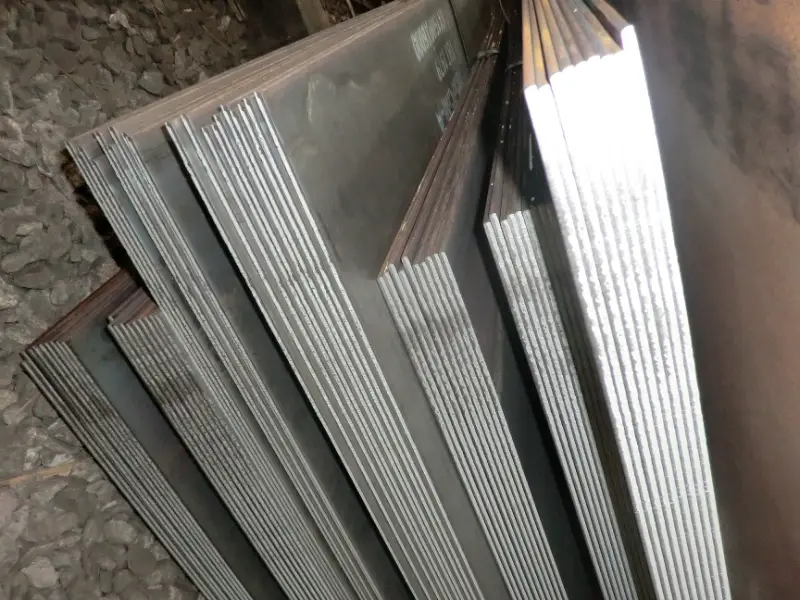
ASME SA633 Grade A Steel Plate
ASME SA633 Grade A (SA633GRA) Normalized High-Strength Low-Alloy Structural Steel Plate
Detailed material data sheet for ASME SA633 Grade A steel plate covering chemical composition, mechanical properties, physical properties, international equivalents, similar grades, and application guidance.
Normalizing, welding, forming, machining, cutting
- Phone : +8618037372205
- Email : [email protected]
- WhatsApp: Contact via Whtsapp
- WeChat: +8618037372205
ASME SA633 Grade A Steel Plate Introduction
ASME SA633 Grade A (SA633GRA) is a normalized high-strength low-alloy structural steel plate designed for welded bridges, buildings, and other critical structures. It offers a good balance of strength, toughness, and weldability. Typical yield strength is 290 MPa (42 ksi) for thicknesses up to 40 mm. The steel is supplied in the normalized condition to ensure uniform grain refinement and consistent mechanical properties.
The alloy design uses manganese and microalloying elements like niobium (columbium) and vanadium to achieve the required strength without excessive carbon content. This results in good weldability and ductility, with elongation values typically above 21% in 200 mm gauge length for thinner sections. The material is widely used in North America and recognized globally under similar standards such as EN 10025-3 S355N and JIS G3106 SM490YA. It is suitable for structural applications subjected to static and dynamic loads, including bridges, offshore platforms, building frames, and heavy machinery. Optional Charpy V-notch impact testing can be specified for low-temperature service, ensuring reliable performance in harsh environments.
ASME SA633 Grade A Steel Plate Chemical Composition
Chemical composition requirements according to ASME SA633/SA633M for Grade A. Elements not listed may be present as residuals. The maximum carbon content is 0.20% for plates over 40 mm thickness.
| Element | Standard Value | Notes |
|---|---|---|
| Carbon (C) | ≤ 0.18 | For thickness ≤ 40 mm; ≤ 0.20 for thickness > 40 mm |
| Manganese (Mn) | 1.00 – 1.35 | |
| Phosphorus (P) | ≤ 0.025 | |
| Sulfur (S) | ≤ 0.025 | |
| Silicon (Si) | 0.15 – 0.50 | |
| Copper (Cu) | ≤ 0.35 (when specified) | Residual element; maximum when copper steel is not required |
| Nickel (Ni) | ≤ 0.25 | Residual element |
| Chromium (Cr) | ≤ 0.25 | Residual element |
| Molybdenum (Mo) | ≤ 0.08 | Residual element |
| Columbium (Niobium) (Cb/Nb) | 0.005 – 0.05 | Grain-refining element |
| Vanadium (V) | 0.02 – 0.10 (if added) | Optional grain-refining element |
| Aluminum (Al) | ≥ 0.020 (total) or ≥ 0.015 (acid-soluble) when fine grain practice is required | Typically used for grain refinement |
ASME SA633 Grade A Steel Plate Thermal and Electrical Physical Properties
Physical properties for low-alloy normalized steel similar to ASME SA633 Grade A. These are typical values for engineering calculations and are not mandatory requirements of the ASME specification. Values may vary slightly with actual composition and heat treatment.
| Property | Typical Value | Unit | Temperature / Condition |
|---|---|---|---|
| Density (ρ) | 7.85 | g/cm³ | Room temperature |
| Modulus of Elasticity (E) | 200 | GPa | Room temperature |
| Shear Modulus (G) | 80 | GPa | Estimated as E/(2(1+ν)) |
| Poisson's Ratio (ν) | 0.3 | - | Room temperature |
| Thermal Expansion Coefficient (α) | 11.7 | 10⁻⁶/K | 20–100°C |
| Thermal Expansion Coefficient (α) | 12.2 | 10⁻⁶/K | 20–200°C |
| Thermal Expansion Coefficient (α) | 13.0 | 10⁻⁶/K | 20–400°C |
| Thermal Conductivity (λ) | 52 | W/(m·K) | At 20°C |
| Thermal Conductivity (λ) | 49 | W/(m·K) | At 200°C |
| Thermal Conductivity (λ) | 43 | W/(m·K) | At 400°C |
| Specific Heat Capacity (cp) | 470 | J/(kg·K) | At 20°C |
| Specific Heat Capacity (cp) | 520 | J/(kg·K) | At 200°C |
| Electrical Resistivity (ρe) | 0.17 | μΩ·m | Room temperature |
ASME SA633 Grade A Steel Plate Mechanical Properties
Tensile and impact properties for ASME SA633 Grade A in normalized condition. Charpy V-notch impact values are optional (Supplementary Requirement S5) and depend on purchase agreement; typical values for transverse specimens are shown. Bend test uses 180° bending with diameter 3t (t = specimen thickness).
| Property | Standard Requirement | Unit | Test Condition / Specimen |
|---|---|---|---|
| Yield Strength (ReH) | ≥ 290 | MPa | Thickness ≤ 40 mm |
| Yield Strength (ReH) | ≥ 275 | MPa | Thickness > 40–100 mm |
| Yield Strength (ReH) | ≥ 260 | MPa | Thickness > 100–150 mm |
| Tensile Strength (Rm) | 430 – 550 | MPa | All thicknesses |
| Elongation (A) | ≥ 21 | % | Gage length 200 mm in 40 mm wide specimen, thickness ≤ 40 mm |
| Elongation (A) | ≥ 23 | % | Gage length 50 mm in round or proportional specimen, thickness > 40 mm |
| Bend Test | No cracks, 180° | Bend diameter = 3 × plate thickness | |
| Charpy V-Notch Impact (KV2) optional | ≥ 27 (average), ≥ 20 (individual) | J | Transverse specimen at -20°C (typical S5) |
| Charpy V-Notch Impact (KV2) optional | ≥ 27 (average), ≥ 20 (individual) | J | Transverse specimen at -40°C (typical alternative) |
ASME SA633 Grade A Steel Plate Directly Equivalent Standards and Substitute Grades
| Country/Region | Standard | Grade/Designation | Remarks |
|---|---|---|---|
| Europe | EN 10025-3 | S355N | Normalized structural steel; minimum yield 355 MPa, similar weldability; often substituted for SA633 GrA but with higher strength. Additional agreement may be required. |
| Japan | JIS G3106 | SM490YA | Yield 365 MPa min; normalized condition; closest Japanese equivalent, widely used in similar applications. |
| China | GB/T 1591 | Q345D | Yield 345 MPa min; low-temperature toughness guaranteed; normalized or hot-rolled; often accepted as alternative after engineering review. |
| International | ISO 630-3 | E355D | High-strength weldable structural steel; normalized delivery; yield 355 MPa; closely related to European and American grades. |
ASME SA633 Grade A Steel Plate Application Introduction
ASME SA633 Grade A is extensively used in welded bridge and building construction because of its excellent strength-to-weight ratio and reliable toughness in the normalized condition. It is suitable for both static and dynamic loads and can be used in low-temperature environments when supplementary impact requirements are met. The steel can be easily welded with low-hydrogen processes and requires no post-weld heat treatment in most cases, provided proper preheating and interpass temperatures are maintained.
Typical applications include:
Product Applications: Welded bridge girders and box sections, Building columns, beams, and truss members, Offshore platform topsides and helideck kevlar, Heavy-duty crane main girders and outriggers, Mining dump truck frames and excavator booms, Storage tank shells and roofs for ambient/low-temperature service
Processed into products: Load-bearing plates and diaphragms, Flanges and webs of welded plate girders, Stiffeners and connecting plates, Base plates and anchorage elements, Bearing supports and pinned connection details, Welded built-up sections for heavy machinery
Application industries: Civil engineering and infrastructure (bridges, viaducts, pedestrian walkways), Building construction (high-rise frameworks, stadiums, industrial buildings), Offshore and marine structures (platform modules, deck plating, support structures), Heavy machinery and mining equipment (chassis, booms, machine frames), Transportation (railway wagons, truck trailers, crane components), Pressure vessels and storage tanks (when supplementary impact and thickness requirements are satisfied)
ASME SA633 Grade A Steel Plate Similar and Alternative Materials with Comparable Performance
| Country/Region | Standard | Grade/Designation | Remarks |
|---|---|---|---|
| USA | ASTM A572/A572M | Grade 42 [290] | Yield 290 MPa; non-normalized; can be a cost-effective alternative when normalizing is not required. |
| USA | ASTM A709/A709M | Grade 36 [250] | Yield 250 MPa; structural steel for bridges; lower strength, but often used when design allows. |
| Europe | EN 10025-4 | S355ML | Thermomechanically rolled with improved toughness; yields 355 MPa; alternative for thicknesses where normalized condition is not mandatory. |
| India | IS 2062 | E350 BR | Yield 350 MPa; normalized or killed; frequently used as SA633 GrA substitute in Indian subcontinent projects. |
| Russia | GOST 27772 | S345 (C345) | Yield 345 MPa; close mechanical properties; often accepted in heavy structural applications. |
Notes:
- Normalizing temperature is typically 900–920°C followed by air cooling.
- Welding procedures should be qualified according to AWS D1.1 or equivalent; low-hydrogen consumables are recommended.
- Supplementary requirements S5 (Charpy V‑notch) or S18 (maximum tensile strength) are commonly specified for critical applications.
- Vacuum degassing and fine grain practice are routinely applied to ensure internal soundness and good through-thickness properties.
- Consult the full ASME SA633 specification for detailed ordering and testing requirements.
- Share



