
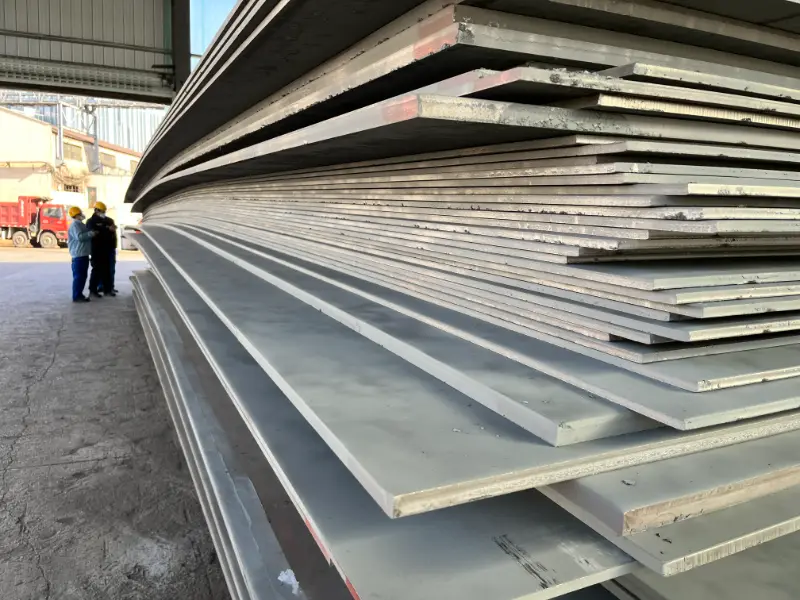
ASME SA656 Grade 60 Steel Plate
ASME SA656 Grade 60 Steel Plate: Low-Alloy High-Strength for Pressure Vessels
Comprehensive material data for ASME SA656 Grade 60 (SA656GR60) carbon and low-alloy high-strength steel plate, including chemical composition, mechanical and thermal properties, international equivalents, and application guidelines.
Hot rolling, controlled rolling, normalizing, welding, cutting, forming, machining
- Phone : +8618037372205
- Email : [email protected]
- WhatsApp: Contact via Whtsapp
- WeChat: +8618037372205
ASME SA656 Grade 60 Steel Plate Introduction
ASME SA656 Grade 60 is a low-alloy high-strength steel plate primarily used in the construction of welded pressure vessels and boilers. It belongs to the family of improved atmospheric corrosion-resistant structural steels, offering a minimum yield strength of 60 ksi (415 MPa) and good weldability. The steel is produced under the ASME SA-656/SA-656M specification and is available in the as-rolled, controlled-rolled, or normalized condition. Its enhanced mechanical properties are achieved through a combination of controlled rolling and microalloying elements, providing an optimal balance of strength, toughness, and formability for demanding pressure vessel applications.
ASME SA656 Grade 60 Steel Plate Chemical Composition
The chemical composition of ASME SA656 Grade 60 steel is designed to provide high strength and good weldability through microalloying. The specified limits are for heat analysis. Elements such as niobium, vanadium, and titanium may be added singly or in combination to achieve the required mechanical properties.
- Silicon acts as a deoxidizer and strength enhancer.
- Manganese improves hardenability and strength.
- Phosphorus and sulfur are kept at low levels to maintain toughness and weldability.
| Element | Standard Value (max. unless range) | Remarks |
|---|---|---|
| Carbon (C) | 0.18% | Heat analysis |
| Manganese (Mn) | 1.65% | Heat analysis |
| Phosphorus (P) | 0.025% | Heat analysis |
| Sulfur (S) | 0.025% | Heat analysis |
| Silicon (Si) | 0.60% | Heat analysis |
| Copper (Cu) | 0.35% max when specified | Optional; if chromium and silicon are also present, min. atmospheric corrosion resistance requirements may apply |
| Nickel (Ni) | 0.40% max when specified | Optional |
| Chromium (Cr) | 0.25% max when specified | Optional |
| Molybdenum (Mo) | 0.08% max when specified | Optional |
| Columbium (Nb) (Niobium) | 0.05% max when specified | Microalloying element; strengthens by precipitation hardening |
| Vanadium (V) | 0.10% max when specified | Microalloying element |
| Titanium (Ti) | 0.05% max when specified | Microalloying element for grain refinement |
| Aluminum (Al) | 0.02% min when specified as grain refining element | Often used for grain refinement |
| Boron (B) | 0.0005–0.003% when specified | Optional for hardenability improvement |
ASME SA656 Grade 60 Steel Plate Thermal and Electrical Physical Properties
Physical properties are typical for low-alloy high-strength steels and are not part of the ASME SA656 specification. These values are provided for design calculations and are based on published data for similar HSLA steels at room temperature unless otherwise noted.
- Density is assumed typical for steel.
- Thermal expansion and conductivity are essential for thermal stress analysis.
- Electrical resistivity may vary slightly with composition.
| Property | Typical Value | Unit | Test Condition / Temperature |
|---|---|---|---|
| Density (ρ) | 7850 | kg/m³ | Room temperature |
| Elastic Modulus (E) | 200–210 | GPa | Room temperature |
| Shear Modulus (G) | 75–80 | GPa | Room temperature, calculated from E and typical Poisson ratio |
| Poisson's Ratio (ν) | 0.27–0.33 | — | Room temperature |
| Thermal Expansion Coefficient (α) | 11.7 (for range 0–100°C) | 10⁻⁶/K | Average, 0–100°C |
| Thermal Expansion Coefficient (α) | 12.5 (0–300°C) | 10⁻⁶/K | Average, 0–300°C |
| Thermal Conductivity (λ) | 42–51 | W/(m·K) | At 20°C, varies with alloy content |
| Specific Heat Capacity (cp) | 460–480 | J/(kg·K) | At 20°C |
| Electrical Resistivity (ρe) | 0.15–0.25 | μΩ·m | At 20°C, typical for HSLA steel |
ASME SA656 Grade 60 Steel Plate Mechanical Properties
Mechanical properties are determined at room temperature on transverse specimens according to ASTM A370. The minimum values depend on plate thickness. For Grade 60, multiple thickness ranges are specified. The Charpy V-notch impact test is not mandatory but may be ordered as a supplementary requirement (e.g., S5 with specific energy and temperature).
- Yield strength decreases slightly with increasing thickness due to rolling restrictions.
- Elongation requirement ensures sufficient ductility for forming and structural integrity.
- Bending test demonstrates the plate's ability to undergo cold forming without cracking.
| Property | Standard Requirement | Unit | Test Condition |
|---|---|---|---|
| Yield Strength (ReH) | 415 min (for t ≤ 40 mm) | MPa | Transverse, 0.2% offset, room temperature |
| Yield Strength (ReH) | 380 min (40 mm < t ≤ 80 mm) | MPa | Transverse, 0.2% offset, room temperature |
| Yield Strength (ReH) | 345 min (80 mm < t ≤ 150 mm) | MPa | Transverse, 0.2% offset, room temperature |
| Tensile Strength (Rm) | 520–690 (for t ≤ 40 mm) | MPa | Transverse, room temperature |
| Tensile Strength (Rm) | 520–690 (for t > 40 mm) | MPa | Transverse, room temperature |
| Elongation (A) in 200 mm (8 in.) | 18 min (for t ≤ 40 mm) | % | Transverse, gauge length 200 mm |
| Elongation (A) in 200 mm (8 in.) | 16 min (40 mm < t ≤ 80 mm) | % | Transverse, gauge length 200 mm |
| Elongation (A) in 200 mm (8 in.) | 14 min (t > 80 mm) | % | Transverse, gauge length 200 mm |
| Elongation (A) in 50 mm (2 in.) | 21 min (for t ≤ 40 mm) | % | Transverse, gauge length 50 mm |
| Elongation (A) in 50 mm (2 in.) | 19 min (40 mm < t ≤ 80 mm) | % | Transverse, gauge length 50 mm |
| Elongation (A) in 50 mm (2 in.) | 17 min (t > 80 mm) | % | Transverse, gauge length 50 mm |
| Bend Test (Bend Diameter) | 3t (for t ≤ 25 mm) | — | D = 3 × specimen thickness, 180° bend, no cracks |
| Bend Test (Bend Diameter) | 4t (25 mm < t ≤ 40 mm) | — | D = 4 × specimen thickness |
| Bend Test (Bend Diameter) | 5t (t > 40 mm) | — | D = 5 × specimen thickness |
| Impact Toughness (KV, Charpy V) | Typically > 27 J at -20°C when S5 specified | J | Optional, transverse, average of 3 specimens, temperature per order |
ASME SA656 Grade 60 Steel Plate Completely Equivalent Material Standards and Substitutable Grades
| Country/Region | Standard | Grade | Remarks |
|---|---|---|---|
| United States | ASTM A572/A572M | Grade 60 [415] | High-strength low-alloy structural steel, similar strength but intended for structural applications. Chemical composition limits differ slightly (e.g., P, S may be 0.04% max). Not listed for pressure vessels. |
| European Union | EN 10025-3 | S420ML | Thermomechanical rolled weldable fine grain structural steel. Yield 420 MPa min, similar chemical concept, but not specifically for pressure vessels. For pressure vessels, refer to EN 10028-6 P355N to P460N (yield 355–460 MPa). |
| Japan | JIS G3124 | SPV450Q | High tensile strength steel plates for pressure vessels for intermediate and moderate temperature service. Yield ≥ 410 MPa, tensile 550–690 MPa. Very close match. |
| International | ISO 4950-2 | E420 | High yield strength flat steel products; Part 2: Products supplied in the normalized or controlled rolled condition. Yield 420 MPa min. Equivalent in mechanical properties. |
ASME SA656 Grade 60 Steel Plate Application Introduction
ASME SA656 Grade 60 steel is engineered for critical welded pressure equipment where a combination of high strength, good impact toughness, and corrosion resistance is required. It is widely adopted in the petrochemical, power generation, and construction industries. The steel's formability and weldability allow it to be fabricated into complex shapes and large structures.
- The controlled rolling process refines grain structure, improving both strength and toughness.
- For low-temperature service, supplementary ultrasonics and impact testing are typically imposed.
- Post-weld heat treatment (PWHT) may be applied without significant loss of strength.
Product Applications: Welded pressure vessels (ASME Code Section VIII), Boiler drums and headers (ASME Code Section I), Atmospheric storage tanks (API 650), Large diameter piping and manifolds, Offshore platforms and jackets, Bridge girders and box sections, Mining equipment bodies
Processed into products: Shell courses and heads of pressure vessels, Flanges and reinforcement pads, Stiffening rings and saddles, Tube sheets for heat exchangers, Gussets and brackets, Base plates and bearing plates, Cut-to-size blanks for fabrication
Application industries: Oil and Gas (pressure vessels, separators, storage tanks), Chemical and Petrochemical (reactors, columns, heat exchangers), Power Generation (boilers, steam drums, deaerator vessels), Water Treatment (pressure tanks, pipe sections), Marine and Offshore (deck structures, hull reinforcement), Mining (heavy-duty chutes, truck bodies), Industrial Machinery (hydraulic cylinders, press frames)
ASME SA656 Grade 60 Steel Plate Similar / Comparable Material Recommendations
| Country/Region | Standard | Grade | Remarks |
|---|---|---|---|
| United States | ASME SA-537/SA-537M | Class 1 | Heat-treated carbon-manganese-silicon steel for pressure vessels. Yield 345 MPa min (lower), but excellent toughness in normalized condition. Suitable when high toughness is required with moderate strength. |
| United States | ASTM A709/A709M | Grade 50W | Weathering steel with similar atmospheric corrosion resistance but lower yield strength (345 MPa). Used in bridges. |
| European Union | EN 10028-3 | P460NH | Weldable fine grain steel normalized for pressure purposes. Yield 460 MPa min, higher strength but still weldable. Alternative for higher design stresses. |
| Japan | JIS G3106 | SM520C | Rolled steels for welded structure, yield ≥ 365 MPa, tensile 520–640 MPa. Used in buildings and bridges. Similar strength level but not specifically for pressure vessels. |
| China | GB/T 1591 | Q420D | High strength low alloy structural steel, yield ≥ 420 MPa. Can be used as structural substitute but verify impact properties and vessel code acceptance. |
Notes:
For pressure vessel design using SA656 Grade 60, maximum allowable stress values must be taken from the appropriate ASME Boiler and Pressure Vessel Code table (e.g., Section II, Part D). Welding consumables should be matched to the strength and toughness requirements; low-hydrogen procedures are recommended. Preheating may be required for thicker sections to avoid hydrogen cracking. The steel exhibits good atmospheric corrosion resistance (when copper and chromium are specified at minimum levels), but it is not a substitute for stainless steels in severely corrosive environments. The minimum design metal temperature (MDMT) should be evaluated based on impact test results. The normalized condition is often specified for critical service to ensure uniform properties.
- Share



