
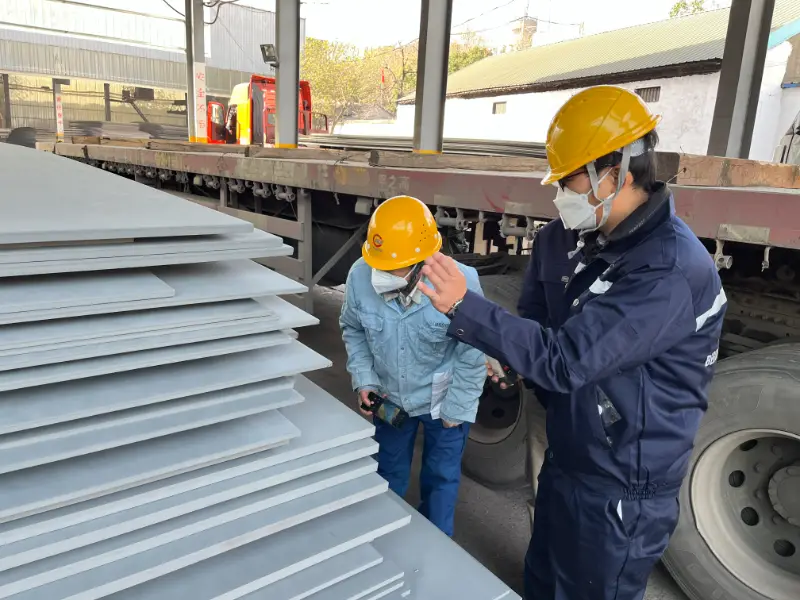
ASME SA656 Grade 70 High-Strength Low-Alloy Steel Plate
ASME SA656 Grade 70 High-Strength Low-Alloy Steel Plate: Properties, Equivalents & Applications
Comprehensive material data for ASME SA656 Grade 70 carbon and low-alloy high-strength steel plate including chemical composition, mechanical properties, thermal and electrical properties, equivalent grades and applications.
Cutting, welding, cold forming, bending, punching, stamping, machining
- Phone : +8618037372205
- Email : [email protected]
- WhatsApp: Contact via Whtsapp
- WeChat: +8618037372205
ASME SA656 Grade 70 High-Strength Low-Alloy Steel Plate Introduction
ASME SA656 Grade 70 is a hot-rolled carbon and low-alloy high-strength steel plate with improved formability, specified under ASME SA656/SA656M. It offers a minimum yield strength of 70 ksi (485 MPa) and is designed for structural applications where weight savings and good formability are required. The steel achieves its mechanical properties through controlled rolling and micro-alloying with elements such as vanadium, niobium, or titanium. This results in fine grain structure and precipitation strengthening. SA656 Grade 70 combines high strength, good weldability, and excellent cold-forming characteristics, making it suitable for welded structures, bridges, heavy equipment, and transportation. Typical delivery condition is as-rolled, controlled-rolled, or normalized as per purchaser requirements. It is widely adopted in North America and globally recognized under the ASME Boiler and Pressure Vessel Code.
ASME SA656 Grade 70 High-Strength Low-Alloy Steel Plate Chemical Composition
The chemical composition according to ASME SA656/SA656M for Grade 70 is designed to ensure high strength and good formability. Maximum limits are provided for residual and micro-alloying elements to achieve the required mechanical properties. Vanadium, niobium, or titanium are added singly or in combination for grain refinement and precipitation strengthening. Silicon is deoxidizer, and phosphorus and sulphur are kept low for cleanliness.
| Element | Standard Value (max %) | Remarks |
|---|---|---|
| Carbon (C) | 0.18 | Heat analysis |
| Manganese (Mn) | 1.60 | Heat analysis |
| Phosphorus (P) | 0.025 | Heat analysis |
| Sulfur (S) | 0.030 | Heat analysis |
| Silicon (Si) | 0.60 | Heat analysis |
| Vanadium (V) | 0.08 | Optional micro-alloying element |
| Niobium (Nb) | 0.05 | Optional micro-alloying element |
| Titanium (Ti) | 0.06 | Optional micro-alloying element |
ASME SA656 Grade 70 High-Strength Low-Alloy Steel Plate Thermal and Electrical Physical Properties
The following physical properties are typical for low-alloy high-strength steel similar to SA656 Grade 70. These values are not mandatory in the standard and are derived from general material data for carbon-manganese structural steels with micro-alloying. They are useful for design calculations involving heat transfer, thermal expansion, and electrical conductivity.
| Property | Standard Reference Value | Unit | Test Condition |
|---|---|---|---|
| Density (ρ) | 7.85 | g/cm³ | At 20°C |
| Elastic Modulus (E) | 205 | GPa | At 20°C |
| Shear Modulus (G) | 80 | GPa | At 20°C |
| Poisson's Ratio (ν) | 0.29 | — | At 20°C |
| Thermal Expansion (α) | 11.7 (average) | 10⁻⁶/K | 20-100°C |
| Thermal Expansion (α) | 12.5 (average) | 10⁻⁶/K | 20-200°C |
| Thermal Expansion (α) | 13.6 (average) | 10⁻⁶/K | 20-400°C |
| Thermal Conductivity (λ) | 48 | W/(m·K) | At 20°C |
| Thermal Conductivity (λ) | 45 | W/(m·K) | At 100°C |
| Specific Heat Capacity (c) | 470 | J/(kg·K) | At 20°C |
| Electrical Resistivity (ρ_e) | 0.20 | μΩ·m | At 20°C |
ASME SA656 Grade 70 High-Strength Low-Alloy Steel Plate Mechanical Properties
The mechanical properties are determined on transverse test pieces. Yield strength and tensile strength are specified as minimum values, while elongation and bending requirements depend on plate thickness. Impact toughness (Charpy V-notch) is not mandatory unless specified by supplementary requirements (e.g., S1, S2). All tests are performed at room temperature.
| Property | Standard Required Value | Unit | Test Condition |
|---|---|---|---|
| Yield Strength (ReH) | 485 (min) | MPa | Plate thickness ≤ 20 mm (≤3/4 in.) |
| Yield Strength (ReH) | 485 (min) | MPa | Plate thickness > 20 mm to 40 mm (>3/4 to 1-1/2 in.) |
| Yield Strength (ReH) | 450 (min) | MPa | Plate thickness > 40 mm to 100 mm (>1-1/2 to 4 in.) |
| Tensile Strength (Rm) | 585 (min) | MPa | All thicknesses |
| Elongation (A) (8 in. or 200 mm gauge) | 13 (min) | % | Plate thickness ≤ 20 mm |
| Elongation (A) (8 in. or 200 mm gauge) | 15 (min) | % | Plate thickness > 20 mm to 40 mm |
| Elongation (A) (8 in. or 200 mm gauge) | 17 (min) | % | Plate thickness > 40 mm to 100 mm |
| Bend Test (Bend Diameter) | 2 t | — | Plate thickness ≤ 20 mm, 180° bend |
| Bend Test (Bend Diameter) | 2.5 t | — | Plate thickness > 20 mm to 40 mm, 180° bend |
| Bend Test (Bend Diameter) | 3 t | — | Plate thickness > 40 mm to 100 mm, 180° bend |
| Charpy Impact (KV) | Not specified | J | Optional supplementary requirement |
ASME SA656 Grade 70 High-Strength Low-Alloy Steel Plate Equivalent Standards and Replaceable Grades
| Country/Region | Standard | Grade | Remarks |
|---|---|---|---|
| USA / International | ASTM A656/A656M | Grade 70 | Identical specification; ASME SA656 directly adopts ASTM A656. |
ASME SA656 Grade 70 High-Strength Low-Alloy Steel Plate Application Introduction
ASME SA656 Grade 70 is a versatile high-strength low-alloy steel primarily used in structural and transport applications. Its improved formability and weldability allow it to replace conventional carbon steels at reduced section thickness, leading to weight savings. It is suitable for both static and dynamic loading conditions in ambient and moderately low temperatures (impact-tested options available).
- Typical industries include heavy equipment manufacturing, bridge construction, building frameworks, shipbuilding, and pressure vessel fabrication.
- Products range from rolled plates and cut-to-length sheets to fabricated welded assemblies.
- Common components are beams, girders, stiffeners, brackets, truck chassis parts, crane arms, and tank shells.
Product Applications: Hot-rolled steel plates and coils, Welded structural sections, Bridge girders and truss members, Building columns and beams, Storage tank shells and bottoms, Pressure vessel components (with additional requirements), Truck chassis frames and cross members, Crane booms and jibs, Railway carriage underframes, Agricultural machinery frames
Processed into products: Flanges and stiffeners for plate girders, Welded box sections, Bent and cold-formed brackets, Cut and punched plates for bolted connections, Support bases and mounting plates, Wear plates in chutes and liners (if hardfaced), End plates and diaphragms, Manholes and reinforcing pads for tanks, Chassis crossmembers and spring hangers, Boom segments for telescopic cranes
Application industries: Construction and Civil Engineering, Heavy Machinery and Equipment, Transportation (Trucks, Trailers, Railway), Shipbuilding / Marine, Pressure Vessel and Storage Tank, Agricultural Equipment, Mining and Earthmoving, Renewable Energy (Wind Tower Structures)
ASME SA656 Grade 70 High-Strength Low-Alloy Steel Plate Similar/Alternative Materials with Comparable Performance
| Country/Region | Standard | Grade | Remarks |
|---|---|---|---|
| Europe | EN 10149-2 | S550MC | Thermo-mechanically rolled high yield strength steel for cold forming; yield strength 550 MPa min, similar formability and weldability. |
| China | GB/T 1591 | Q550D | High strength low alloy structural steel; yield 550 MPa min, good low-temperature toughness if D quality. |
| Japan | JIS G 3113 | SAPH440 | Hot-rolled steel plate for automobile structural uses; yield ≥275 MPa, but some grades reach 440 MPa tensile, lower strength than Grade 70; closer equivalent is JIS G 3134 SPFH540 (yield 355 MPa min) or higher grades. |
| International | ISO 6930-1 | S550MC | High yield strength steel for cold forming; yield 550 MPa min, similar chemistry approach. |
| Germany | DIN EN 10149-2 | S550MC | Equivalent to EN standard above, widely used in European engineering. |
Notes:
Optional supplementary requirements from ASME SA656/SA656M include Charpy V-notch impact testing at specified temperatures, ultrasonic examination, and restricted chemistry for improved weldability. Mill test certificates typically report heat analysis and mechanical test results. When higher toughness or through-thickness properties are needed, consult the standard for supplementary requirements S1 to S5. For applications involving pressure boundaries, additional ASME Boiler and Pressure Vessel Code criteria may apply. Welding: Use low-hydrogen processes and appropriate preheat/interpass temperatures to avoid cold cracking; the steel is generally readily weldable with commonly used structural procedures.
- Share



