
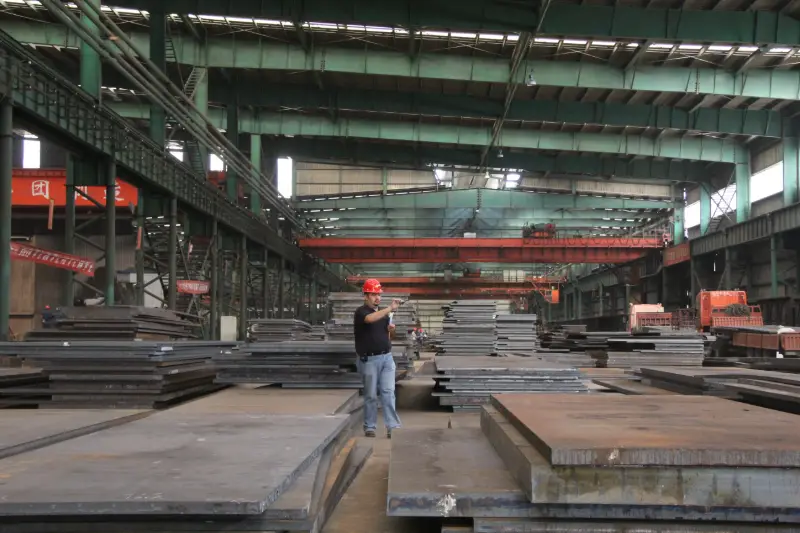
ASME SA656 Grade 80 High-Strength Low-Alloy Steel Plate
ASME SA656 Grade 80 High-Strength Low-Alloy Steel Plate: Properties & Equivalents
Complete technical data for ASME SA656 Grade 80 (SA656GR80) carbon and low-alloy high-strength steel plate, including chemical composition, mechanical properties, physical properties, international equivalents, and application guidelines.
Hot rolling, controlled rolling, thermomechanical controlled processing (TMCP), normalizing (optional), cutting, welding, forming, machining
- Phone : +8618037372205
- Email : [email protected]
- WhatsApp: Contact via Whtsapp
- WeChat: +8618037372205
ASME SA656 Grade 80 High-Strength Low-Alloy Steel Plate Introduction
ASME SA656 Grade 80 is a high-strength low-alloy (HSLA) carbon steel plate produced under the ASME Boiler and Pressure Vessel Code, Section II, Part A. It is equivalent to ASTM A656/A656M Grade 80 and is designed for applications requiring high yield strength (minimum 80 ksi / 550 MPa), good weldability, and improved toughness. The steel is typically supplied in the hot-rolled condition, often with controlled rolling or thermomechanical processing. Key features include:
- High strength-to-weight ratio, enabling weight reduction in structural designs.
- Good formability and weldability, using common welding procedures without excessive preheat.
- Available in multiple chemical composition types (Type 3, Type 4, Type 5, Type 7) to balance strength, toughness, and corrosion resistance.
- Commonly used in heavy equipment, crane booms, truck frames, railcars, and pressure vessel components where high strength is paramount.
ASME SA656 Grade 80 High-Strength Low-Alloy Steel Plate Chemical Composition
The chemical composition varies depending on the type (3, 4, 5, or 7) as specified in ASME SA656/ASTM A656. Grade 80 is normally supplied with microalloying elements such as niobium, vanadium, and/or titanium to achieve the required strength. The values below are the maximum limits unless a range is given. Actual composition is reported on the material test certificate.
- Type 3: Nb + V, with limited nitrogen.
- Type 7: Nb + V + Ti, allowing enhanced toughness.
Consult the purchaser's order for the specific type required.
| Element | Standard Value (max, %) | Remarks |
|---|---|---|
| Carbon (C) | 0.18 | Max for all types |
| Manganese (Mn) | 1.60 (Type 3/4/5); 1.65 (Type 7) | Varies by type |
| Phosphorus (P) | 0.025 | Max |
| Sulfur (S) | 0.035 | Max |
| Silicon (Si) | 0.60 | Max for all types |
| Vanadium (V) | 0.005 – 0.15 | Required for Types 3,4,5,7; min 0.005 |
| Niobium (Nb) | 0.005 – 0.15 | Required for Types 3,4,7; min 0.005 |
| Titanium (Ti) | 0.005 – 0.15 | Required for Type 7 only |
| Nitrogen (N) | 0.020 | Max for Type 3; not specified for other types, but restricted by V/Nb additions |
| Copper (Cu) | 0.35 (optional) | May be specified for atmospheric corrosion resistance (e.g., Type 5) |
| Nickel (Ni) | 0.25 (optional) | May be added |
| Chromium (Cr) | 0.25 (optional) | May be added |
| Molybdenum (Mo) | 0.10 (optional) | May be added |
ASME SA656 Grade 80 High-Strength Low-Alloy Steel Plate Thermal and Electrical Physical Properties
The following properties are typical for low-carbon high-strength low-alloy steels similar to ASME SA656 Grade 80 and are provided for design guidance. These are not specified in the material standard but are widely accepted engineering data at room temperature unless otherwise noted. Actual values may vary slightly depending on composition and heat treatment.
- Density is near that of pure iron.
- Thermal conductivity decreases with increasing temperature.
- Electrical resistivity is typical for steel.
| Property | Typical Value | Unit | Condition / Temperature |
|---|---|---|---|
| Density (ρ) | 7.85 | g/cm³ | Ambient temperature |
| Elastic Modulus (E) | 200 | GPa | Ambient temperature, tension/compression |
| Shear Modulus (G) | 80 | GPa | Calculated from E and Poisson's ratio |
| Poisson's Ratio (ν) | 0.3 | — | Elastic range |
| Thermal Expansion Coefficient (α) | 11.7 | 10⁻⁶/K | 0–100°C (32–212°F) |
| Thermal Expansion Coefficient (α) | 12.5 | 10⁻⁶/K | 0–300°C (32–572°F) |
| Thermal Conductivity (λ) | 51.9 | W/(m·K) | At 20°C (68°F) |
| Thermal Conductivity (λ) | 47.6 | W/(m·K) | At 200°C (392°F) |
| Specific Heat Capacity (Cp) | 486 | J/(kg·K) | Ambient temperature |
| Electrical Resistivity (ρ_e) | 0.15 – 0.20 | μΩ·m | At 20°C, typical for low-alloy steel |
ASME SA656 Grade 80 High-Strength Low-Alloy Steel Plate Mechanical Properties
The following mechanical properties are the minimum required values according to ASME SA656/ASTM A656 for plate thickness up to 40 mm (1.5 in.), unless otherwise noted. The properties are validated through tensile and bend testing. Impact toughness (KV) is not mandatory but may be specified by supplementary requirement. All values apply to the longitudinal direction.
- Yield strength (ReH) is determined by 0.2% offset method.
- Elongation is measured on standard 200 mm (8 in.) and 50 mm (2 in.) gauge lengths.
| Property | Required Value | Unit | Test Condition |
|---|---|---|---|
| Yield Strength (ReH) | 550 min | MPa [ksi] | Transverse or longitudinal; 0.2% offset, plate thickness ≤ 40 mm |
| Tensile Strength (Rm) | 620 min | MPa [ksi] | Plate thickness ≤ 40 mm |
| Elongation in 200 mm (8 in.) | 10 min | % | Gauge length 200 mm; thickness ≤ 40 mm |
| Elongation in 50 mm (2 in.) | 14 min | % | Gauge length 50 mm; thickness ≤ 40 mm |
| Bend Test (Bend Diameter) | 3t (t = plate thickness) | — | 180° bend, thickness ≤ 40 mm; no cracks on outside of bent portion |
| Bend Test (Bend Diameter) | 4t | — | Thickness > 40 mm to 100 mm; 180° bend |
| Impact Toughness (KV) | Not mandatory; by agreement | J [ft·lbf] | e.g., Charpy V-notch at specified temperature (e.g., -20°C, -40°F) when ordered |
ASME SA656 Grade 80 High-Strength Low-Alloy Steel Plate Directly Equivalent Material Standards and Substitute Grades
ASME SA656 Grade 80 is essentially the same as ASTM A656 Grade 80 and has no other full international duplicate standards. However, the following grades are recognized as functionally equivalent or directly interchangeable under certain qualification agreements.
| Country/Region | Standard | Grade | Remarks |
|---|---|---|---|
| USA | ASTM A656/A656M | Grade 80 | Identical to ASME SA656; same chemical and mechanical requirements. |
| — | — | — | No other full international equivalent exists. Equivalence must be verified by comparison of chemical and mechanical requirements. |
ASME SA656 Grade 80 High-Strength Low-Alloy Steel Plate Application Introduction
ASME SA656 Grade 80 is used where high strength and reduced weight are critical. Its lean alloy design ensures low carbon equivalent values, favouring good field weldability. The following are typical areas of application.
Product Applications: Mobile crane telescoping booms and outriggers, Dump truck bodies and trailers, Excavator buckets and arms, Railcar underframes and side sills, Offshore platform skid beams and deck plates, High-strength structural girders, Welded H-beams and box sections, High-stress machinery frames
Processed into products: Bent and formed chassis rails, Laser- or plasma-cut structural brackets and gussets, Welded box stiffeners and cross members, Machined pin joints and lugs, Sheared and punched flanges, Rolled cylinders (when warm forming is applied)
Application industries: Construction and heavy civil engineering, Earthmoving and agricultural equipment, Mining equipment, Transportation (truck frames, trailers, railcars), Cranes and lifting equipment, Offshore structures (topsides modules), Shipbuilding (limited, structural parts), Pressure vessel and storage tank components (non-pressure parts)
ASME SA656 Grade 80 High-Strength Low-Alloy Steel Plate Similar Alternative Materials and Their Analysis
The following materials exhibit comparable minimum yield strength (≥550 MPa) and are used in similar structural applications, though they may differ in delivery condition, weldability, or supplementary requirements. Direct substitution should be approved by the design engineer.
| Country/Region | Standard | Grade | Remarks |
|---|---|---|---|
| Europe | EN 10025-6 | S550Q (1.8909) | Quenched and tempered structural steel; yield 550 MPa, tensile 640-820 MPa. Higher alloying can affect weldability; careful preheat may be required. |
| Europe | EN 10149-2 | S550MC (1.0980) | Thermomechanically rolled high-strength low-alloy for cold forming; yield 550 MPa, tensile 600-760 MPa. Fine grain, low carbon equivalent – excellent weldability. |
| Japan | JIS G 3106 | SM570 | Rolled steel for welded structures; yield ≥460 MPa (thickness ≤16mm), 450 MPa (>16mm). Lower yield than 550 MPa; suitable for static loading but not a direct strength match. |
| International | ISO 4950-2 | E550DD (FeE550) | High yield strength flat products for cold forming; delivery condition thermomechanical; yield 550 MPa. Similar to S550MC. |
| China | GB/T 1591 | Q550D | High strength low alloy structural steel; yield ≥550 MPa (thickness ≤16mm). Available in normalized or TMCP condition. Similar weldability but check CEV. |
| USA | ASTM A572/A572M | Grade 65 (450 MPa) | Common HSLA steel; yield only 450 MPa. Not a strength match for Grade 80, but sometimes considered if redesign allows thicker sections. |
Notes:
Note 1: When specifying ASME SA656 Grade 80, the Type (3, 4, 5, or 7) should be indicated in the purchase order. Note 2: Supplementary requirements such as ultrasonic testing (UT) per ASME SA578, Charpy V‑notch impact testing at low temperatures, or restricted carbon equivalent (CE) may be added by agreement. Note 3: Although this steel is listed in ASME Section II for pressure vessel materials, it is not intended for the primary pressure boundary unless approved by the designer and accepted by the competent inspectorate. Note 4: Data from ASTM A656/A656M-19 and ASME SA656 (identic). Typical physical property values are derived from general steel engineering references and should be confirmed for critical design.
- Share



