
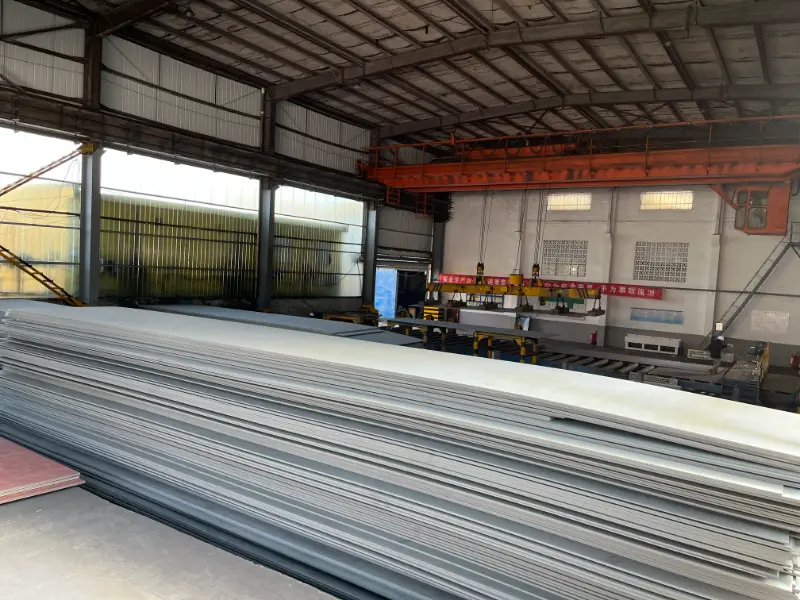
ASME SA709 Grade 36 Carbon & Low-Alloy High-Strength Steel Plate
ASME SA709 Grade 36 Carbon & Low-Alloy High-Strength Steel Plate | Bridge Structural Steel
Detailed specifications, chemical composition, mechanical and thermal properties of ASME SA709 Grade 36 (SA709Gr36) carbon and low-alloy high-strength steel plate for bridge construction, with equivalent grades and application guide.
Hot rolling, normalizing (optional), controlled rolling, cutting, welding
- Phone : +8618037372205
- Email : [email protected]
- WhatsApp: Contact via Whtsapp
- WeChat: +8618037372205
ASME SA709 Grade 36 Carbon & Low-Alloy High-Strength Steel Plate Introduction
ASME SA709 Grade 36 (SA709Gr36) is a carbon-manganese structural steel plate intended primarily for welded, bolted, and riveted bridge construction. It is the base grade in the ASME SA709/SA709M standard, which adopts ASTM A709/A709M with identical technical requirements. The material offers a minimum yield strength of 36 ksi (250 MPa) and tensile strength ranging from 58 to 80 ksi (400–550 MPa) for plate thicknesses up to 200 mm. Good weldability, reliable notch toughness (when supplementary impact tests are specified), and proven performance in structural applications make it a widely used grade for main bridge members, stiffeners, and connection plates. It can be supplied in as-rolled or normalized condition and is compatible with various welding processes conforming to AWS D1.5 bridge welding code.
ASME SA709 Grade 36 Carbon & Low-Alloy High-Strength Steel Plate Chemical Composition
The chemical composition limits for ASME SA709 Grade 36 are specified in ASTM A709/A709M. Silicon is generally added for deoxidation. Copper may be required when enhanced atmospheric corrosion resistance is specified (Grade 36W). Elements are controlled to ensure good weldability and structural performance.
| Chemical Element | Specified Value | Remarks |
|---|---|---|
| Carbon (C) | ≤0.26% | Maximum |
| Manganese (Mn) | 0.80–1.20% | For plate thickness ≤20 mm (3/4 in.) |
| Manganese (Mn) | 0.80–1.20% | For plate thickness >20 mm to 40 mm |
| Manganese (Mn) | 0.85–1.20% | For plate thickness >40 mm to 100 mm |
| Manganese (Mn) | 0.85–1.20% | For plate thickness >100 mm |
| Phosphorus (P) | ≤0.04% | Maximum |
| Sulfur (S) | ≤0.05% | Maximum |
| Silicon (Si) | ≤0.40% | Optional; typically 0.15–0.40% for deoxidation |
| Copper (Cu) | ≥0.20% | Optional; required for Grade 36W or when atmospheric corrosion resistance is specified |
ASME SA709 Grade 36 Carbon & Low-Alloy High-Strength Steel Plate Thermal and Electrical Physical Properties
The following physical property data are representative for carbon steel and are not mandated by the ASME SA709 standard. They are based on general knowledge of low-carbon structural steels and provide useful guidance for design calculations involving thermal or electrical behavior.
| Property | Typical Value | Unit | Test Conditions / Notes |
|---|---|---|---|
| Density (ρ) | 7.85 | g/cm³ | At room temperature |
| Modulus of Elasticity (E) | 200 | GPa | Tension, at 20 °C |
| Shear Modulus (G) | 77 | GPa | Calculated from E and Poisson's ratio |
| Poisson's Ratio (ν) | 0.27–0.30 | — | Typical for carbon steel |
| Thermal Expansion Coefficient (α) | 11.7 × 10⁻⁶ | /°C | Average for 0–100 °C (12.1 up to 200 °C, 12.9 up to 300 °C) |
| Thermal Conductivity (λ) | 52 | W/(m·K) | At 100 °C; decreases with rising temperature |
| Specific Heat Capacity | 486 | J/(kg·K) | Approximately 0.116 Btu/(lb·°F) at 50–100 °C |
| Electrical Resistivity (ρₐ) | 0.142 × 10⁻⁶ | Ω·m | At 20 °C for low-carbon steel |
ASME SA709 Grade 36 Carbon & Low-Alloy High-Strength Steel Plate Mechanical Properties
Tensile and yield strength requirements apply to plates up to 200 mm (8 in.) in thickness. Elongation values are based on a 200 mm (8 in.) gauge length. Bend tests verify ductility; bend diameter depends on plate thickness. Charpy V-notch impact toughness (KV) is governed by supplementary requirement S5, with test temperature and minimum energy level defined by the purchaser for the specific bridge service zone.
| Property | Required Value | Unit | Test Conditions |
|---|---|---|---|
| Yield Strength (ReH) | ≥250 [36] | MPa [ksi] | Plate thickness ≤200 mm (8 in.) |
| Tensile Strength (Rm) | 400–550 [58–80] | MPa [ksi] | Plate thickness ≤200 mm (8 in.) |
| Elongation (A), 200 mm gauge | ≥23 | % | Thickness ≤20 mm (3/4 in.) |
| Elongation (A), 200 mm gauge | ≥21 | % | Thickness >20 mm to 50 mm |
| Elongation (A), 200 mm gauge | ≥18 | % | Thickness >50 mm to 100 mm |
| Elongation (A), 200 mm gauge | ≥16 | % | Thickness >100 mm to 200 mm |
| Bend Test | 180°; no cracks | — | Bend diameter: 1.5t (t≤20 mm), 2t (20 |
| Charpy V-Notch Impact (KV) | As per S5 | J [ft·lbf] | Typical: 27 J @ ‒20 °C (Zone 2), 34 J @ ‒34 °C (Zone 3); energy and temperature defined by purchaser |
ASME SA709 Grade 36 Carbon & Low-Alloy High-Strength Steel Plate Equivalent Material Standards and Replaceable Grades
| Country/Region | Standard | Grade | Remarks |
|---|---|---|---|
| United States | ASTM A709/A709M | Grade 36 [250] | Identical to ASME SA709 Grade 36; often specified for non-ASME code bridge projects. |
| United States | ASTM A36/A36M | — | Chemically and mechanically equivalent for general structural use; lacks mandatory bridge impact toughness (S5) unless separately specified. |
| International | ISO 630-2 | S235B (Fe 360B) | Similar carbon-manganese chemistry; yield strength 235 MPa (lower than 250 MPa) – may be considered with design adjustments. |
| European Union | EN 10025-2 | S275JR/J0/J2 | Minimum yield 275 MPa (higher than Grade 36); alternative for bridge applications with verification of toughness and weldability. |
| Japan | JIS G3106 | SM400A/B/C | Yield point 245 MPa; welded structural steel with guaranteed impact values for SM400B/C; comparable performance. |
| China | GB/T 714 | Q235qC/D/E | Bridge structural steel with yield strength 235 MPa; a lower-strength alternative that can be used with increased section dimensions. |
ASME SA709 Grade 36 Carbon & Low-Alloy High-Strength Steel Plate Application Introduction
ASME SA709 Grade 36 is engineered for primary and secondary bridge structural components where good toughness and medium strength are required. It is easily fabricated by cutting, welding, and machining, and it performs reliably under static and dynamic loads typical of highway and railway bridges. When used with supplementary impact requirement S5, the steel can be tailored for low-temperature service zones.
Product Applications: Bridge main girders and floor beams, Truss bridges and arches, Bearing and sole plates, Gusset plates and splice plates, Bridge railings and expansion joint supports, Temporary and permanent structural shoring
Processed into products: Longitudinal and transverse girders, Cross frames and lateral bracing members, Stiffeners (longitudinal and transverse), Bolted and welded connection plates, Anchor bolt assemblies fabricated from plate, Deck support brackets and diaphragms
Application industries: Bridge engineering, Civil infrastructure, Heavy structural construction, Offshore platforms (with corrosion protection systems), Machinery support frames
ASME SA709 Grade 36 Carbon & Low-Alloy High-Strength Steel Plate Similar / Alternative Material Recommendations
| Country/Region | Standard | Grade | Remarks |
|---|---|---|---|
| United States | ASTM A572/A572M | Grade 42 [290] | Higher strength (290 MPa yield); may substitute with potential benefits in weight reduction; check weldability. |
| United States | ASTM A529/A529M | Grade 42 [290] | Higher carbon and manganese; suitable for bolted and welded structures where added strength is advantageous. |
| European Union | EN 10025-2 | S235JR/J0/J2 | Lower yield (235 MPa) but widely available; replaceable when design loads allow thicker sections. |
| China | GB/T 714 | Q345qD/E | High-strength bridge steel with 345 MPa yield; can replace Grade 36 with potential section reduction; requires attention to weld procedures. |
| Japan | JIS G3101 | SS400 | General structural grade with yield around 245 MPa; not specifically for bridges but functionally similar for non-fracture-critical members. |
Notes:
For bridge applications, supplementary requirement S5 (Charpy V-Notch impact testing) is almost always invoked, with test temperatures and energy absorption values specified according to the project's service temperature zone (e.g., 27 J at ‒20 °C or 34 J at ‒34 °C). Welding procedures must comply with AWS D1.5 or equivalent bridge welding code. The material is not intended for atmospheric corrosion resistance unless copper is specified (Grade 36W) or protective coatings are applied. For enhanced resistance, consider upgrading to HPS 50W or HPS 70W grades within the same standard.
- Share



