
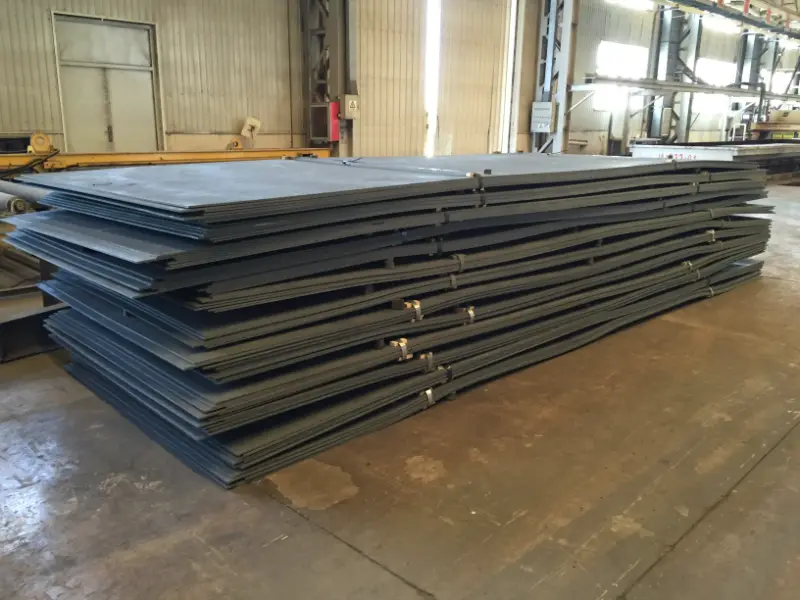
ASME SA709 Grade 50 High-Strength Structural Steel Plate
ASME SA709 Grade 50 High-Strength Structural Steel Plate: Comprehensive Data & Equivalents
Complete material properties of ASME SA709 Grade 50 (SA709GR50) carbon and low-alloy high-strength steel plate for bridges, including chemistry, mechanics, thermal physics, international equivalents, and application guide.
Hot rolling, controlled rolling, normalizing, quenching and tempering; suitable for cutting, welding, machining, cold bending, and forming operations.
- Phone : +8618037372205
- Email : [email protected]
- WhatsApp: Contact via Whtsapp
- WeChat: +8618037372205
ASME SA709 Grade 50 High-Strength Structural Steel Plate Introduction
ASME SA709 Grade 50 is a carbon and low-alloy high-strength structural steel plate specifically developed for bridge construction. It complies with the ASME SA709/SA709M standard and offers a guaranteed minimum yield strength of 50 ksi (345 MPa) with excellent weldability and notch toughness. The alloy is designed to carry heavy cyclic loads while providing reliable performance in demanding environments.
Key features:
- High strength-to-weight ratio, reducing structural dead load
- Excellent notch toughness at low temperatures (optional Charpy requirements)
- Good formability and weldability with standard procedures
- Available in various delivery conditions: as-rolled, normalized, or quenched & tempered
This grade is widely used in welded bridge girders, trusses, and structural supports, where durability and fatigue resistance are critical.
ASME SA709 Grade 50 High-Strength Structural Steel Plate Chemical Composition
Chemical composition limits as specified in ASME SA709/SA709M for Grade 50. Elements listed are mandatory for the heat analysis; optional microalloying elements (Nb, V, Ti) may be added at the manufacturer's discretion for grain refinement and property enhancement. Product analysis tolerances apply per ASTM A6/A6M.
| Element | Standard Value (max, wt%) | Remarks |
|---|---|---|
| Carbon (C) | 0.23 | For thickness ≤ 100 mm |
| Manganese (Mn) | 1.35 | May be lower for certain product sizes |
| Phosphorus (P) | 0.04 | |
| Sulfur (S) | 0.05 | |
| Silicon (Si) | 0.40 | Optional unless specified; ranges 0.15–0.40 if required |
| Copper (Cu) | 0.20 min (if specified) | Required only when atmospheric corrosion resistance is specified (unusual for Grade 50) |
| Nickel (Ni) | 0.25 | Residual |
| Chromium (Cr) | 0.25 | Residual |
| Molybdenum (Mo) | 0.08 | Residual |
| Vanadium (V) | 0.01–0.15 | Optional microalloy addition, if used |
| Niobium (Nb) | 0.005–0.05 | Optional microalloy addition, if used |
| Titanium (Ti) | 0.006–0.04 | Optional microalloy addition, if used |
| Aluminum (Al) | 0.02 min | If fine grain practice is required |
ASME SA709 Grade 50 High-Strength Structural Steel Plate Thermal & Electrical Physical Properties
Typical physical properties for carbon-manganese structural steel (Grade 50) at ambient temperature unless otherwise specified. Values are representative and may vary slightly with processing route and exact chemical composition.
| Property | Standard Value | Unit | Test Condition |
|---|---|---|---|
| Density (ρ) | 7.85 | g/cm³ | At 20°C |
| Elastic Modulus (E) | 200 | GPa | At 20°C; also 29,000 ksi |
| Shear Modulus (G) | 80 | GPa | At 20°C; also 11,600 ksi |
| Poisson's Ratio (ν) | 0.30 | — | At 20°C |
| Thermal Expansion (α) | 11.7 × 10⁻⁶ | 1/°C | 20–100°C range |
| Thermal Expansion (α) | 12.5 × 10⁻⁶ | 1/°C | 20–200°C range |
| Thermal Expansion (α) | 13.6 × 10⁻⁶ | 1/°C | 20–400°C range |
| Thermal Conductivity (λ) | 51.9 | W/(m·K) | At 0°C |
| Thermal Conductivity (λ) | 48.3 | W/(m·K) | At 100°C |
| Specific Heat Capacity | 486 | J/(kg·K) | At 20°C |
| Electrical Resistivity (ρₑ) | 0.16 × 10⁻⁶ | Ω·m | At 20°C; about 0.16 μΩ·m |
ASME SA709 Grade 50 High-Strength Structural Steel Plate Mechanical Properties
Minimum mechanical properties as required by ASME SA709 Grade 50 for plates. Values apply to the longitudinal direction unless otherwise noted. Impact test requirements are optional and depend on the Charpy toughness class (e.g., 0°C, -20°C, -40°C) when specified in the purchase order.
| Property | Standard Requirement (min) | Unit | Test Condition / Remarks |
|---|---|---|---|
| Yield Strength (ReH) | 345 | MPa | Thickness ≤ 100 mm |
| Tensile Strength (Rm) | 450 | MPa | Thickness ≤ 100 mm |
| Elongation (A200) | 21 | % | Gauge 200 mm, thickness ≤ 20 mm |
| Elongation (A200) | 20 | % | Gauge 200 mm, thickness 20–65 mm |
| Elongation (A200) | 18 | % | Gauge 200 mm, thickness 65–100 mm |
| Elongation (A50) | 18 | % | Gauge 50 mm, thickness ≤ 20 mm |
| Elongation (A50) | 18 | % | Gauge 50 mm, thickness > 20–65 mm |
| Elongation (A50) | 16 | % | Gauge 50 mm, thickness 65–100 mm |
| Bend Test (Bend Radius) | 2.5 × t | — | Thickness ≤ 20 mm, 180° bend |
| Bend Test (Bend Radius) | 3.0 × t | — | Thickness > 20–25 mm |
| Bend Test (Bend Radius) | 3.5 × t | — | Thickness > 25–50 mm |
| Bend Test (Bend Radius) | 4.0 × t | — | Thickness > 50 mm |
| Charpy V-Notch Impact (Long.) | 20 (typical) | J | At specified test temperature (e.g., 0°C, -20°C) when required by S5; minimum lateral expansion 0.38 mm |
| Charpy V-Notch Impact (Trans.) | 20 (typical) | J | When transverse testing is ordered |
ASME SA709 Grade 50 High-Strength Structural Steel Plate Fully Equivalent Material Standards & Substitute Grades
| Country/Region | Standard | Grade | Remarks |
|---|---|---|---|
| USA | ASTM A709/A709M | Grade 50 | Identical technical requirements; ASME SA709 is the boiler & pressure vessel code adoption of A709. |
| International | ISO 630-2 | S355D (structural hot-rolled steel) | Closest ISO equivalent in strength class; requires verification of toughness and additional chemistry limits. |
| Canada | CSA G40.21 | 350W | Comparable strength and toughness; often used as substitute in bridge construction. |
ASME SA709 Grade 50 High-Strength Structural Steel Plate Application Introduction
ASME SA709 Grade 50 is engineered for dynamic load-bearing structures, primarily in bridge engineering. Its balanced chemistry and controlled rolling provide a fine-grained microstructure that ensures reliable fatigue resistance and weldability. The steel is typically delivered with a Charpy toughness requirement (e.g., 20 J at 0°C or -20°C) to safeguard against brittle fracture in service.
Typical Applications:
- Highway and railway bridge girders, cross-bracing, and deck plates
- Heavy structural columns and frames in buildings
- Offshore platform topside modules
- Heavy-duty machinery bases and crane structures
Components routinely fabricated from this grade include welded built-up box sections, flange and web plates, stiffeners, base plates, and splice connections. All common fabrication methods—saw cutting, thermal cutting, submerged arc welding (SAW), and bolt joining—are employed successfully.
Product Applications: Bridge Girders and Trusses, Deck Plates and Diaphragms, Structural Columns and Beams for High-Rise Buildings, Offshore Platform Topsides and Jacket Legs, Heavy Crane Runway Beams
Processed into products: Flame-cut Flange and Web Plates for Welded Girders, Butt-welded Splice Plates, Stiffeners and Connection Gusset Plates, Bearing Stiffeners and Base Plates, Longitudinal and Transverse Stiffeners, Pinned Connections and Gusset Assemblies
Application industries: Bridge & Infrastructure Construction, Heavy Structural Engineering, Offshore & Marine Structures, Heavy Machinery Manufacturing, Transportation Equipment (trailer beams, vehicle frames)
ASME SA709 Grade 50 High-Strength Structural Steel Plate Similar / Alternative Material Standards & Grades
| Country/Region | Standard | Grade | Remarks |
|---|---|---|---|
| USA | ASTM A572/A572M | Grade 50 | Same strength level but wider application; often interchangeable with SA709 Gr 50 when Charpy requirements not mandatory. |
| European Union | EN 10025-2 | S355JR, S355J0, S355J2 | Similar yield strength (355 MPa min); J0 and J2 provide notch toughness at 0°C and -20°C respectively, matching common A709 Charpy classes. |
| Japan | JIS G3106 | SM490A / SM490B / SM490C | Yield ≥ 325–345 MPa; B and C grades offer impact toughness at 0°C or -10°C, suitable for bridge use. |
| China | GB/T 1591 | Q345D | Minimum yield 345 MPa, good low-temperature toughness (-20°C); widely used in Chinese bridge structures. |
Notes:
Welding Considerations: Preheating may be required for thick sections or when low-hydrogen processes are mandated. Typical preheat temperature range is 100–150°C for thicknesses above 40 mm. Post-weld heat treatment is generally not necessary but can be applied for stress relief if specified.
Corrosion Protection: Since Grade 50 is not a weathering steel, protective coating (painting, metallization) is essential for outdoor exposure. Supplementary requirements S1 to S6 in SA709 allow tailoring of notch toughness, through-thickness properties, and special testing.
Ordering Information: Specify thickness, width, length, Charpy test temperature and orientation (if required), and any supplementary requirements (e.g., S5 for impact testing, S6 for drop-weight tests). Plates are normally supplied with mill test reports (EN 10204 3.1 or equivalent).
- Share



