
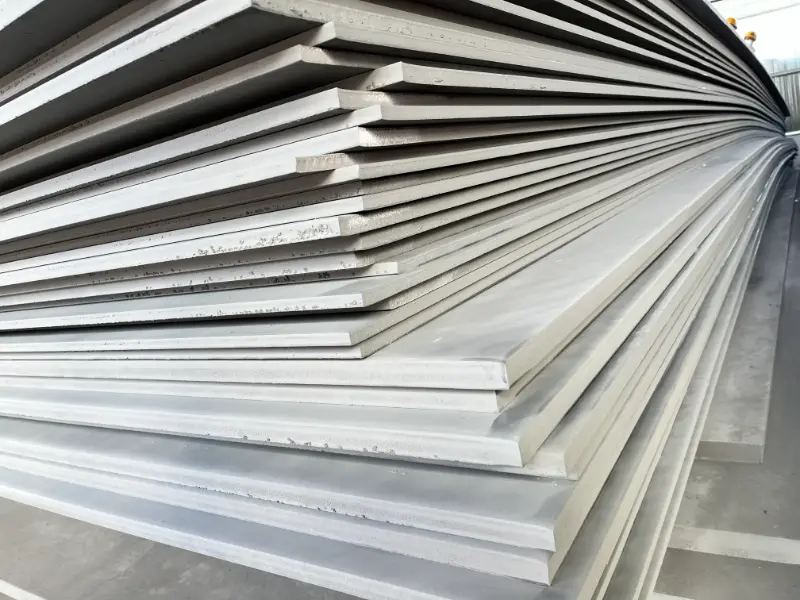
ASME SA709 Grade 50S (SA709GR50S) Low-Alloy Bridge Steel Plate
ASME SA709 Grade 50S (SA709GR50S) - High-Strength Carbon & Low-Alloy Bridge Steel Plate
Detailed analysis of ASME SA709 Grade 50S, a 50 ksi (345 MPa) minimum yield strength structural steel plate for bridge applications, including composition, mechanical and physical properties, and international equivalents.
Hot rolling, normalizing, thermomechanical controlled processing (TMCP), quenching and tempering (by agreement), welding, bending, forming, cutting, machining
- Phone : +8618037372205
- Email : [email protected]
- WhatsApp: Contact via Whtsapp
- WeChat: +8618037372205
ASME SA709 Grade 50S Low-Alloy Bridge Steel Plate Introduction
ASME SA709 Grade 50S (designated SA709GR50S) is a high-strength low-alloy carbon steel plate specifically developed for bridge construction under ASME SA709/SA709M. It offers a minimum yield strength of 50 ksi (345 MPa) in thicknesses up to 4 in. (100 mm), combined with good weldability and notch toughness. The steel is killed and made to fine grain practice, ensuring uniform properties. It is commonly supplied in the as-rolled, normalized, or TMCP condition, and is often ordered with supplementary Charpy impact requirements for fracture-critical members.
- Typical applications: welded plate girders, stiffeners, bearing plates, and splice plates in highway and railway bridges.
- Key features: consistent mechanical properties, good formability, and reliable performance under dynamic loads.
ASME SA709 Grade 50S Low-Alloy Bridge Steel Plate Chemical Composition
The following chemical limits apply to ASME SA709 Grade 50S according to the base specification. Manganese and silicon ranges are thickness-dependent. Steel shall be made to fine grain practice and may contain microalloying elements (e.g., Nb, V, Ti) at the manufacturer's discretion to meet mechanical properties. Copper is mandatory only when atmospheric corrosion resistance is specified.
| Element | Standard Value | Remarks |
|---|---|---|
| Carbon (C) | 0.23 max | All thicknesses |
| Manganese (Mn) | 0.60 – 1.35 | For thickness ≤ 2 in. (50 mm) |
| Manganese (Mn) | 0.85 – 1.20 | For thickness >2 in. to 4 in. (50–100 mm) |
| Phosphorus (P) | 0.04 max | All thicknesses |
| Sulfur (S) | 0.05 max | All thicknesses |
| Silicon (Si) | 0.15 – 0.40 | For thickness ≤ 2 in. (50 mm) |
| Silicon (Si) | 0.15 – 0.50 | For thickness >2 in. to 4 in. (50–100 mm) |
| Copper (Cu) | 0.20 min | When atmospheric corrosion resistance is required (optional) |
ASME SA709 Grade 50S Low-Alloy Bridge Steel Plate Thermal & Electrical Physical Properties
The following physical properties are representative of low-alloy carbon‑manganese structural steels under ambient conditions. Actual values may vary slightly depending on exact composition and processing history.
| Property | Typical Value | Unit | Test Condition |
|---|---|---|---|
| Density (ρ) | 7.85 | g/cm³ | At 20 °C |
| Elastic Modulus (E) | 200 GPa (29,000 ksi) | GPa | Tension |
| Shear Modulus (G) | 80 GPa | GPa | Calculated from E and ν |
| Poisson's Ratio (ν) | 0.3 | – | Elastic range |
| Thermal Expansion Coefficient (α) | 11.7 × 10⁻⁶ /°C (6.5 × 10⁻⁶ /°F) | 1/°C | 20–100 °C |
| Thermal Conductivity (λ) | 51.9 | W/m·K | At 20 °C |
| Specific Heat Capacity (c) | 486 | J/kg·K | At 20 °C |
| Electrical Resistivity (ρe) | 0.159 (15.9 µΩ·cm) | µΩ·m | At 20 °C |
ASME SA709 Grade 50S Low-Alloy Bridge Steel Plate Mechanical Properties
Minimum tensile requirements per ASME SA709 for plates up to 4 in. (100 mm) thick. For bridge service, supplementary Charpy V-notch impact testing is often specified; typical minimum average absorbed energy depends on temperature zone (e.g., 15 ft·lbf at 70 °F, 15 ft·lbf at 40 °F, or 15 ft·lbf at 10 °F per ASTM A709 Supplement S5). The values below are mandatory baseline properties.
| Property | Required Value | Unit | Test Condition |
|---|---|---|---|
| Yield Strength (ReH) | ≥ 50 ksi [≥ 345 MPa] | ksi [MPa] | Plate thickness ≤ 4 in. (100 mm); transverse test direction |
| Tensile Strength (Rm) | ≥ 65 ksi [≥ 450 MPa] | ksi [MPa] | Plate thickness ≤ 4 in. (100 mm) |
| Elongation in 2 in. (A) | ≥ 18% | % | Gauge length 2 in. (50 mm); applicable to plates ≤ 4 in. (100 mm) thickness |
ASME SA709 Grade 50S Low-Alloy Bridge Steel Plate Completely Equivalent Material Standards & Alternative Designations
| Country/Region | Standard | Grade | Remarks |
|---|---|---|---|
| USA | ASME SA709/SA709M | Grade 50S [345S] | Identical specification; inch‑pound and SI units |
| USA | ASTM A709/A709M | Grade 50S [345S] | Equivalent standard; ASME SA709 is adopted from ASTM A709 |
ASME SA709 Grade 50S Low-Alloy Bridge Steel Plate Application Introduction
ASME SA709 Grade 50S is specifically engineered for welded bridge construction and heavy structural applications requiring high strength and reliable toughness. It is processed into plates that are then cut, formed, and welded into various bridge components. The material exhibits good weldability (typical CE ≤ 0.45%) and can be used with most common welding processes when proper preheat and procedures are followed.
Product Applications: Bridge plates (standard mill plates), Fabricated welded I‑girders and box girders, Deck and diaphragm plates, Splice plates and connection plates
Processed into products: Welded plate girders (webs and flanges), Stiffeners (transverse and longitudinal), Gusset plates, Bearing plates and base plates, Floor beams and stringers, Bolted and welded splice plates, Truss chords and compression members
Application industries: Bridge Engineering (Highway & Railway), Civil Construction & Infrastructure, Heavy Machinery & Structural Fabrication, Offshore & Marine Topside Structures (where specified)
ASME SA709 Grade 50S Low-Alloy Bridge Steel Plate Similar / Alternative Material Recommendations
| Country/Region | Standard | Grade | Remarks |
|---|---|---|---|
| USA | ASTM A572/A572M | Grade 50 [345] | Same strength but not bridge‑specific; may lack Charpy requirements |
| European Union | EN 10025-2 | S355J0 / S355J2 | Comparable yield/tensile; different toughness and delivery conditions |
| Japan | JIS G 3106 | SM490A / SM490B | Similar strength for welded structures; check thickness limits |
| China | GB/T 714 | Q345qD / Q345qE | Bridge structural steel with analogous strength; fine‑grained variants for low temperature |
Notes:
Supplementary impact testing (e.g., Charpy V‑notch at temperatures of 70 °F, 40 °F, or 10 °F) is typically required for bridge service and must be specified on the purchase order. The steel shall be killed and made to fine grain practice. Copper may be specified for improved atmospheric corrosion resistance. Weldability is generally good; however, for thicker plates and low‑temperature service, preheat and hydrogen control practices are recommended. Carbon equivalent values for this grade are typically ≤ 0.45% using the formula CE = C + Mn/6 + (Cr+Mo+V)/5 + (Ni+Cu)/15.
- Share



