
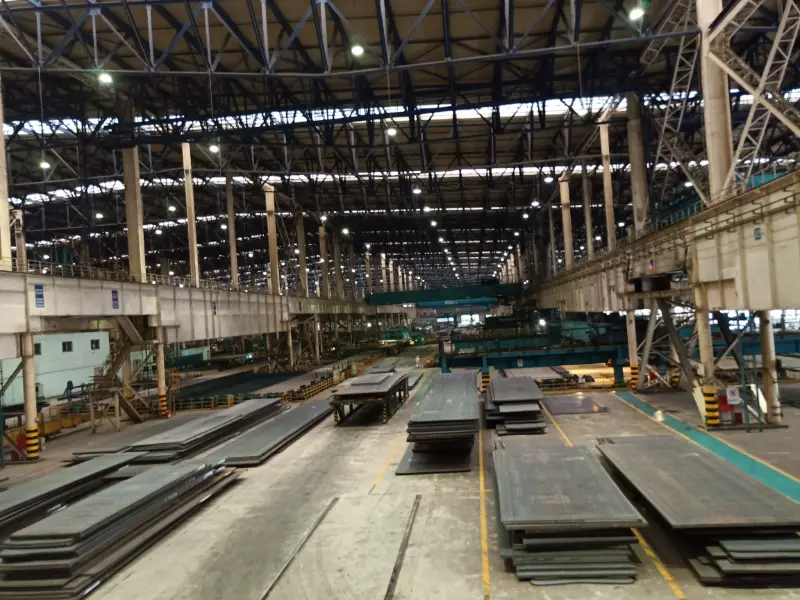
ASME SA573 Grade 65 Carbon Steel Plate
ASME SA573 Grade 65 Carbon Steel Plate – Structural & Weldable Plate
Detailed material analysis of ASME SA573 Grade 65 (SA573GR65) carbon steel plate, including chemical composition, mechanical properties, physical properties, international equivalents, and application guidance.
Hot rolling, controlled rolling, normalizing (optional), welding, machining, forming
- Phone : +8618037372205
- Email : [email protected]
- WhatsApp: Contact via Whtsapp
- WeChat: +8618037372205
ASME SA573 Grade 65 Carbon Steel Plate Introduction
ASME SA573 Grade 65 is a carbon-manganese-silicon steel plate primarily used for structural applications requiring moderate strength and good weldability. It is covered by the ASME SA573/SA573M specification, which is identical to ASTM A573/A573M. Key characteristics include a minimum yield strength of 240 MPa (35 ksi) and a tensile strength of 450–585 MPa (65–85 ksi). The steel offers excellent notch toughness at ambient temperatures and is often supplied in the as-rolled condition, though normalized or controlled rolled conditions are available. Its balanced composition ensures reliable performance in welded structures, pressure vessels, storage tanks, and general engineering components.
ASME SA573 Grade 65 Carbon Steel Plate Chemical Composition
The chemical composition of ASME SA573 Grade 65 is designed to provide a balance of strength and weldability. Key elements include controlled carbon and manganese levels. Silicon is specified for deoxidation. Residual elements such as copper, nickel, chromium, and molybdenum are limited to maintain weldability.
- The ladle analysis limits are per ASME SA573/SA573M.
- Check notes for thickness-dependent silicon range.
| Element | Composition (wt.%) | Remarks |
|---|---|---|
| Carbon (C) | ≤ 0.26 | Ladle analysis |
| Manganese (Mn) | 0.60 – 0.90 | Ladle analysis |
| Phosphorus (P) | ≤ 0.035 | Ladle analysis |
| Sulfur (S) | ≤ 0.04 | Ladle analysis |
| Silicon (Si) | 0.15 – 0.40 | For plates over 40 mm (1.5 in.) thick; for thinner plates 0.15 – 0.30 may apply |
| Copper (Cu) | ≤ 0.20 (minimum specified if copper steel is ordered) | Residual element; may be specified for atmospheric corrosion resistance |
ASME SA573 Grade 65 Carbon Steel Plate Thermal and Electrical Physical Properties
Physical properties are not mandatory in ASME SA573 but are typical for carbon-manganese structural steels. These values are provided for engineering calculations and may vary slightly with temperature and processing. Properties are given at ambient temperature unless noted.
| Property | Typical Value | Unit | Condition / Temperature |
|---|---|---|---|
| Density (ρ) | 7.85 | g/cm³ | 20°C |
| Modulus of Elasticity (E) | 200 – 210 | GPa | 20°C |
| Shear Modulus (G) | 75 – 81 | GPa | 20°C |
| Poisson's Ratio (ν) | 0.27 – 0.30 | — | 20°C |
| Thermal Expansion Coefficient (α) | 11.5 – 12.5 | µm/m·°C | 20 – 100°C (average) |
| Thermal Conductivity (λ) | 45 – 55 | W/m·K | 20°C |
| Specific Heat Capacity (Cp) | 460 – 500 | J/kg·K | 20°C |
| Electrical Resistivity (ρ_e) | 0.14 – 0.20 | µΩ·m | 20°C |
ASME SA573 Grade 65 Carbon Steel Plate Mechanical Properties
Mechanical properties are determined from longitudinal test specimens in accordance with ASME SA573/SA573M. Minimum yield strength and tensile strength requirements apply for all thicknesses, with elongation values dependent on specimen orientation and thickness. The Charpy V-notch impact test is not mandatory but may be performed to verify toughness at specified temperatures. Bending tests are usually conducted to ensure ductility.
| Property | Specified Value | Unit | Test Condition |
|---|---|---|---|
| Yield Strength (ReH) | ≥ 240 | MPa | Minimum, 0.2% offset or 0.5% extension under load |
| Tensile Strength (Rm) | 450 – 585 | MPa | |
| Elongation (A) in 200 mm (8 in.) | ≥ 20 | % | Applicable for plates ≤ 19 mm (3/4 in.) thickness; longitudinal specimen |
| Elongation (A) in 50 mm (2 in.) | ≥ 23 | % | Applicable for plates ≤ 19 mm (3/4 in.) thickness; transverse specimen |
| Elongation (A) in 200 mm (8 in.) | see standard | % | For thicker plates, elongation values diminish; consult ASME SA573 |
| Bend Test (180° cold bend) | No cracks on outside of bent portion | — | Mandrel diameter varies with thickness; typically 1–3 times thickness |
ASME SA573 Grade 65 Carbon Steel Plate Exact Equivalent Material Standards & Substitutable Grades
| Country / Region | Standard | Grade | Remarks |
|---|---|---|---|
| USA | ASTM A573/A573M | Grade 65 | Identical specification; fully interchangeable with ASME SA573 GR65 |
ASME SA573 Grade 65 Carbon Steel Plate Application Introduction
ASME SA573 Grade 65 is a versatile structural carbon steel suitable for welded fabrication where moderate strength and good toughness at ambient temperature are required. It is commonly used in building frames, industrial structures, and storage vessels. The steel can be cut, formed, machined, and welded using standard practices.
Product Applications: Storage tanks and silos, Pressure vessel shells and heads, Building columns, beams, and truss members, Bridge structural elements, Offshore platform components, Heavy equipment frames and chassis
Processed into products: Welded plate girders, Flanges and stiffeners, Brackets and base plates, Machined connecting rods, Bulkheads and baffles, Formed shell courses
Application industries: Civil and structural engineering, Pressure vessel and tank fabrication, Shipbuilding and marine structures, Railway and transportation equipment, Mining and earthmoving machinery, Power generation plants
ASME SA573 Grade 65 Carbon Steel Plate Similar / Approximate Substitute Materials
| Country / Region | Standard | Grade | Remarks |
|---|---|---|---|
| Europe | EN 10025-2 | S275J0 (+N or +AR) | Similar strength level; S275J0 has minimum yield 275 MPa and tensile 430–580 MPa. Charpy at 0°C. Check weldability equivalence. |
| Japan | JIS G3106 | SM490A | Higher strength (yield ≥ 325 MPa, tensile 490–610 MPa). Suitable for welded structures; often used as stronger alternative. |
| China | GB/T 700 | Q235B/C | Comparable carbon steel with yield ~235 MPa and tensile 370–500 MPa. Lower strength than Grade 65, but widely used for general structures. |
| International | ISO 630-2 | S275J0 | Matches EN 10025-2; suitable structural steel with guaranteed impact properties at 0°C. |
Notes:
ASME SA573 Grade 65 may be supplied with supplementary requirements, such as restricted chemistry, impact testing, or ultrasonic examination.
- When Charpy V-notch impact testing is specified, test temperature and minimum absorbed energy must be agreed upon.
- For thicknesses above 40 mm, normalized or controlled rolled condition is recommended to ensure through-thickness properties.
- Welding consumables should be selected to match the base metal strength (e.g., E70xx electrodes).
- Share



