
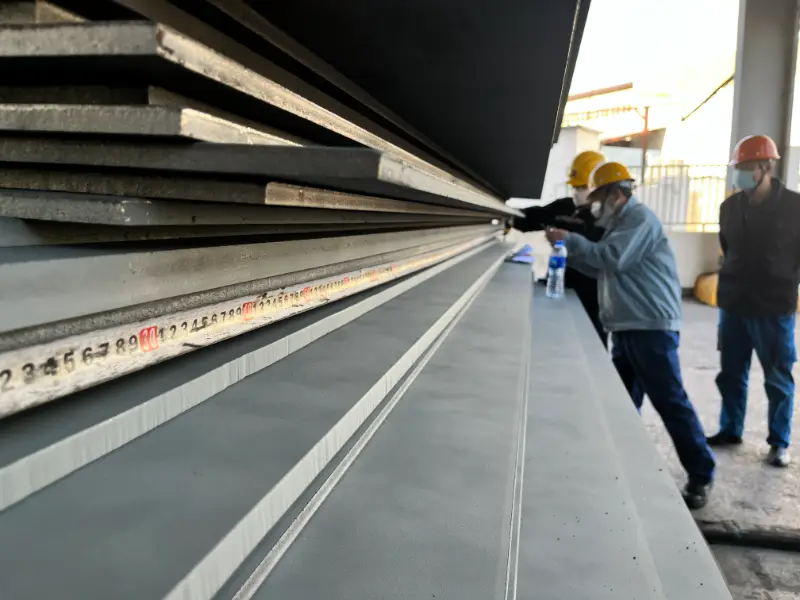
ASME SA709 Grade 100 High-Strength Low-Alloy Steel Plate for Bridges
ASME SA709 Grade 100 High Strength Steel Plate for Bridges: Data & Equivalents
Detailed material properties of ASME SA709 Grade 100 (SA709GR100) carbon and low-alloy high-strength steel plate: chemical composition, mechanical properties, thermal and electrical physical properties, cross-reference equivalents, and application guidelines.
Hot rolling, quenching and tempering, cutting, welding, cold forming (limited), machining
- Phone : +8618037372205
- Email : [email protected]
- WhatsApp: Contact via Whtsapp
- WeChat: +8618037372205
ASME SA709 Grade 100 High-Strength Low-Alloy Steel Plate for Bridges Introduction
ASME SA709 Grade 100 (SA709GR100) is a high-strength low-alloy structural steel plate primarily used in bridge construction. Covered by the ASME SA709/SA709M standard, it is supplied in the quenched and tempered (Q&T) condition and designated as Type Q. This grade offers a minimum yield strength of 100 ksi (690 MPa) and tensile strength in the range of 110–130 ksi (760–895 MPa), combined with good weldability and notch toughness when specified. The alloy design includes microalloying elements (V, Ti, B) to achieve the required mechanical properties through heat treatment. It is resistant to atmospheric corrosion when produced as Grade 100W (weathering variant). Typical applications include welded bridge girders, heavy structural frameworks, and other components requiring high strength-to-weight ratio.
ASME SA709 Grade 100 High-Strength Low-Alloy Steel Plate for Bridges Chemical Composition
The typical chemical composition for ASME SA709 Grade 100 Type Q (quenched and tempered) according to the standard. These elements are controlled to achieve high strength and good weldability. Values are maximum unless a range is indicated.
| Chemical Element | Nominal Value (wt%) | Remarks |
|---|---|---|
| Carbon (C) | 0.20 | max |
| Manganese (Mn) | 0.95 – 1.50 | range |
| Phosphorus (P) | 0.035 | max |
| Sulfur (S) | 0.04 | max |
| Silicon (Si) | 0.20 – 0.65 | range |
| Copper (Cu) | 0.20 – 0.40 | range |
| Nickel (Ni) | 0.30 – 0.70 | range |
| Chromium (Cr) | 0.40 – 0.70 | range |
| Molybdenum (Mo) | 0.15 – 0.25 | range |
| Vanadium (V) | 0.03 – 0.08 | range |
| Titanium (Ti) | 0.015 – 0.05 | range |
| Boron (B) | 0.0005 – 0.005 | range |
ASME SA709 Grade 100 High-Strength Low-Alloy Steel Plate for Bridges Thermal and Electrical Physical Properties
The following physical properties are typical for quenched and tempered low-alloy steels of this class. They are not part of the mandatory standard requirements but are representative for engineering calculations.
| Property | Typical Value | Unit | Test Condition / Remarks |
|---|---|---|---|
| Density (ρ) | 7.85 | g/cm³ | at 20 °C |
| Modulus of Elasticity (E) | 210 | GPa | at room temperature |
| Shear Modulus (G) | 80 | GPa | calculated |
| Poisson's Ratio (ν) | 0.3 | - | typical for steel |
| Thermal Expansion Coefficient (α) | 11.7 × 10⁻⁶ | K⁻¹ | 20–100 °C |
| Thermal Expansion Coefficient (α) | 12.5 × 10⁻⁶ | K⁻¹ | 20–200 °C |
| Thermal Expansion Coefficient (α) | 13.2 × 10⁻⁶ | K⁻¹ | 20–300 °C |
| Thermal Conductivity (λ) | 40 | W/(m·K) | at 20 °C, typical for alloy steel |
| Specific Heat Capacity | 470 | J/(kg·K) | at 20 °C, typical |
| Electrical Resistivity (ρ_e) | 0.25 | μΩ·m | at 20 °C, typical |
ASME SA709 Grade 100 High-Strength Low-Alloy Steel Plate for Bridges Mechanical Properties
Mechanical properties are determined on quenched and tempered test specimens. The values represent the minimum or range required by ASME SA709/SA709M for Grade 100 plates. Charpy impact test may be specified as a supplementary requirement.
| Property | Required Value | Unit | Test Condition |
|---|---|---|---|
| Yield Strength (ReH) | 690 | MPa | min, 0.2% offset; plate thickness ≤ 100 mm |
| Tensile Strength (Rm) | 760 – 895 | MPa | range |
| Elongation (A) | 18 | % | min, gauge length 50 mm (2 in.) |
| Elongation (A) | 17 | % | min, gauge length 200 mm (8 in.) for plates > 20 mm |
| Bend Test (bend diameter / specimen thickness ratio) | 2.0t | - | thickness ≤ 20 mm, 180° bend |
| Bend Test | 2.5t | - | thickness > 20 mm to 25 mm |
| Bend Test | 3.0t | - | thickness > 25 mm to 50 mm |
ASME SA709 Grade 100 High-Strength Low-Alloy Steel Plate for Bridges Fully Equivalent Material Standards & Substitute Grades
| Country/Region | Standard | Grade | Remarks |
|---|---|---|---|
| USA | ASTM A709/A709M | Grade 100 (Type Q) | Technically identical to ASME SA709 Grade 100 |
| European Union | EN 10025-6 | S690Q | Comparable quenched and tempered high-strength structural steel; composition may differ slightly |
| International | ISO 4950-2 | E690 | High yield strength flat products; equivalent grade |
| Japan | JIS G3128 | SHY685 | High yield strength steel plate for welded structures; similar strength level |
| China | GB/T 16270 | Q690D | Quenched and tempered high strength structural plate; equivalent in quality |
ASME SA709 Grade 100 High-Strength Low-Alloy Steel Plate for Bridges Application Introduction
ASME SA709 Grade 100 is engineered for heavy-load bridge structures and similar demanding applications. Its high strength reduces structural weight and simplifies fabrication. With appropriate welding consumables and preheat, it can be welded using common processes. The quenched and tempered condition provides a good balance of strength, toughness, and formability. The steel is often specified for primary tension members, girders, and other critical components in highway and railway bridges.
Product Applications: Bridge girders (main beams, cross beams), Box girder flanges and webs, Truss nodes and chords, Heavy welded built-up sections, Crane runway beams, Load-bearing columns and stanchions
Processed into products: Main girder plates, Splice plates, Stiffener plates, Bolted and welded connections, Base plates for heavy equipment, Diaphragm plates in bridges
Application industries: Bridge engineering, Heavy construction, Offshore and marine structures, Mining equipment, Pressure vessel supports, Civil infrastructure
ASME SA709 Grade 100 High-Strength Low-Alloy Steel Plate for Bridges Similar or Closely Related Steel Grades
| Country/Region | Standard | Grade | Remarks |
|---|---|---|---|
| USA | ASTM A514/A514M | Grade B, H, F, Q (etc.) | High yield strength quenched and tempered alloy steel plate; similar strength but different composition for structural use |
| USA | ASTM A709/A709M | Grade 100W | Weathering variant with enhanced atmospheric corrosion resistance |
| European Union | EN 10025-6 | S690QL/QL1 | Low-temperature notch toughness option; close mechanical properties |
| Germany | DIN EN 10025-6 | S690Q | Same as European grade, widely used in bridge engineering |
Notes:
Additional supplementary requirements (e.g., notch toughness, through-thickness tensile testing, or ultrasonic examination) may be specified in the purchase order. The maximum thickness for Grade 100 quenched and tempered plates is typically limited to 100 mm (4 in.) to ensure uniform properties. Care must be taken during welding to follow recommended heat inputs and interpass temperatures to maintain mechanical properties.
- Share



