
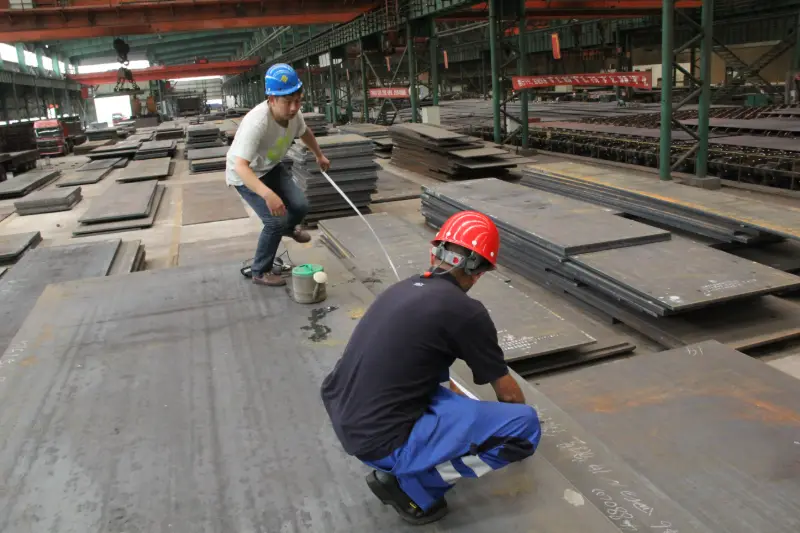
ASME SA709 Grade HPS70W High-Performance Weathering Steel Plate
ASME SA709 Grade HPS70W High-Performance Weathering Steel Plate for Bridges
ASME SA709 Grade HPS70W (SA709GRHPS70W) is a low-carbon, microalloyed high-performance weathering steel plate with minimum yield strength 70 ksi (485 MPa), excellent toughness, and superior atmospheric corrosion resistance.
Hot rolling, thermomechanical controlled rolling (TMCP), normalizing, quenching and tempering, welding, flame cutting, plasma cutting, brake forming, bending
- Phone : +8618037372205
- Email : [email protected]
- WhatsApp: Contact via Whtsapp
- WeChat: +8618037372205
ASME SA709 Grade HPS70W High-Performance Weathering Steel Plate Introduction
ASME SA709 Grade HPS70W (SA709GRHPS70W) is a high-performance weathering steel plate specifically developed for welded bridge and structural applications. It combines high strength (minimum yield strength 70 ksi / 485 MPa) with excellent atmospheric corrosion resistance and superior low-temperature toughness. The "HPS" designation stands for High Performance Steel, originally developed through a cooperative research program involving the Federal Highway Administration (FHWA), the U.S. Navy, and the American Iron and Steel Institute (AISI).
- Key features include: Low carbon equivalent (CE) for improved weldability, often eliminating preheat requirements; Controlled microalloying (vanadium, columbium, aluminum) for grain refinement and precipitation strengthening; Enhanced weathering resistance due to alloying with copper, chromium, and nickel, allowing unpainted use in many environments; Excellent fracture toughness at low service temperatures, meeting Charpy V-notch requirements down to -40°F (-40°C).
This grade is primarily supplied in plate form, typically in thicknesses up to 4 inches (100 mm), and can be delivered in as-rolled, normalized, or quenched and tempered conditions, though modern practice favors thermomechanical controlled processing (TMCP). HPS 70W is mandated by the ASTM A709/A709M standard (equivalent to ASME SA709) and is widely used in the construction of major bridge structures across North America, reducing lifecycle costs through durability and minimal maintenance.
ASME SA709 Grade HPS70W High-Performance Weathering Steel Plate Chemical Composition
The chemical composition of ASME SA709 Grade HPS 70W is carefully controlled to achieve the required mechanical properties and weathering characteristics while ensuring excellent weldability. The low carbon content (max 0.11%) reduces hardenability and the risk of cold cracking, while manganese, silicon, and a combination of microalloys (vanadium, aluminum, possibly niobium and titanium) provide strength and grain refinement. The addition of copper, chromium, and nickel enhances atmospheric corrosion resistance, forming a protective patina. Impurity elements such as phosphorus and sulfur are strictly limited to maintain toughness. These composition limits are defined by heat analysis per the standard; product analysis tolerances apply as per the standard.
| Element | Standard Value (wt%) | Remarks |
|---|---|---|
| Carbon (C) | ≤0.11 | |
| Manganese (Mn) | 1.10–1.35 | |
| Phosphorus (P) | ≤0.020 | |
| Sulfur (S) | ≤0.006 | |
| Silicon (Si) | 0.30–0.50 | |
| Copper (Cu) | 0.25–0.40 | |
| Nickel (Ni) | 0.25–0.40 | |
| Chromium (Cr) | 0.45–0.70 | |
| Molybdenum (Mo) | 0.02–0.08 | |
| Vanadium (V) | 0.04–0.08 | |
| Aluminum (Al) | 0.010–0.040 | |
| Nitrogen (N) | ≤0.015 | Grain refiners such as Nb or Ti may be added by producer agreement |
ASME SA709 Grade HPS70W High-Performance Weathering Steel Plate Thermal and Electrical Physical Properties
Physical properties are typical for low-alloy high-strength steels and are not directly specified in the material standard. These values are useful for design calculations involving heat transfer, thermal stress, and electromagnetic effects. They are influenced by the alloying elements and processing history but generally fall within narrow ranges for this steel class. All values are at room temperature (20°C / 68°F) unless noted.
| Property | Standard Required Value | Unit | Test Condition |
|---|---|---|---|
| Density (ρ) | 7.85 | g/cm³ | 20°C |
| Elastic Modulus (E) | 200 (29,000) | GPa (ksi) | 20°C |
| Shear Modulus (G) | 80 (11,600) | GPa (ksi) | 20°C |
| Poisson's Ratio (ν) | 0.3 | — | 20°C |
| Thermal Expansion Coefficient (α) | 11.7 (6.5 × 10⁻⁶) | µm/m·°C (in/in/°F) | 0–100°C (32–212°F) |
| Thermal Conductivity (λ) | 45 (26) | W/m·K (Btu/ft·h·°F) | 20°C |
| Specific Heat Capacity | 480 (0.115) | J/kg·K (Btu/lb·°F) | 20°C |
| Electrical Resistivity (ρ_e) | 0.18 (10.8) | µΩ·m (µΩ·in) | 20°C |
ASME SA709 Grade HPS70W High-Performance Weathering Steel Plate Mechanical Properties
Mechanical properties are determined on test specimens taken from plates in the as-supplied condition. The specified minimum yield and tensile strengths guarantee structural integrity. Elongation requirements ensure adequate ductility. Charpy V-notch impact testing, when specified (usually mandatory via Supplementary Requirement S5), demonstrates the steel's ability to resist brittle fracture at low service temperatures. The values below are per ASME SA709/SA709M, applicable for plate thickness up to 100 mm (4 in).
| Property | Standard Required Value | Unit | Test Condition |
|---|---|---|---|
| Yield Strength (ReH) | ≥70 (≥485) | ksi (MPa) | Plate thickness ≤ 4 in (100 mm) |
| Tensile Strength (Rm) | 85–110 (585–760) | ksi (MPa) | Plate thickness ≤ 4 in (100 mm) |
| Elongation (A) in 2 in [50 mm] | ≥19 | % | Thickness ≤ 0.75 in (20 mm) |
| Elongation (A) in 2 in [50 mm] | ≥16 | % | Thickness > 0.75 in to 4 in (20–100 mm) |
| Charpy V-Notch Impact (KV) | ≥35 (≥47) | ft-lbf (J) | At specified temperature (e.g., -20°F / -29°C for Zone 2) per S5 |
ASME SA709 Grade HPS70W High-Performance Weathering Steel Plate Identical Grade Standards and Substitutable Designations
| Country/Region | Standard | Grade | Remarks |
|---|---|---|---|
| USA | ASTM A709/A709M | Grade HPS 70W (HPS 70W) | Technically identical to ASME SA709 Grade HPS70W; ASME adopts ASTM specification with identical requirements. |
ASME SA709 Grade HPS70W High-Performance Weathering Steel Plate Application Introduction
HPS 70W is ideal for weight-critical, long-span bridge structures where high strength, corrosion resistance, and low-temperature toughness are essential. It allows unpainted construction in many environments, reducing lifecycle costs. Its excellent weldability simplifies fabrication, often eliminating preheating even for thick sections. Typical applications and products include:
Product Applications: Steel bridge girders (plate girders, box girders), Highway sign and signal pole supports, Structural frameworks for buildings and stadia, Offshore platform deck components
Processed into products: Welded plate girders, Built-up box sections, Truss members and chords, Stiffeners and diaphragm plates, Bearing plates and sole plates, Cross frames and lateral bracing, Deck support beams and stringers
Application industries: Bridge construction, Highway infrastructure, Commercial and industrial building construction, Offshore and marine structures (topsides)
ASME SA709 Grade HPS70W High-Performance Weathering Steel Plate Comparable / Similar Alternative Materials
| Country/Region | Standard | Grade | Remarks |
|---|---|---|---|
| USA | ASTM A709 | Grade 50W (A588) | Lower yield strength (50 ksi) weathering steel but similar corrosion resistance; not a direct strength substitute. |
| USA | ASTM A709 | Grade HPS 100W | Higher yield (100 ksi) member of the same HPS family; offers higher strength but slightly lower ductility; often used in hybrid designs. |
| Europe | EN 10025-5 | S355J2W/WP | Weathering steel with 355 MPa min yield (equivalent to 50 ksi); lower strength but widely available outside North America; cannot replace HPS 70W without redesign. |
| China | GB/T 4171 | Q460NH | 460 MPa yield weathering steel; similar strength range and atmospheric corrosion resistance, but toughness and weldability may differ; verify Charpy and CEV. |
| Europe | EN 10025-4 | S690Q | 690 MPa quenched & tempered structural steel; high strength but not inherently weathering; requires painting for corrosion protection; not a direct substitute for unpainted applications. |
Notes:
Weldability: The low carbon equivalent (typically ≤ 0.45 CE) allows welding with minimal or no preheat under normal conditions. Toughness: Guaranteed Charpy V-notch values at low temperatures ensure reliable performance in cold climates. Weathering: The alloy design forms a dense, adherent oxide layer (patina) that retards further corrosion, often eliminating the need for paint systems in non-marine environments. Additional supplementary requirements (e.g., ultrasonic testing, fracture toughness, Z-quality) may be specified by the purchaser.
- Share



