
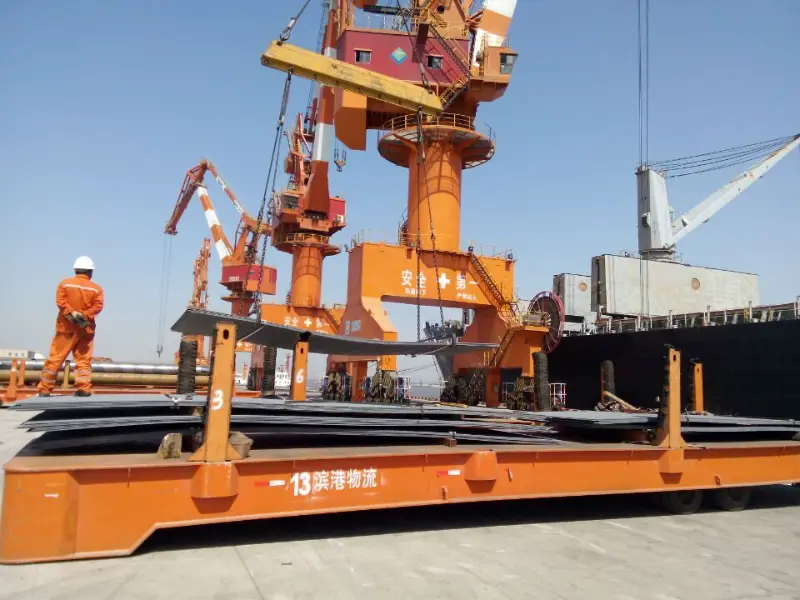
ASME SA709 HPS 50W Plate
ASME SA709 HPS 50W Plate - High-Performance Weathering Steel for Modern Bridge Structures
Comprehensive material data for ASME SA709 Grade HPS 50W (SA709GRHPS50W) carbon and low-alloy high-strength steel plate, featuring chemistry, tensile properties, physical constants, international equivalents, and typical bridge engineering applications.
Plates can be hot cut, plasma/laser cut, cold formed (within specific bend radii), machined, and welded using common processes (SMAW, FCAW, SAW etc.) following appropriate preheat and interpass controls.
- Phone : +8618037372205
- Email : [email protected]
- WhatsApp: Contact via Whtsapp
- WeChat: +8618037372205
ASME SA709 HPS 50W Plate Introduction
ASME SA709 Grade HPS 50W (also designated HPS 345W in metric) is a high-performance, weathering-grade structural steel plate specifically developed for welded highway bridges. It belongs to the family of carbon and low-alloy high-strength steels and conforms to the rigorous requirements of the ASME SA709/SA709M standard (identical to ASTM A709/A709M). The combined minimum yield strength of 50 ksi (345 MPa) with enhanced atmospheric corrosion resistance (the "W" suffix) enables designers to reduce maintenance painting and long-term life-cycle costs. Controlled chemical composition – notably low carbon with deliberate additions of copper, chromium, nickel, and vanadium – delivers excellent weldability, good low-temperature notch toughness, and a self-protecting patina under normal weathering conditions. Plates are typically supplied in the as-rolled, controlled-rolled, normalized, or quenched-and-tempered condition, depending on thickness and supplementary requirements. This grade is widely regarded as the backbone of modern steel bridges in North America, often specified alongside AASHTO M270 Grade HPS 50W for critical tension and compression members.
ASME SA709 HPS 50W Plate Chemical Composition
The chemistry of ASME SA709 Grade HPS 50W is tightly controlled to achieve the required strength, toughness, and weathering characteristics. Maximum sulfur and phosphorus are severely restricted, while copper, chromium, nickel, and vanadium provide the corrosion-resistant patina. Aluminum is added as a grain refiner and nitrogen scavenger. The low carbon content ensures excellent weldability. All values are taken from the official ASME SA709/SA709M standard, Table 1, for Grade HPS 50W [HPS 345W].
| Element | Standard Value (wt%) | Remarks |
|---|---|---|
| Carbon (C) | max 0.11 | Ladle analysis limit |
| Manganese (Mn) | 1.10 – 1.35 | Enhances strength and hardenability |
| Phosphorus (P) | max 0.020 | Controlled for toughness |
| Sulfur (S) | max 0.006 | Ultra-low sulfur for through-thickness ductility |
| Silicon (Si) | 0.30 – 0.50 | Deoxidizer and strength contributor |
| Copper (Cu) | 0.25 – 0.40 | Key element for weathering resistance |
| Nickel (Ni) | 0.25 – 0.40 | Enhances toughness and weathering |
| Chromium (Cr) | 0.45 – 0.70 | Promotes dense patina formation |
| Molybdenum (Mo) | 0.02 – 0.08 | Minor addition for strength and temper resistance |
| Vanadium (V) | 0.04 – 0.08 | Microalloying for precipitation strengthening |
| Aluminum (Al) | 0.010 – 0.040 | Grain size control and deoxidation |
| Nitrogen (N) | max 0.015 | Restricted to avoid detrimental effects on toughness |
| Iron (Fe) | Balance | The remainder of the composition |
ASME SA709 HPS 50W Plate Physical, Thermal, and Electrical Properties
The physical constants listed below are representative of low-alloy structural steels and are suitable for design calculations. They are not mandatory requirements of ASME SA709 but are derived from published data for similar HSLA weathering grades. Properties such as thermal expansion and thermal conductivity are critical for bridge designs subjected to daily and seasonal temperature swings. The values are valid for room temperature unless otherwise noted.
| Property | Typical Value | Unit | Remarks / Conditions |
|---|---|---|---|
| Density (ρ) | 7850 | kg/m³ | Ambient temperature |
| Modulus of Elasticity (E) | 205 | GPa | Tensile/compressive modulus at 20 °C |
| Shear Modulus (G) | 80 | GPa | Calculated from E and Poisson's ratio |
| Poisson's Ratio (ν) | 0.3 | — | Within elastic range |
| Coefficient of Thermal Expansion (α) | 11.7 × 10⁻⁶ | /°C | 20 °C to 100 °C range |
| Thermal Conductivity (λ) | 51.9 | W/(m·K) | At 100 °C |
| Specific Heat Capacity (cp) | 486 | J/(kg·K) | At 20 °C |
| Electrical Resistivity (ρe) | 0.18 × 10⁻⁶ | Ω·m | Typical for low-alloy steel at 20 °C |
ASME SA709 HPS 50W Plate Tensile and Impact Properties
The mechanical properties of ASME SA709 HPS 50W are verified in accordance with ASME SA709, primarily through tensile tests. Minimum yield strength of 50 ksi (345 MPa) is guaranteed for all plate thicknesses covered by the standard. The alloy exhibits a yield-to-tensile ratio conducive to structural safety. Elongation requirements guarantee ductility, and optional Charpy impact testing (when supplemented) ensures fracture toughness at low service temperatures. Bending performance is validated when specified. The values below are taken from the standard's Table 2 and relevant supplementary requirements.
| Property | Required Value | Unit | Test Condition / Remarks |
|---|---|---|---|
| Yield Strength (ReH, min) | 50 | ksi | All thicknesses (up to 4 in.) |
| Yield Strength (ReH, min) | 345 | MPa | Metric equivalent |
| Tensile Strength (Rm) | 70 – 110 | ksi | Full thickness range |
| Tensile Strength (Rm) | 485 – 760 | MPa | Metric equivalent |
| Elongation in 50 mm (LO = 50 mm, min) | 21 | % | Plate thickness ≤ ¾ in. (≤ 20 mm) |
| Elongation in 50 mm (LO = 50 mm, min) | 21 | % | Plate thickness > ¾ in. to 2 in. (20 to 50 mm) |
| Elongation in 50 mm (LO = 50 mm, min) | 18 | % | Plate thickness > 2 in. to 4 in. (50 to 100 mm) |
| Elongation in 200 mm (LO = 200 mm, min) | 18 | % | Plate thickness ≤ ¾ in. (≤ 20 mm) |
| Elongation in 200 mm (LO = 200 mm, min) | 18 | % | Plate thickness > ¾ in. to 2 in. (20 to 50 mm) |
| Elongation in 200 mm (LO = 200 mm, min) | 16 | % | Plate thickness > 2 in. to 4 in. (50 to 100 mm) |
| Bend Test (180°) – optional S5.4 | D = 1½t | — | Thickness ≤ ¾ in., no cracks on outside of bend |
| Bend Test (180°) – optional S5.4 | D = 2t | — | Thickness > ¾ in. to 2 in. |
| Bend Test (180°) – optional S5.4 | D = 2½t | — | Thickness > 2 in. to 4 in. |
| Charpy V‑Notch Impact (S5.2, Zone 2) | min avg. 27 / min single 22 | J | Test at –18 °C (0 °F), transverse specimens |
| Charpy V‑Notch Impact (S5.2, Zone 2) | min avg. 20 / min single 16 | ft·lbf | US customary units, same test conditions |
ASME SA709 HPS 50W Plate Complete Material Equivalents – Identical Standard and Grade Designations
| Country / Region | Standard | Grade | Remarks |
|---|---|---|---|
| USA (ASME) | ASME SA709/SA709M | Grade HPS 50W (HPS 345W) | The base specification under Boiler & Pressure Vessel Code, identical to ASTM A709 |
| USA (ASTM) | ASTM A709/A709M | Grade HPS 50W | Identical chemical and mechanical requirements; frequently referenced for bridge plate |
| USA (AASHTO) | AASHTO M270/M270M | Grade HPS 50W (345W) | Highway bridge design standard, fully interchangeable with ASME/ASTM grades |
ASME SA709 HPS 50W Plate Application Introduction
ASME SA709 Grade HPS 50W is purpose‑engineered for welded highway bridge construction. Its combination of high strength, excellent weldability, and natural weathering capability makes it the material of choice for unpainted bridge superstructures exposed to the atmosphere. The grade's guaranteed toughness, even in thick sections, supports redundant load paths and fracture‑critical member designs. Typical applications extend beyond bridges to heavy industrial structures where maintenance‑free corrosion protection is desired.
Product Applications: Plate girders and box girders, Truss bridges and arch ribs, Bridge deck plates and orthotropic deck panels, Cross frames and lateral bracing, Stiffeners, diaphragms, and splice plates, Built-up columns and pier segments
Processed into products: Flanges and webs of welded I‑girders, Splice plates and cover plates, Stifffeners (transverse and longitudinal), Cross‑frame angles and channels, Bolted or welded connection plates, Bearing stiffeners and sole plates, Cable‑stayed bridge anchor boxes (non‑marine environment)
Application industries: Bridge engineering (highway, railway, pedestrian), Heavy civil infrastructure, Industrial construction (caustic or corrosive atmospheres without marine salt spray), Transmission towers and poles (thinner gauges), Offshore topside secondary structures (if coating not required)
ASME SA709 HPS 50W Plate Similar and Closely Related Alternative Grades
| Country / Region | Standard | Grade | Remarks / Comparative Analysis |
|---|---|---|---|
| Europe | EN 10025-5 | S355J2W+N | Similar weathering steel but with lower minimum yield strength (355 MPa) and different alloying concept; suitable for less demanding bridge or structural applications where HPS 50W strength is not required. |
| Europe | EN 10025-4 | S460ML | Thermo-mechanically rolled, fine-grain structural steel with 460 MPa yield, excellent toughness; not a standard weathering grade (no specific Cu-Cr-Ni addition), requires protective coating for corrosion resistance similar to HPS 50W. |
| Canada | CSA G40.21 | 350WT | Weathering structural steel with 350 MPa minimum yield strength, similar in concept to HPS 50W but differs in specified chemical ranges and notch toughness categories; often accepted as alternative with engineering approval. |
Notes:
Weathering steel best practice: HPS 50W develops a dense, adherent patina when correctly detailed to allow wet‑dry cycling. The alloy is not recommended for continuously submerged conditions, marine splash zones, or highly polluted industrial atmospheres (above ISO C4 corrosivity category) without additional protective measures. When impact toughness is required, the purchaser must specify the desired A709 supplementary requirement S5.2 (Charpy V‑Notch test) with the applicable temperature zone (typically Zone 2, –18 °C). For through‑thickness tensile ductility, supplementary requirement S5.1 (T‑test) may be invoked. The steel is readily weldable with conventional processes using low‑hydrogen practices and appropriate preheat, typically 150–200 °F (65–95 °C), depending on plate thickness. Post‑weld heat treatment is normally not required for bridge fabrication. Ordering: Plates should be ordered to ASME SA709/SA709M with the designation "Grade HPS 50W" and any supplementary requirements clearly listed.
- Share



