
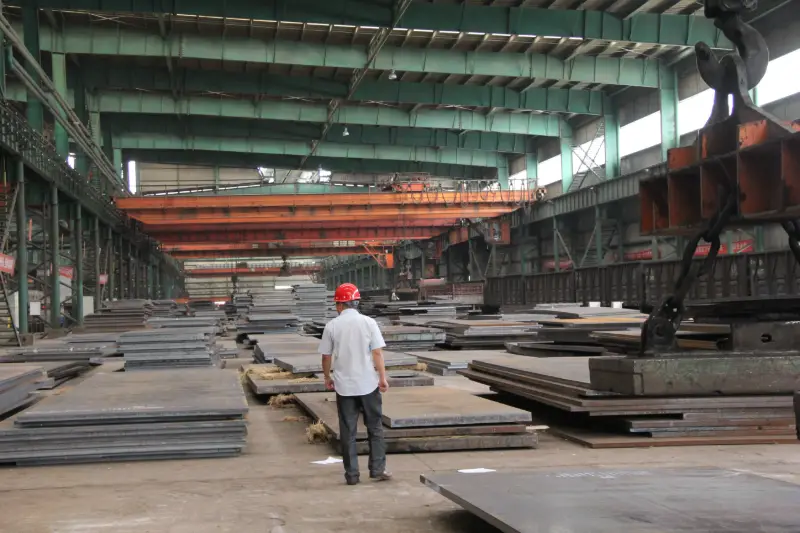
EN10025-2 S275J0 Steel
EN10025-2 S275J0 Steel: Technical Datasheet, Equivalents & Applications for Structural Engineering
Comprehensive technical datasheet for EN10025-2 S275J0 carbon steel, including chemical composition, mechanical and thermal properties, international equivalents, and application guidance.
Hot rolling, Normalizing, Welding, Machining, Bending, Cutting
- Phone : +8618037372205
- Email : [email protected]
- WhatsApp: Contact via Whtsapp
- WeChat: +8618037372205
EN10025-2 S275J0 Steel Introduction
EN10025-2 S275J0 is a hot-rolled, non-alloy structural steel grade defined in the European standard EN 10025-2:2019. It offers a minimum yield strength of 275 MPa for thicknesses up to 16 mm and is characterized by good weldability and machinability. The 'J0' designation indicates a minimum impact energy of 27 J at 0°C, ensuring reliable toughness for structural applications in ambient and low-temperature environments. This grade is widely used in construction, engineering, and machinery manufacturing.
EN10025-2 S275J0 Steel Chemical Composition
The chemical composition limits for S275J0 steel are defined in EN 10025-2:2019. These elements are carefully controlled to achieve the required mechanical properties and weldability.
- Ladle analysis values apply to the molten steel, while permissible deviations for the product analysis are specified in the standard.
- Carbon Equivalent Value (CEV) is a critical measure for weldability, with a maximum typically based on thickness, e.g., ≤0.40 for thicknesses ≤30mm.
| Element | Standard Value (Ladle Analysis, max %) | Notes |
|---|---|---|
| Carbon (C) | ≤0.18 | For thicknesses ≤16mm; for >16mm, ≤0.18 |
| Silicon (Si) | — | No specific limit mandated by standard |
| Manganese (Mn) | ≤1.50 | For thicknesses ≤16mm; for >16mm, ≤1.50 |
| Phosphorus (P) | ≤0.030 | |
| Sulfur (S) | ≤0.030 | |
| Nitrogen (N) | ≤0.012 | Nitrogen-fixing elements may be added, such as Aluminum, Titanium, or Vanadium |
| Copper (Cu) | ≤0.55 | If specified, content must be stated |
| Other Elements (e.g., Cr, Ni, Mo) | Residual limits apply | Not intentionally added; total residual ≤0.70 |
EN10025-2 S275J0 Steel Thermal and Electrical Physical Properties
Physical properties are typical for non-alloy structural steels and are not part of the mandatory verification under EN 10025-2, but crucial for design calculations. Modulus of elasticity and thermal expansion are essential for structural analysis involving stiffness and thermal loads. Thermal conductivity and specific heat are critical for processes like welding preheat calculation and fire resistance design.
| Property Item | Standard Typical Value | Unit | Testing Condition |
|---|---|---|---|
| Density (ρ) | 7850 | kg/m³ | At 20°C |
| Modulus of Elasticity (E) | 210 | GPa | At 20°C |
| Shear Modulus (G) | ~81 | GPa | At 20°C |
| Poisson's Ratio (ν) | ~0.3 | — | At 20°C, Elastic range |
| Thermal Expansion Coefficient (α) | 12.0 × 10⁻⁶ | K⁻¹ | From 20°C to 100°C |
| Thermal Expansion Coefficient (α) | 12.5 × 10⁻⁶ | K⁻¹ | From 20°C to 200°C |
| Thermal Expansion Coefficient (α) | 13.0 × 10⁻⁶ | K⁻¹ | From 20°C to 300°C |
| Thermal Expansion Coefficient (α) | 13.5 × 10⁻⁶ | K⁻¹ | From 20°C to 400°C |
| Thermal Expansion Coefficient (α) | 14.0 × 10⁻⁶ | K⁻¹ | From 20°C to 500°C |
| Thermal Conductivity (λ) | 54 | W/(m·K) | At 20°C |
| Thermal Conductivity (λ) | 51 | W/(m·K) | At 100°C |
| Thermal Conductivity (λ) | 48 | W/(m·K) | At 200°C |
| Thermal Conductivity (λ) | 44 | W/(m·K) | At 300°C |
| Thermal Conductivity (λ) | 41 | W/(m·K) | At 400°C |
| Thermal Conductivity (λ) | 38 | W/(m·K) | At 500°C |
| Specific Heat Capacity (cp) | 480 | J/(kg·K) | At 20°C |
| Specific Heat Capacity (cp) | 500 | J/(kg·K) | At 100°C |
| Specific Heat Capacity (cp) | 520 | J/(kg·K) | At 200°C |
| Specific Heat Capacity (cp) | 550 | J/(kg·K) | At 300°C |
| Specific Heat Capacity (cp) | 580 | J/(kg·K) | At 400°C |
| Specific Heat Capacity (cp) | 600 | J/(kg·K) | At 500°C |
| Electrical Resistivity (ρ_e) | ~0.20 × 10⁻⁶ | Ω·m | At 20°C |
EN10025-2 S275J0 Steel Mechanical Properties
Mechanical properties of S275J0 steel are guaranteed at ambient temperature according to EN 10025-2:2019. Values vary with product thickness. Longitudinal Charpy V-notch impact test at 0°C is mandatory, with minimum average absorbed energy of 27 J.
- Tensile testing is performed on transverse test pieces for plates, wide flats, and bars, and on longitudinal pieces for sections.
- Bendability is verified via a bending test to a specified mandrel diameter without cracking.
| Property Item | Standard Required Value | Unit | Testing Condition |
|---|---|---|---|
| Yield Strength (ReH) min | 275 | MPa | Nominal thickness (t) ≤ 16 mm |
| Yield Strength (ReH) min | 265 | MPa | 16 mm < t ≤ 40 mm |
| Yield Strength (ReH) min | 255 | MPa | 40 mm < t ≤ 63 mm |
| Yield Strength (ReH) min | 245 | MPa | 63 mm < t ≤ 80 mm |
| Yield Strength (ReH) min | 235 | MPa | 80 mm < t ≤ 100 mm |
| Yield Strength (ReH) min | 225 | MPa | 100 mm < t ≤ 150 mm |
| Tensile Strength (Rm) | 430 - 580 | MPa | t ≤ 100 mm |
| Tensile Strength (Rm) | 400 - 540 | MPa | 100 mm < t ≤ 150 mm |
| Elongation (A) min | 22 | % | Longitudinal, t ≤ 1 mm |
| Elongation (A) min | 21 | % | Longitudinal, 1 mm < t ≤ 1.5 mm |
| Elongation (A) min | 20 | % | Longitudinal, 1.5 mm < t ≤ 2 mm |
| Elongation (A) min | 19 | % | Longitudinal, 2 mm < t ≤ 2.5 mm |
| Elongation (A) min | 18 | % | Longitudinal, 2.5 mm < t < 3 mm |
| Elongation (A) min | 17 | % | Longitudinal, t ≥ 3 mm |
| Elongation (A) min | 15 | % | Transverse, t ≥ 3 mm |
| Charpy Impact Energy (KV) min | 27 | J | Longitudinal, 0°C |
| Bending Test (Mandrel Diameter) | See formula | Bend to 180° without cracking. Mandrel diameter D = 1.0 x thickness (t) for t ≤ 16mm; D = 2.0 x t for 16mm < t ≤ 100mm; D = 3.0 x t for 100mm < t ≤ 150mm. |
EN10025-2 S275J0 Steel Completely Equivalent Standards and Replaceable Grades
| Country/Region | Standard | Grade | Notes |
|---|---|---|---|
| European Union | EN 10025-2:2019 | S275J0 (1.0143) | Original specification |
| International | ISO 630-2:2011 | S275B | Identical chemical and mechanical requirements. Direct equivalent. |
| Germany | DIN EN 10025-2 | S275J0 (St 44-3 U) | Historic German designation in brackets, now equivalent |
| United Kingdom | BS EN 10025-2 | S275J0 | British adoption of the European standard. Identical. |
EN10025-2 S275J0 Steel Application Introduction
S275J0 is a versatile structural steel grade designed for a wide range of applications. Its balance of strength, toughness, and weldability makes it suitable for both static and dynamically loaded structures. It can be readily formed and machined, and its 0°C impact energy requirement ensures safety in moderate low-temperature service.
Product Applications: Multi-story building frames and beams, Bridge structural members (trusses, girders), Offshore platform topside secondary structures, Transmission line towers and lattice masts, Truck chassis and trailer frames, Storage tank shells and support structures, Piling pipes and sheet piles, Agricultural machinery frames and booms
Processed into products: Welded H-beams, I-beams, and box columns, Base plates, end plates, and stiffeners, Crane girders and runway beams, Booms, arms, and frames for excavators and loaders, Railway vehicle bogie frames, Industrial flooring plates and gratings, Brackets, flanges, and gussets, pressure vessel shells (optional quality classes available)
Application industries: Civil Engineering and Construction, General and Heavy Machinery Manufacturing, Automotive and Transportation (Heavy-Duty), Shipbuilding and Marine Structures (Non-critical components), Energy Sector (Transmission towers, structural supports), Agricultural Equipment, Metal Fabrication Workshops
EN10025-2 S275J0 Steel Recommendation for Similar/Alternative Materials
| Country/Region | Standard | Grade | Notes |
|---|---|---|---|
| China | GB/T 700 | Q275B | Similar yield strength (~275 MPa) and impact test (27J at 20°C). Q275B has slightly higher temperature impact requirement than J0 (0°C), making S275J0 marginally tougher in this aspect. Chemical ranges are analogous but not identical. |
| USA | ASTM A572/A572M | Grade 50 | Similar yield strength (345 MPa for t≤some ranges, but 275 MPa is available option for thicker sections). For matching 275 MPa yield, thicker Grade 50 or Grade 42 may be specified. Weldability and C, Mn levels are comparable, but ASTM chemistry is less prescriptive on residuals. |
| Japan | JIS G3106 | SM400A | Offers slightly lower min tensile strength (400-510 MPa vs 430-580 MPa), but matching yield strength (min 245 MPa for typical thicknesses) and 0°C impact option (/B). Weldable structural steel with good general equivalence. |
| Russia | GOST 27772 | C275 | Designed for similar yield strength (275 MPa) in construction. Chemical composition ranges differ, notably higher Silicon and Manganese limits, and it includes mandatory aluminum content for deoxidation. |
Notes:
Weldability: S275J0 is easily weldable with standard methods (SMAW, GMAW, SAW). Preheating is generally not required for sections under 30 mm, although a CEV assessment should be performed for thicker sections and restrained joints. Low-hydrogen procedures are always recommended.
Corrosion Resistance: As a non-alloy steel, S275J0 has no inherent atmospheric corrosion resistance and must be protected via painting, galvanizing, or other coating systems in corrosive environments.
Certification: Supplied with inspection certificates per EN 10204, typically type 3.1 or 3.2, verifying chemical composition and mechanical properties, including Charpy V-notch testing at 0°C.
De-oxidation: The steel is fully killed (Al-killed), ensuring fine grain size and uniform properties.
- Share



