
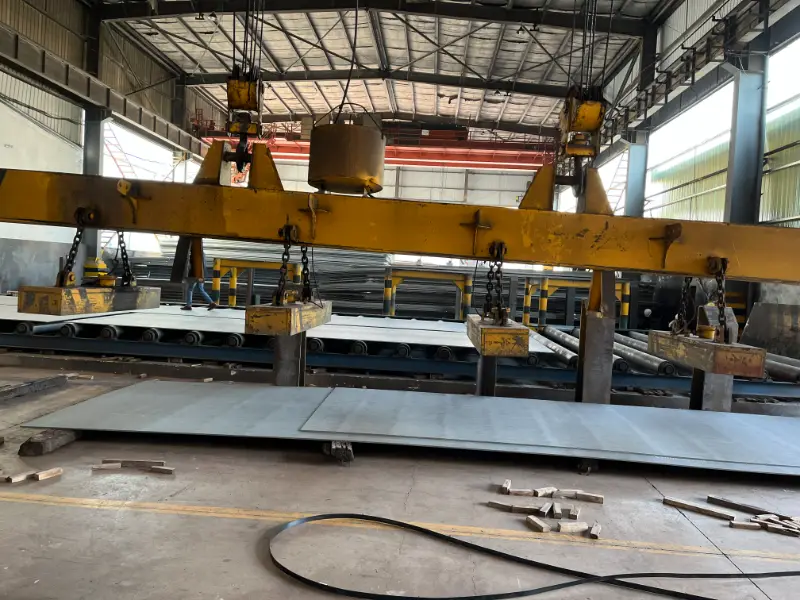
EN10025-2 S275JR Structural Steel Plate
EN10025-2 S275JR Structural Steel Plate - Everything You Need to Know
Comprehensive technical data for S275JR hot-rolled structural steel to EN10025-2: chemical composition, mechanical and physical properties, international equivalents, and application guidelines.
Hot rolling, normalizing rolling, normalizing (on agreement), flame cutting, welding, cold forming, machining
- Phone : +8618037372205
- Email : [email protected]
- WhatsApp: Contact via Whtsapp
- WeChat: +8618037372205
EN10025-2 S275JR Structural Steel Plate Introduction
S275JR is a non-alloy structural steel grade defined in EN 10025-2:2004. It delivers a minimum yield strength of 275 MPa in thicknesses up to 16 mm and guarantees a Charpy impact energy of at least 27 J at +20 °C (JR designation). The steel is produced via hot rolling and is primarily intended for welded, bolted, and riveted structures. Its balanced carbon-manganese chemistry ensures good weldability, formability, and machinability, making it one of the most widely used constructional steels in Europe and regions adopting EN standards. Typical applications include:
- Building frames and columns
- Bridge girders
- General engineering fabrications
- Storage tanks and silos
- Automotive chassis components
The material is normally supplied in the as-rolled condition, with the option of normalizing rolling or normalizing upon agreement. With excellent availability in plate, strip, sections, and hollow sections, S275JR serves as a cost-effective choice for medium-strength structural requirements where toughness, weldability, and dimensional stability are essential.
EN10025-2 S275JR Structural Steel Plate Chemical Composition
The following limits apply to S275JR according to EN 10025-2:2004. Values represent ladle analysis. Elements not listed are regarded as residual and must not exceed customary levels. Vanadium, niobium, and titanium are intentionally not added unless agreed. The carbon equivalent value (CEV) shall not exceed 0.40% when required for weldability assessment.
| Element | Standard Value (max %) | Remarks |
|---|---|---|
| Carbon (C) | 0.21 | For thickness ≤ 40 mm; 0.22 for >40 ≤ 100 mm; 0.23 for >100 mm |
| Manganese (Mn) | 1.50 | Applies to all thicknesses |
| Silicon (Si) | – | Not specified; typically 0.10 – 0.55 % if deoxidised |
| Phosphorus (P) | 0.035 | |
| Sulfur (S) | 0.035 | |
| Nitrogen (N) | 0.012 | |
| Copper (Cu) | 0.55 | May be present from scrap |
| Carbon Equivalent (CEV) | 0.40 | Based on ladle analysis; CEV = C + Mn/6 + (Cr+Mo+V)/5 + (Ni+Cu)/15 |
EN10025-2 S275JR Structural Steel Plate Physical Properties
The values below are indicative and represent typical behaviour of mild carbon steel at room temperature and elevated temperature ranges. Actual values may vary slightly depending on the exact manufacturing process and chemical composition. These data are useful for design calculations involving heat transfer, thermal stress, and electrical resistivity.
| Property | Typical Value | Unit | Test Condition / Remarks |
|---|---|---|---|
| Density (ρ) | 7.85 | g/cm³ | At 20 °C |
| Elastic modulus (E) | 210 | GPa | At 20 °C |
| Shear modulus (G) | 81 | GPa | At 20 °C |
| Poisson's ratio (ν) | 0.30 | – | Elastic range |
| Thermal expansion coefficient (α) | 11.1 | 10⁻⁶ /K | 20 – 100 °C |
| Thermal expansion coefficient (α) | 12.1 | 10⁻⁶ /K | 20 – 200 °C |
| Thermal expansion coefficient (α) | 12.9 | 10⁻⁶ /K | 20 – 300 °C |
| Thermal conductivity (λ) | 53 | W/(m·K) | At 20 °C |
| Thermal conductivity (λ) | 51 | W/(m·K) | At 100 °C |
| Specific heat capacity (Cp) | 460 – 500 | J/(kg·K) | 20 – 100 °C |
| Electrical resistivity (ρ_e) | 0.16 – 0.20 | μΩ·m | At 20 °C; depends on exact composition |
EN10025-2 S275JR Structural Steel Plate Mechanical Properties
Properties are valid for as-rolled (+AR) or normalized rolling (+N) condition. Mandatory testing is performed in accordance with EN 10025-1 and EN 10025-2. Impact values are verified on longitudinal Charpy-V specimens (transverse values on agreement). Yield strength and tensile strength depend on nominal product thickness.
| Property | Required Value | Unit | Test Condition / Thickness Range |
|---|---|---|---|
| Yield Strength (ReH) | 275 | MPa | Nominal thickness ≤ 16 mm |
| Yield Strength (ReH) | 265 | MPa | 16 mm < thickness ≤ 40 mm |
| Yield Strength (ReH) | 255 | MPa | 40 mm < thickness ≤ 63 mm |
| Yield Strength (ReH) | 245 | MPa | 63 mm < thickness ≤ 80 mm |
| Yield Strength (ReH) | 235 | MPa | 80 mm < thickness ≤ 100 mm |
| Yield Strength (ReH) | 225 | MPa | 100 mm < thickness ≤ 150 mm |
| Yield Strength (ReH) | 215 | MPa | 150 mm < thickness ≤ 200 mm |
| Yield Strength (ReH) | 205 | MPa | 200 mm < thickness ≤ 250 mm |
| Tensile Strength (Rm) | 410 – 560 | MPa | Thickness ≤ 100 mm |
| Tensile Strength (Rm) | 400 – 540 | MPa | 100 mm < thickness ≤ 150 mm |
| Tensile Strength (Rm) | 380 – 540 | MPa | 150 mm < thickness ≤ 250 mm |
| Elongation after fracture (A) | 23 | % | Longitudinal; thickness ≤ 40 mm; gauge length L₀ = 5.65√S₀ |
| Elongation after fracture (A) | 22 | % | 40 < thickness ≤ 63 mm |
| Elongation after fracture (A) | 21 | % | 63 < thickness ≤ 100 mm |
| Elongation after fracture (A) | 19 | % | 100 < thickness ≤ 150 mm |
| Elongation after fracture (A) | 18 | % | 150 < thickness ≤ 250 mm |
| Bending test (180°) | Mandrel diameter = 2.0 × thickness | – | Thickness ≤ 16 mm; no cracks |
| Bending test (180°) | Mandrel diameter = 3.0 × thickness | – | 16 < thickness ≤ 100 mm |
| Bending test (180°) | Mandrel diameter = 4.0 × thickness | – | 100 < thickness ≤ 250 mm |
| Charpy impact energy (KV₂) | ≥ 27 | J | At +20 °C; longitudinal; standard specimen 10 × 10 mm |
EN10025-2 S275JR Structural Steel Plate Exact and Near-Equivalent International Standards and Grades
| Country / Region | Standard | Grade | Remarks |
|---|---|---|---|
| International (ISO) | ISO 630-2:2011 | S275JR | Technically identical to EN S275JR |
| Germany | DIN EN 10025-2 | S275JR | Adoption of EN, previously St 44-2 (DIN 17100) |
| France | NF EN 10025-2 | S275JR | Adoption of EN, previously E 28-2 (NF A 35-501) |
| United Kingdom | BS EN 10025-2 | S275JR | Adoption of EN, previously Grade 43B (BS 4360) |
| China | GB/T 700-2006 | Q275B | Yield ≥275 MPa, impact 20 °C; higher carbon content possible |
| Japan | JIS G3101:2015 | SS400 | Yield ≥245 MPa; often accepted as substitute with project approval |
| USA | ASTM A36/A36M | A36 | Yield ≥250 MPa; strength derating may be required |
EN10025-2 S275JR Structural Steel Plate Application Introduction
EN10025-2 S275JR is a versatile structural steel that combines adequate strength, guaranteed toughness at room temperature, and excellent weldability using all common methods. It is designed for static and quasi‑static loads in civil and mechanical engineering. Because of its moderate carbon equivalent, the steel can be cold formed and machined without excessive tool wear. Detailed design and fabrication instructions should follow the relevant Eurocodes (EN 1993 for steel structures) and EN 1090 for execution.
Product Applications: Multi‑storey building skeletons and portal frames, Bridge decks and composite girders, Welded and bolted trusses, Heavy‑duty shelving and racking systems, Piling and sheet piles, Crane rails and supporting beams, Industrial flooring and grating, Pressure vessel shells (limited to low‑pressure applications)
Processed into products: I‑beams, H‑columns, and channel sections, Steel plates for base plates and gusset plates, Brackets, cleats, and connection angles, Welded box sections and tubular profiles, Stiffeners and diaphragms for bridges, Brackets and supports for curtain walls, Chassis parts for trucks and trailers, Excavator booms and equipment frames, Undercarriage components for agricultural machinery
Application industries: Construction and civil engineering, Bridge building and viaducts, Industrial and commercial steel framing, Shipbuilding and marine structures (secondary members), Railway vehicles and road transport, Agricultural and forestry equipment, Mechanical engineering, Storage tank and silo manufacturing, Wind turbine towers (specific parts)
EN10025-2 S275JR Structural Steel Plate Similar/Alternative Structural Steel Grades
| Country / Region | Standard | Grade | Remarks |
|---|---|---|---|
| EU | EN 10025-2 | S235JR | Lower strength (235 MPa); used where stiffness governs |
| EU | EN 10025-2 | S355JR | Higher strength (355 MPa); heavier load‑carrying members |
| China | GB/T 700 | Q235B | Yield ≥235 MPa; widely used for general structures |
| China | GB/T 1591 | Q345B | Similar to S355JR; often used for welded structures |
| Japan | JIS G3106 | SM400A | Weldable structural steel with comparable tensile properties |
| USA | ASTM A572/A572M | Grade 42 | Yield ≥290 MPa; improved strength, may replace S275JR after engineering review |
| India | IS 2062 | E250 B | Yield ≥250 MPa, impact 20 °C; widely used equivalent to mild steel |
Notes:
S275JR may be supplied with increased copper content (0.25–0.40 %) for enhanced atmospheric corrosion resistance; consult the producer. The '+' marking indicates impact tested at +20 °C on longitudinal samples unless otherwise agreed. For welded structures subject to fatigue, additional toughness requirements (e.g., J2 at -20 °C) should be considered. When specifying this steel for pressure‑bearing parts, verify compliance with PED 2014/68/EU or ASME as applicable. Normalizing (+N) is recommended for severe cold forming or to refine the grain structure after heavy welding. Environmental product declarations (EPD) based on EN 15804 are often available from major mills.
- Share



