
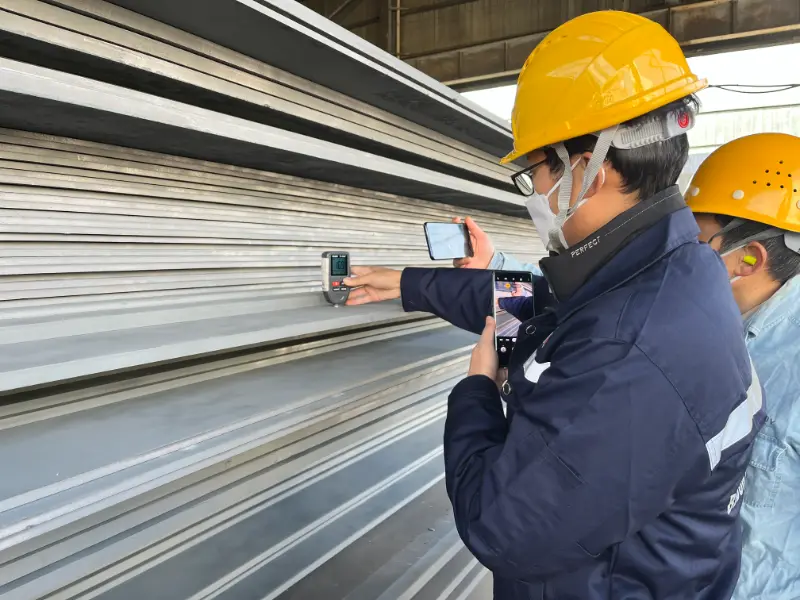
EN10025-2 S235J2 Steel Plate
EN10025-2 S235J2 Steel Plate: High-Strength Low-Alloy Structural Material with -20°C Impact Toughness
Comprehensive technical data for S235J2 structural steel according to EN 10025-2, including chemical composition, mechanical properties, physical characteristics, equivalent grades, and application guidance.
Hot rolling, normalizing rolling (+N), thermomechanical rolling (+M), welding, cutting, cold forming, punching, machining
- Phone : +8618037372205
- Email : [email protected]
- WhatsApp: Contact via Whtsapp
- WeChat: +8618037372205
EN10025-2 S235J2 Steel Plate Introduction
S235J2 is a non-alloy structural steel grade defined in the European standard EN 10025-2, widely utilized for welded, bolted, and riveted structures. Its designation indicates a minimum yield strength of 235 MPa (for thicknesses up to 16 mm) and guaranteed impact energy absorption of 27 J at -20°C (longitudinal Charpy V-notch), making it suitable for service in cold climates. The J2 suffix denotes that the steel is fully killed and fine-grain treated, ensuring consistent notch toughness.
- Excellent weldability with controlled carbon equivalent (CEV ≤ 0.35 for t ≤ 30 mm).
- Good formability for cold bending and moderate drawing operations.
- Available in a wide range of plate, sheet, and section dimensions, typically delivered in the normalized rolled (+N) condition to stabilize mechanical properties.
- Compliant with CE marking requirements under the Construction Products Regulation.
This material is a cornerstone for general structural engineering, offering a reliable balance of strength, ductility, and low-temperature performance.
EN10025-2 S235J2 Steel Plate Chemical Composition for S235J2 per EN 10025-2
The chemical composition is designed to provide good weldability and low-temperature toughness. Values are maximum limits unless a range is specified. The steel is fully killed and typically fine-grain treated with aluminium. For thicknesses >30 mm, carbon equivalent restrictions ensure satisfactory weldability without excessive preheat. The sum of residual elements (Cr+Mo+Ni+Cu) is normally limited to ≤0.70% for thickness ≤40 mm to maintain homogeneity.
| Chemical Element | Value (max, % by weight) | Remarks |
|---|---|---|
| C | ≤0.17 | Applicable for product thickness t ≤ 16 mm |
| Si | ≤0.35 | Deoxidation control |
| Mn | ≤1.40 | Contributes to strength and toughness |
| P | ≤0.025 | Low phosphorus for improved ductility |
| S | ≤0.025 | Low sulfur for better weldability |
| N | ≤0.012 | Nitrogen content limited to avoid strain ageing |
| Cu | ≤0.55 | If specified; copper improves atmospheric corrosion resistance |
| Al (total) | ≥0.020 | Indicative value when aluminium is used as grain refiner |
| CEV (Ceq) | ≤0.35 | Carbon equivalent value for t ≤ 30 mm; for 30 < t ≤ 100 mm, CEV ≤ 0.38 |
EN10025-2 S235J2 Steel Plate Thermal and Electrical Physical Properties
Physical properties are representative of low-carbon structural steels and may vary slightly depending on exact composition and heat treatment. The values provided are good engineering approximations for design calculations. Density is used for weight estimation, while thermal expansion and conductivity are critical for fire engineering and fabrication. Electrical resistivity is relevant for electrical grounding and induction heating applications.
| Property | Typical Value | Unit | Condition / Reference |
|---|---|---|---|
| Density (ρ) | 7850 | kg/m³ | At 20°C |
| Modulus of elasticity (E) | 210 | GPa | At 20°C |
| Shear modulus (G) | approx. 81 | GPa | Calculated from E and ν=0.3 |
| Poisson's ratio (ν) | 0.3 | — | Elastic range |
| Thermal expansion coefficient (α) | 11.1 | 10&supmin;&sup6;/K | 20-100°C |
| Thermal expansion coefficient | 12.1 | 10&supmin;&sup6;/K | 20-200°C |
| Thermal expansion coefficient | 13.5 | 10&supmin;&sup6;/K | 20-400°C |
| Thermal conductivity (λ) | 53 | W/(m·K) | At 20°C |
| Specific heat capacity (c) | 460 | J/(kg·K) | At 20°C |
| Electrical resistivity (ρₑ) | approx. 0.15 | μΩ·m | At 20°C |
EN10025-2 S235J2 Steel Plate Mechanical Properties of S235J2 according to EN 10025-2
Mechanical properties are determined on test pieces taken from the normalized rolled or normalized condition. The yield strength decreases with increasing thickness, while tensile strength and elongation also show thickness-dependent variation. Charpy V-notch impact energy is verified at -20°C for thicknesses ≥6 mm. The bending test confirms adequate formability; no cracking shall occur after 180° bending around a specified mandrel diameter. The values below represent minimum requirements unless a range is given.
| Property | Value | Unit | Condition / Thickness |
|---|---|---|---|
| Yield strength (ReH) | ≥235 | MPa | t ≤ 16 mm |
| Yield strength (ReH) | ≥225 | MPa | 16 < t ≤ 40 mm |
| Yield strength (ReH) | ≥215 | MPa | 40 < t ≤ 100 mm |
| Tensile strength (Rm) | 360 - 510 | MPa | t ≤ 100 mm |
| Tensile strength (Rm) | 350 - 500 | MPa | 100 < t ≤ 150 mm |
| Elongation A5 (L0=5.65√S0) | ≥26 | % | t ≤ 16 mm (longitudinal) |
| Elongation A5 | ≥26 | % | 16 < t ≤ 40 mm |
| Elongation A5 | ≥25 | % | 40 < t ≤ 63 mm |
| Elongation A5 | ≥24 | % | 63 < t ≤ 100 mm |
| Charpy V-notch impact energy (KV) | ≥27 | J | Longitudinal, -20°C, t ≥ 6 mm |
| Bend test (180°) | Mandrel dia. = 0.5a | — | t ≤ 16 mm (a = specimen thickness) |
| Bend test (180°) | Mandrel dia. = 1.0a | — | 16 < t ≤ 100 mm |
EN10025-2 S235J2 Steel Plate Fully Equivalent International Standards and Replaceable Grades
| Country/Region | Standard | Grade | Remarks |
|---|---|---|---|
| International (ISO) | ISO 630-2 | S235J2 | Identical technical delivery requirements; same mechanical and chemical limits, impact at -20°C. |
| China | GB/T 700 | Q235D | Equivalent impact temperature (-20°C), similar yield strength; however, Mn content is typically lower (≤0.60% for thinner sections, ≤0.80% for thicker). Additional verification recommended. |
| USA | ASTM A283/A283M | Grade D | Comparable tensile range (415-550 MPa) and yield (≥230 MPa). Impact testing must be specially ordered to Supplementary Requirement S5 to ensure -20°C performance. |
| Japan | JIS G3106 | SM400B | Yield ≥235 MPa; impact test at 0°C (27 J) – close but not fully equivalent to -20°C. SM400C (impact at -20°C) is a rarer grade and more matching. |
EN10025-2 S235J2 Steel Plate Application Introduction
S235J2 is a versatile structural steel suitable for a wide range of general engineering and construction projects. Its guaranteed -20°C impact toughness makes it particularly valuable for outdoor structures in temperate to cold climates, such as Northern Europe, Canada, and northern China. The steel is easily welded using conventional methods (SMAW, GMAW, SAW) and can be cut by flame, plasma, or mechanical shearing. Normalizing rolling ensures uniformity and freedom from harmful internal stresses, reducing the risk of distortion during fabrication.
- For thicknesses below 30 mm, preheating is typically unnecessary when welding at temperatures above +5°C.
- Galvanizing and painting are common surface protection measures.
- Cold forming radii should follow EN 10025-2 guidelines to avoid cracking, particularly in thicker sections.
Designers should consider the thickness-dependent reduction in yield strength when detailing connections and selecting member sizes.
Product Applications: Multi-story building columns and beams, Bridge girders, diaphragms and stiffeners, Crane runway beams and support frames, Chassis and dump bodies for heavy trucks, Storage silos, hoppers and bins, Wind turbine tower internals and platforms, Pressure vessel shells (non-ASME, utility service), Excavator booms, arms and base frames
Processed into products: Welded built-up I-beams and box sections, Base plates for columns and machinery, Gusset plates and stiffener ribs, Bolted end-plate connections, Flanges formed by bending or pressing, Pipe and hollow section components (cold-formed or hot-finished), Laser-cut or waterjet-cut parts for mechanical engineering, Brackets, lugs and support chairs
Application industries: Civil engineering and building construction, Bridge engineering (road and rail bridges), Heavy machinery and equipment manufacturing, Shipbuilding (secondary structures), Offshore platform topsides and modules, Pressure vessel and storage tank production, Vehicle and trailer chassis fabrication, Warehouse, factory and hangar structures
EN10025-2 S235J2 Steel Plate Closely Related or Similar Alternative Materials
| Country/Region | Standard | Grade | Remarks |
|---|---|---|---|
| Europe | EN 10025-2 | S235JR | Impact at +20°C (27 J); otherwise same strength and weldability. Suitable for indoor or mild climates. |
| Europe | EN 10025-2 | S235J0 | Impact at 0°C; intermediate toughness option between JR and J2. |
| Europe | EN 10025-2 | S275J2 | Higher yield (275 MPa) with -20°C impact; can substitute when weight savings are needed but requires design adjustments. |
| USA | ASTM A36/A36M | A36 | Yield ≥250 MPa; no mandatory impact requirement. Often used in similar structural applications but not for low-temperature toughness unless specified. |
| China | GB/T 700 | Q235B | Impact at +20°C; lower cost alternative for non-cold regions. Not a direct equivalent to J2. |
| Japan | JIS G3101 | SS400 | General structural steel; no impact guarantee; good weldability; commonly used where toughness is not critical. |
Notes:
Ordering information: Specify EN 10025-2, grade S235J2, delivery condition +N (normalized rolled), dimensions, tolerances (e.g., EN 10029 for plates), and any additional testing such as ultrasonic examination to EN 10160. Fabrication notes: For welded structures, a weldability study is recommended if thickness exceeds 50 mm. Post-weld heat treatment is generally not required due to the low carbon content. When exposed to aggressive environments, coating systems (e.g., hot-dip galvanizing to EN ISO 1461) should be applied. Storage: Store plates on flat, level supports to prevent bending and keep away from moisture to minimize oxidation before fabrication.
- Share



