
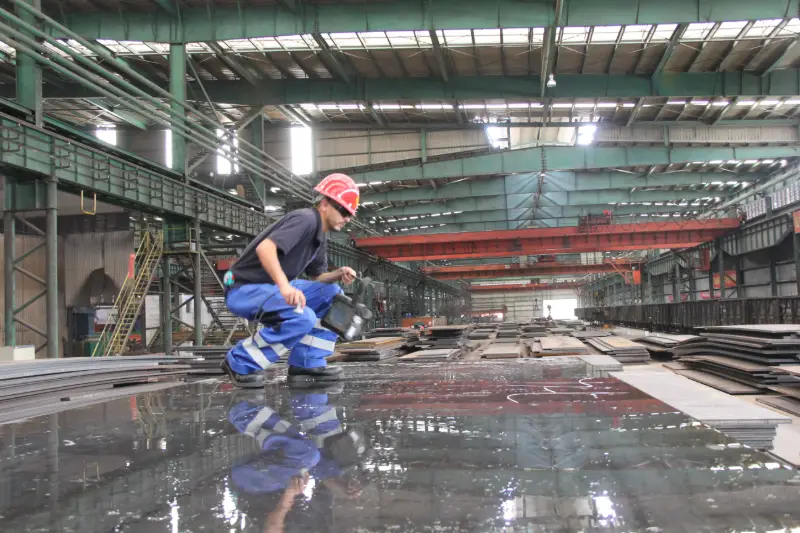
EN10025-4 S275ML Steel
EN10025-4 S275ML Steel: Thermomechanical Rolled Weldable Fine-Grain Structural Plate
Comprehensive material data for S275ML steel plate according to EN10025-4, including chemical composition, mechanical properties, thermal and electrical physical properties, equivalent grades, and application guidance.
Thermomechanical rolling, hot rolling, cutting, cold forming, welding, machining
- Phone : +8618037372205
- Email : [email protected]
- WhatsApp: Contact via Whtsapp
- WeChat: +8618037372205
EN10025-4 S275ML Steel Introduction
EN10025-4 S275ML is a thermomechanically rolled weldable fine-grain structural steel with a minimum yield strength of 275 MPa. It belongs to the S275 grade family and the 'ML' designation indicates guaranteed impact properties at -50°C (minimum 27 J). This steel offers a balanced combination of strength, ductility, and excellent low-temperature toughness, making it suitable for demanding structural applications in cold climates and offshore environments. Its fine-grain microstructure, achieved through controlled rolling without subsequent heat treatment, ensures good weldability and formability.
- Delivery condition: thermomechanically rolled (M)
- Low carbon equivalent for enhanced weldability
- Available in thicknesses up to 150 mm, with tailored properties across ranges
- Conforms to EN 10025-4:2019 (or earlier 2004)
EN10025-4 S275ML Steel Chemical Composition per EN 10025-4
The ladle analysis limits for S275ML according to EN 10025-4 are shown below. Residual elements and deoxidizing additions may be present. Note: For product analysis, permissible deviations apply as specified in the standard. Nitrogen-binding elements (Al, Nb, V, Ti) ensure grain refinement.
| Element | Maximum Value (%) | Remarks |
|---|---|---|
| Carbon (C) | 0.14 | |
| Silicon (Si) | 0.50 | |
| Manganese (Mn) | 1.50 | |
| Phosphorus (P) | 0.020 | |
| Sulfur (S) | 0.008 | |
| Aluminium total (Altot) | ≥0.015 | Minimum required for grain refinement |
| Niobium (Nb) | 0.05 | |
| Vanadium (V) | 0.08 | Sum Nb+V+Ti ≤0.22% |
| Titanium (Ti) | 0.05 | |
| Nickel (Ni) | 0.50 | |
| Molybdenum (Mo) | 0.20 | |
| Nitrogen (N) | 0.015 | The sum of N-binding elements must be sufficient to fix N |
| Copper (Cu) | 0.55 | If agreed, may be limited for hot-dip galvanizing |
EN10025-4 S275ML Steel Thermal and Electrical Physical Properties
The following physical properties are typical for S275ML steel at room temperature unless otherwise specified. Actual values may vary slightly with composition and condition. These data are useful for design calculations involving thermal expansion, heating, or electrical resistance.
| Property | Typical Value | Unit | Test Conditions |
|---|---|---|---|
| Density (ρ) | 7850 | kg/m³ | 20°C |
| Modulus of elasticity (E) | 210 | GPa | 20°C |
| Shear modulus (G) | 80 | GPa | 20°C |
| Poisson's ratio (ν) | 0.3 | — | 20°C |
| Thermal expansion coefficient (α) | 12 | 10⁻⁶/K | 20–100°C |
| Thermal conductivity (λ) | 50 | W/(m·K) | 20°C |
| Specific heat capacity | 460 | J/(kg·K) | 20°C |
| Electrical resistivity (ρ_e) | 0.20 | μΩ·m | 20°C |
EN10025-4 S275ML Steel Mechanical Properties per EN 10025-4
Tensile and impact properties determined at room temperature on longitudinal test pieces, except where noted. Impact test temperature is -50°C for ML grade. Values are minimum unless a range is given. Bending test performed with mandrel diameter as per table.
| Property | Standard Required Value | Unit | Test Conditions |
|---|---|---|---|
| Yield strength (ReH) | 275 | MPa | Thickness ≤16 mm |
| Yield strength (ReH) | 265 | MPa | Thickness 16-40 mm |
| Yield strength (ReH) | 255 | MPa | Thickness 40-63 mm |
| Yield strength (ReH) | 245 | MPa | Thickness 63-80 mm |
| Yield strength (ReH) | 235 | MPa | Thickness 80-100 mm |
| Tensile strength (Rm) | 370 – 530 | MPa | Thickness ≤100 mm |
| Tensile strength (Rm) | 360 – 510 | MPa | Thickness 100-150 mm |
| Elongation (A5) | 24 | % | Thickness ≤40 mm, L0=5.65√S0 |
| Elongation (A5) | 23 | % | Thickness 40-63 mm |
| Elongation (A5) | 22 | % | Thickness 63-80 mm |
| Elongation (A5) | 22 | % | Thickness 80-100 mm |
| Elongation (A5) | 21 | % | Thickness 100-150 mm |
| Impact energy (KV2) | 27 (longitudinal) | J | -50°C, thickness ≥6 mm |
| Bend test (mandrel dia.) | 1.0t (tensile face crack free) | — | Thickness ≤16 mm, 180° bend |
| Bend test | 1.5t | — | Thickness 16-40 mm |
| Bend test | 2.0t | — | Thickness >40 mm |
EN10025-4 S275ML Steel Fully Equivalent Material Standards and Substitutable Grades
| Country/Region | Standard | Grade | Remarks |
|---|---|---|---|
| Europe | EN 10025-4:2019 | S275ML | Original designation |
| International (ISO) | ISO 24314:2019 | S275ML | Harmonized with EN |
| Germany | DIN EN 10025-4 | S275ML | National adoption |
| France | NF EN 10025-4 | S275ML | National adoption |
| United Kingdom | BS EN 10025-4 | S275ML | National adoption |
| Italy | UNI EN 10025-4 | S275ML | National adoption |
| Spain | UNE EN 10025-4 | S275ML | National adoption |
| Sweden | SS EN 10025-4 | S275ML | National adoption |
| Poland | PN-EN 10025-4 | S275ML | National adoption |
EN10025-4 S275ML Steel Application Introduction
S275ML is widely used in welded steel structures where a combination of good strength, ductility, and reliable low-temperature toughness is essential. Its thermomechanical rolling results in a fine-grain microstructure, so the steel offers excellent weldability without excessive preheat requirements and resists brittle fracture in cold environments. Recommended for:
Product Applications: Welded structural sections and fabricated beams, Offshore platform legs and nodes, Wind turbine tower shells and flanges, Bridge deck plates and box girders, Crane booms and heavy machinery frames, Tank shell plates for low-temperature liquids (LNG/LPG), Ship hull plating for arctic operations, Piling and structural supports in seismic zones
Processed into products: Flanges for welded tubular connections, Stiffeners and web plates, Crane rail support beams, Mast and tower base plates, Heavy-duty bearing blocks, Cut-and-welded gearbox housings, Transition pieces for offshore wind monopiles
Application industries: Offshore engineering (platforms, sub-sea structures), Bridge construction (heavy plate girders, box girders), Wind energy (turbine towers, foundation transitions), Shipbuilding (hull plates, polar-class vessels), Crane and heavy lifting equipment, Pressure vessels and storage tanks in low-temperature service, Civil engineering (stadiums, long-span roofs)
EN10025-4 S275ML Steel Similar and Alternative Material Recommendations
| Country/Region | Standard | Grade | Remarks |
|---|---|---|---|
| Europe | EN 10025-3 | S275NL | Normalized rolled, same strength and -50°C impact, different delivery condition |
| Europe | EN 10025-4 | S275M | Same strength but minimum impact temperature -20°C (instead of -50°C) |
| Europe | EN 10025-4 | S355ML | Higher strength (355 MPa yield) with similar low-temperature toughness |
| Europe | EN 10025-4 | S420ML | Higher strength grade with -50°C impact properties |
| USA | ASTM A572/A572M | Grade 50 [345] Type 5 | Similar strength, but impact temperature and testing differ; may require supplementary requirements for low temp. |
| China | GB/T 1591 | Q345C | Yield strength ~345 MPa, impact 0°C; not fully equivalent but comparable in many structural uses |
| International (ISO) | ISO 24314 | S275M | Thermomechanical rolled, 275 MPa, impact -20°C |
Notes:
Additional requirements for through-thickness properties (Z-grade), ultrasonic testing (EN 10160, ASTM A578), or restrictions on chemical composition for hot-dip galvanizing may be specified at the time of ordering. The steel can be supplied with improved surface quality or closer dimensional tolerances upon agreement. Long-term exposure at temperatures above 400°C may affect properties; for elevated temperature applications refer to EN 10025-4 guidelines.
- Share



