
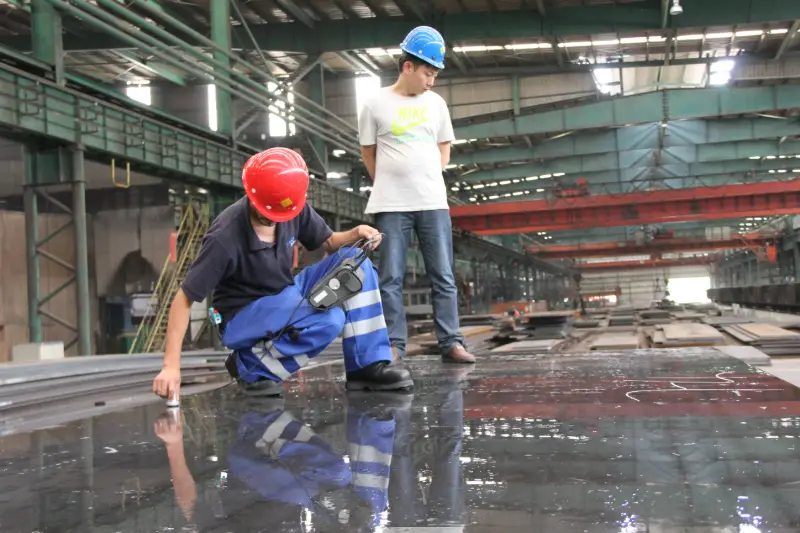
EN10025-4 S275M Steel
EN10025-4 S275M Steel: Thermomechanical Rolled Weldable Fine Grain Structural Steel
Comprehensive technical data for S275M structural steel according to EN 10025-4: chemical composition, mechanical properties, thermal and electrical characteristics, international equivalents, and application guidance.
Thermomechanical rolling, cold forming, welding, cutting, machining
- Phone : +8618037372205
- Email : [email protected]
- WhatsApp: Contact via Whtsapp
- WeChat: +8618037372205
EN10025-4 S275M Steel Introduction
S275M is a weldable fine grain structural steel produced by thermomechanical rolling, specified in EN 10025-4. It belongs to the family of carbon and low-alloy high-strength steels for structural applications. The grade ensures minimum yield strengths of 225–275 MPa depending on thickness, with excellent toughness down to -20 °C. Its fine grain microstructure, controlled by aluminium and micro-alloying elements, delivers superior weldability, formability, and notch toughness. S275M is extensively used in bridges, buildings, offshore structures, cranes, and heavy machinery where weight reduction and high reliability are required. The steel is supplied in normalized or as-rolled conditions and meets strict requirements for internal soundness and dimensional accuracy.
EN10025-4 S275M Steel Chemical Composition
The chemical composition follows EN 10025-4:2004 Table 1 for S275M. Maximum values unless otherwise stated. The steel is fine grain killed with aluminium and micro-alloyed with niobium, vanadium, titanium to achieve strength and toughness through grain refinement.
| Element | Standard Value (max, %) | Remarks |
|---|---|---|
| C | ≤ 0.13 | Carbon equivalent CEV ≤ 0.38 typical |
| Si | ≤ 0.50 | Silicon for deoxidation |
| Mn | ≤ 1.50 | Manganese for strength |
| P | ≤ 0.025 | Phosphorus, low content for toughness |
| S | ≤ 0.020 | Sulphur, low for weldability |
| Al (total) | ≥ 0.015 | Minimum for fine grain practice |
| Nb | ≤ 0.05 | Niobium micro-alloying |
| V | ≤ 0.08 | Vanadium micro-alloying |
| Ti | ≤ 0.05 | Titanium micro-alloying |
| Cr | ≤ 0.30 | Residual element |
| Ni | ≤ 0.30 | Residual element |
| Mo | ≤ 0.10 | Residual element |
| Cu | ≤ 0.55 | Residual element |
| N | ≤ 0.015 | Nitrogen, tied up by Al/Ti |
EN10025-4 S275M Steel Thermal and Electrical Physical Properties
Typical physical properties for S275M steel at room temperature and elevated temperatures. Values are representative for low-alloy structural steels and may vary slightly with actual composition and processing. Heat treatment and service conditions can influence these properties.
| Property | Standard Value (typical) | Unit | Test Condition / Temperature |
|---|---|---|---|
| Density (ρ) | 7850 | kg/m³ | 20 °C |
| Elastic Modulus (E) | 210 | GPa | 20 °C |
| Shear Modulus (G) | 81 | GPa | 20 °C |
| Poisson's Ratio (ν) | 0.3 | – | 20 °C |
| Thermal Expansion Coefficient (α) | 12 × 10⁻⁶ | K⁻¹ | 20–100 °C |
| Thermal Expansion Coefficient (α) | 13 × 10⁻⁶ | K⁻¹ | 20–200 °C |
| Thermal Expansion Coefficient (α) | 14 × 10⁻⁶ | K⁻¹ | 20–400 °C |
| Thermal Conductivity (λ) | 52 | W/(m·K) | 20 °C |
| Thermal Conductivity (λ) | 49 | W/(m·K) | 100 °C |
| Thermal Conductivity (λ) | 44 | W/(m·K) | 200 °C |
| Specific Heat Capacity (c) | 460 | J/(kg·K) | 20 °C |
| Specific Heat Capacity (c) | 490 | J/(kg·K) | 100 °C |
| Electrical Resistivity (ρ_e) | 0.16 – 0.20 | µΩ·m | 20 °C |
EN10025-4 S275M Steel Mechanical Properties
Properties according to EN 10025-4:2004 Tables 2–4. Tensile test transverse to rolling direction unless longitudinal specified. Impact test on longitudinal Charpy-V specimens at -20 °C. Values vary with product thickness.
| Property | Standard Requirement | Unit | Test Condition / Thickness Range |
|---|---|---|---|
| Yield Strength (ReH) | 275 | MPa | t ≤ 16 mm |
| Yield Strength (ReH) | 265 | MPa | 16 < t ≤ 40 mm |
| Yield Strength (ReH) | 255 | MPa | 40 < t ≤ 63 mm |
| Yield Strength (ReH) | 245 | MPa | 63 < t ≤ 80 mm |
| Yield Strength (ReH) | 235 | MPa | 80 < t ≤ 100 mm |
| Yield Strength (ReH) | 225 | MPa | 100 < t ≤ 120 mm |
| Tensile Strength (Rm) | 370 – 530 | MPa | t ≤ 16 mm |
| Tensile Strength (Rm) | 360 – 520 | MPa | 16 < t ≤ 40 mm |
| Tensile Strength (Rm) | 350 – 510 | MPa | 40 < t ≤ 63 mm |
| Tensile Strength (Rm) | 340 – 500 | MPa | 63 < t ≤ 80 mm |
| Tensile Strength (Rm) | 330 – 490 | MPa | 80 < t ≤ 100 mm |
| Tensile Strength (Rm) | 320 – 480 | MPa | 100 < t ≤ 120 mm |
| Elongation after fracture (A) | 24 | % | Long. t ≤ 16 mm, L0=5.65√S0 |
| Elongation after fracture (A) | 23 | % | Long. 16 < t ≤ 40 mm |
| Elongation after fracture (A) | 22 | % | Long. 40 < t ≤ 63 mm |
| Elongation after fracture (A) | 21 | % | Long. 63 < t ≤ 80 mm |
| Elongation after fracture (A) | 20 | % | Long. 80 < t ≤ 100 mm |
| Elongation after fracture (A) | 19 | % | Long. 100 < t ≤ 120 mm |
| Bend test (transverse) | d = 2a | – | t ≤ 16 mm (180° bend) |
| Bend test (transverse) | d = 3a | – | 16 < t ≤ 40 mm |
| Bend test (transverse) | d = 3a | – | 40 < t ≤ 63 mm |
| Bend test (transverse) | d = 3a | – | 63 < t ≤ 80 mm |
| Bend test (transverse) | d = 4a | – | 80 < t ≤ 100 mm |
| Bend test (transverse) | d = 4a | – | 100 < t ≤ 120 mm |
| Charpy Impact (KV, long.) | ≥ 27 | J | -20 °C, 10x10 mm specimen |
EN10025-4 S275M Steel Perfect Material Equivalent Standards and Replaceable Grades
| Country / Region | Standard | Grade | Remarks |
|---|---|---|---|
| EU | EN 10025-4:2004 | S275M | Identical base standard for thermomechanical rolled fine grain steel. |
| Japan | JIS G3106:2015 | SM490A | Direct replacement, similar strength and toughness at -20°C. |
| United States | ASTM A572/A572M-18 | Grade 50 [345] | Yield strength is higher (345 MPa for t≤100 mm), adjust design accordingly. |
| China | GB/T 1591-2018 | Q345D | Comparable strength and -20°C impact; check deoxidation practice. |
| International | ISO 4950-2:1995 | E355-DD | Higher yield class but similar fine grain weldable concept. |
EN10025-4 S275M Steel Application Introduction
S275M combines good strength, excellent weldability, and reliable low-temperature toughness. It is widely applied in structural engineering, heavy machinery, and offshore engineering where dynamic loads and safety are critical. The thermomechanical rolling process refines the grain without excessive alloying, making it cost-effective and easy to fabricate. Below are typical industries, products, and components.
Product Applications: Steel plate for welded beams and columns, Wide flat bars for crane rails, Hot-rolled coils for formed hollow sections, Cut-to-length plate for structural fabrication
Processed into products: Welded I-beams and box girders for bridges, Crane main booms and jibs, Offshore platform legs and deck beams, Excavator arms and buckets, Wind tower tubular sections, Heavy vehicle chassis frames, Storage tank shells and roofs
Application industries: Construction and civil engineering (bridges, high-rise buildings, stadiums), Shipbuilding and marine structures (hulls, decks, offshore platforms), Crane and lifting equipment (mobile cranes, tower cranes), Earthmoving and mining machinery (excavator booms, dump truck bodies), Transport and railway vehicles (wagon frames, trailer chassis), Energy (wind turbine towers, pressure vessel shells)
EN10025-4 S275M Steel Similar / Alternative Material Recommendations
| Country / Region | Standard | Grade | Remarks |
|---|---|---|---|
| EU | EN 10025-2:2004 | S275JR/J0/J2 | Non-fine grain carbon steel; lower toughness and not TMCP, may require larger sections. |
| EU | EN 10025-3:2004 | S275N/NL | Normalized fine grain steel; similar strength, slightly higher toughness class. |
| EU | EN 10025-6:2004 | S460QL | Quenched and tempered steel with higher strength, good weldability. |
| United States | ASTM A709/A709M | Grade 36 (≤250 MPa) or 50 | Bridge steel; Grade 50 can substitute if strength/dimensions adjusted. |
| Russia | GOST 19281-2014 | 09G2S | Low-alloy structural steel, suitable for welded structures, -40°C impact available. |
Notes:
CEV (Carbon Equivalent Value) is limited to typically ≤ 0.38% for good weldability. Preheating may be needed for thick sections. Post-weld heat treatment is not normally required. Delivery options include ultrasonic testing according to EN 10160, improved Z-grade through-thickness properties per EN 10164, and additional impact testing. Consult the corresponding standard for supplementary requirements.
- Share



