
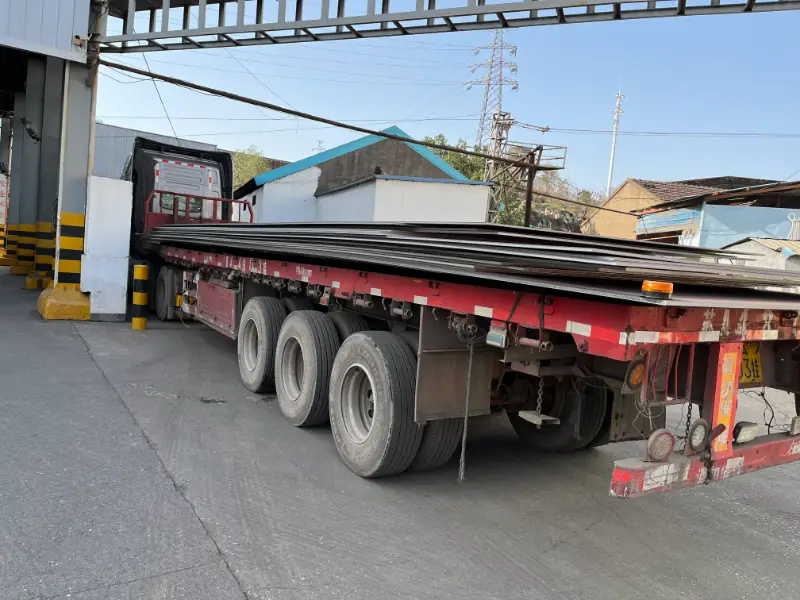
EN10025-3 S460NL Heavy Structures
EN10025-3 S460NL Normalized High-Strength Low-Alloy Steel Plate for Heavy Structures
Detailed data sheet of S460NL steel according to EN 10025-3, including chemical composition, mechanical properties, thermal and electrical physical properties, international equivalents, and application guidance.
hot rolling, normalized rolling, normalizing (+N), cutting, forming, welding, machining
- Phone : +8618037372205
- Email : [email protected]
- WhatsApp: Contact via Whtsapp
- WeChat: +8618037372205
EN10025-3 S460NL Heavy Structures Introduction
S460NL is a normalized / normalized rolled weldable fine-grain structural steel defined in EN 10025-3. It belongs to the high-strength low-alloy (HSLA) category and is designed for heavy structural applications requiring a minimum yield strength of 460 MPa and excellent low-temperature toughness. The designation 'N' indicates that the steel is supplied in the normalized or normalized rolled condition, while 'L' specifies impact testing at -50°C with a minimum energy of 27 J. S460NL offers a favorable combination of high strength, good weldability, and resistance to brittle fracture, making it suitable for severe service conditions such as bridges, offshore platforms, pressure vessels, and crane booms. It is typically delivered in thicknesses up to 150 mm. The fine-grain structure is achieved by controlled rolling and normalizing heat treatment, ensuring uniform mechanical properties through thickness. The steel can be readily formed, machined, and welded using standard procedures, though preheating may be required for thicker sections and low-hydrogen practices are recommended to avoid hydrogen-induced cracking.
EN10025-3 S460NL Heavy Structures Chemical Composition
The ladle analysis limits for S460NL according to EN 10025-3:2019 for product thickness ≤ 100 mm. Fine-grain elements such as Al, Nb, V and Ti are controlled to achieve the required strength and toughness.
- Aluminum is added for grain refinement and deoxidation (minimum total Al).
- Niobium, vanadium and titanium contribute to precipitation hardening and grain size control.
- Phosphorus and sulfur are kept very low to ensure good weldability and ductility.
| Element | Standard Value (wt%) | Remarks |
|---|---|---|
| C (Carbon) | ≤ 0.20 | CEV depends on thickness; typically ≤ 0.47 for t≤63 mm |
| Si (Silicon) | ≤ 0.60 | Deoxidizer and strength contributor |
| Mn (Manganese) | 1.00 - 1.70 | Enhances hardenability and toughness |
| P (Phosphorus) | ≤ 0.025 | Low level for improved weldability and ductility |
| S (Sulfur) | ≤ 0.015 | Low sulfur reduces hot shortness |
| Al (Aluminum) | ≥ 0.015 (total) | Grain refining and deoxidation |
| N (Nitrogen) | ≤ 0.015 | Nitrogen fixed by Al and V to avoid strain ageing |
| Nb (Niobium) | ≤ 0.05 | Microalloying for strength and grain refinement |
| V (Vanadium) | ≤ 0.20 | Microalloying, optional; may be added solely or in combination |
| Ti (Titanium) | ≤ 0.05 | Microalloying, optional; also used for grain refinement |
| Cr (Chromium) | ≤ 0.30 | Residual element, limited to maintain weldability |
| Ni (Nickel) | ≤ 0.80 | Improves toughness; limit to avoid hardenability issues |
| Mo (Molybdenum) | ≤ 0.10 | Residual; low content ensures good weldability |
| Cu (Copper) | ≤ 0.55 | May appear from scrap; limit to avoid hot shortness |
EN10025-3 S460NL Heavy Structures Thermal and Electrical Physical Properties
Typical physical properties for S460NL at room temperature and elevated temperatures. These values are generic for low-alloy structural steels and may vary slightly depending on exact composition and heat treatment.
- Density is close to that of pure iron.
- Elastic modulus decreases with temperature; values given at 20°C are standard.
- Thermal expansion coefficient increases with temperature range.
- Thermal conductivity decreases as temperature rises.
| Property | Typical Value | Unit | Condition / Temperature |
|---|---|---|---|
| Density (ρ) | 7850 | kg/m³ | 20 °C |
| Elastic modulus (E) | 210 | GPa | 20 °C |
| Shear modulus (G) | 81 | GPa | 20 °C |
| Poisson ratio (ν) | 0.3 | — | 20 °C |
| Thermal expansion coefficient (α) | 11.7 | ×10⁻⁶ /K | 20–100 °C |
| Thermal expansion coefficient (α) | 12.5 | ×10⁻⁶ /K | 20–200 °C |
| Thermal expansion coefficient (α) | 13.5 | ×10⁻⁶ /K | 20–300 °C |
| Thermal expansion coefficient (α) | 14.0 | ×10⁻⁶ /K | 20–400 °C |
| Thermal conductivity (λ) | 52 | W/(m·K) | 20 °C |
| Thermal conductivity (λ) | 51 | W/(m·K) | 100 °C |
| Thermal conductivity (λ) | 48 | W/(m·K) | 200 °C |
| Thermal conductivity (λ) | 45 | W/(m·K) | 300 °C |
| Thermal conductivity (λ) | 42 | W/(m·K) | 400 °C |
| Specific heat capacity | 460 | J/(kg·K) | 20 °C |
| Electrical resistivity (ρ_e) | 2.0×10⁻⁷ | Ω·m | 20 °C |
EN10025-3 S460NL Heavy Structures Mechanical Properties
Mechanical properties for S460NL according to EN 10025-3, valid for normalized / normalized rolled condition and longitudinal test pieces.
- Yield strength (ReH) decreases with increasing product thickness.
- Elongation is measured on a gauge length L0 = 5.65√S0 (proportional test piece, either 80 mm or 50 mm depending on thickness).
- Charpy-V impact energy is guaranteed at -50°C for all thicknesses up to 150 mm.
- Bend test (180°) ensures sufficient formability.
| Property | Standard Requirement | Unit | Test Condition / Thickness |
|---|---|---|---|
| Yield strength ReH | ≥ 460 | MPa | t ≤ 16 mm |
| Yield strength ReH | ≥ 440 | MPa | 16 mm < t ≤ 40 mm |
| Yield strength ReH | ≥ 420 | MPa | 40 mm < t ≤ 63 mm |
| Yield strength ReH | ≥ 400 | MPa | 63 mm < t ≤ 80 mm |
| Yield strength ReH | ≥ 390 | MPa | 80 mm < t ≤ 100 mm |
| Yield strength ReH | ≥ 380 | MPa | 100 mm < t ≤ 150 mm |
| Tensile strength Rm | 540 - 720 | MPa | t ≤ 16 mm |
| Tensile strength Rm | 540 - 720 | MPa | 16 mm < t ≤ 40 mm |
| Tensile strength Rm | 540 - 720 | MPa | 40 mm < t ≤ 63 mm |
| Tensile strength Rm | 540 - 720 | MPa | 63 mm < t ≤ 100 mm |
| Tensile strength Rm | 540 - 720 | MPa | 100 mm < t ≤ 150 mm |
| Elongation A (L0=5.65√S0) | ≥ 15 | % | t ≤ 16 mm, longitudinal |
| Elongation A (L0=5.65√S0) | ≥ 15 | % | 16 mm < t ≤ 40 mm, longitudinal |
| Elongation A (L0=5.65√S0) | ≥ 15 | % | 40 mm < t ≤ 63 mm, longitudinal |
| Elongation A (L0=5.65√S0) | ≥ 15 | % | 63 mm < t ≤ 100 mm, longitudinal |
| Elongation A (L0=5.65√S0) | ≥ 15 | % | 100 mm < t ≤ 150 mm, longitudinal |
| Bend test (180°) | d = 2 a | — | t ≤ 16 mm; a = specimen thickness |
| Bend test (180°) | d = 3 a | — | 16 mm < t ≤ 40 mm |
| Bend test (180°) | d = 4 a | — | 40 mm < t ≤ 63 mm |
| Bend test (180°) | d = 5 a | — | 63 mm < t ≤ 100 mm |
| Bend test (180°) | d = 6 a | — | 100 mm < t ≤ 150 mm |
| Impact energy KV (-50°C) | ≥ 27 | J | longitudinal, t ≤ 150 mm |
EN10025-3 S460NL Heavy Structures Exact Equivalent Material Standards & Substitute Grades
| Country / Region | Standard | Grade | Remarks |
|---|---|---|---|
| European Union | EN 10025-3 | S460NL | Base specification; normalized or normalized rolled, impact -50°C |
| International | ISO 630-3 | S460NL | Identical technical requirements, identical designation |
| United Kingdom | BS EN 10025-3 | S460NL | Adopted European standard, fully equivalent |
| Germany | DIN EN 10025-3 | S460NL | German version of EN standard, equivalent |
| France | NF EN 10025-3 | S460NL | French version of EN standard, equivalent |
| Italy | UNI EN 10025-3 | S460NL | Italian version of EN standard, equivalent |
EN10025-3 S460NL Heavy Structures Application Introduction
S460NL is used where high strength, good weldability, and safety against brittle fracture at low temperatures are required. Typical applications lie in heavy structural engineering and transportation. The fine-grain normalized microstructure ensures homogeneous properties even in thick plates, making it ideal for critical, fatigue-loaded components.
- Welding: conventional methods (SMAW, SAW, GMAW) with low-hydrogen procedures; preheating recommended for thickness >30 mm.
- Design: high yield strength allows weight reduction and slender sections.
- Cold forming: possible for thin plates but springback must be compensated.
Product Applications: Steel bridges (box girders, trusses, arches), High-rise and industrial buildings (columns, beams, frame connections), Offshore platforms and subsea structures, Wind turbine towers and transition pieces, Crane booms and mobile crane chassis, Pressure vessels (with additional requirements per EN 13445 or ASME BPVC), Mining equipment (dump trucks, excavator booms)
Processed into products: Welded I-beams, box sections, and built-up members, Bridge deck plates and stiffeners, Column-to-beam connections and end plates, Thick-walled structural nodes and gussets, Tubular sections for offshore jackets, Flanges and web plates in crane girders, Reinforcing ribs and stiffeners in heavy fabrications, Cut and machined parts for bolted or welded assemblies
Application industries: Bridge construction, High-rise building and civil engineering, Offshore and marine structural engineering, Wind energy tower fabrication, Pressure vessel and storage tank manufacturing, Heavy machinery and equipment, Mining and earthmoving equipment, Shipbuilding (including hull, decks, and superstructures)
EN10025-3 S460NL Heavy Structures Similar / Analogous Alternative Material Recommendations
| Country / Region | Standard | Grade | Remarks |
|---|---|---|---|
| China | GB/T 1591-2018 | Q460NE | Normalized, minimum yield 460 MPa, impact at -40°C (KV≥34 J). Slightly higher impact temperature than S460NL (-50°C); suitable for less severe cold conditions. |
| China | GB/T 1591-2018 | Q460ND | Normalized, min yield 460 MPa, impact at -20°C. Lower toughness; can replace S460NL only if low-temperature toughness not critical. |
| Japan | JIS G3106 | SM570 | Tensile strength 570-720 MPa, yield typically ≥430 MPa (depend thickness). No mandatory low-temperature impact; Charpy may be agreed. Can be used with supplementary impact test at -50°C. |
| USA | ASTM A572/A572M | Grade 65 | Yield 450 MPa, tensile 550 MPa. No impact guarantee; supplementary Charpy at -50°C can be ordered, making it a partial substitute. |
| European Union | EN 10025-4 | S460ML | Thermomechanically rolled, same strength level, impact -50°C. Different delivery condition; mechanical properties similar, but forming and welding characteristics differ from normalized steel. |
| European Union | EN 10025-6 | S460QL | Quenched and tempered, impact -60°C, higher strength variation. Suitable for special cases with appropriate design; not a direct replacement for normalized applications. |
Notes:
S460NL is typically supplied with inspection certificate 3.1 according to EN 10204. The carbon equivalent (CEV) is controlled and usually ≤0.47% for thicknesses up to 63 mm, and ≤0.49% for thicker products, ensuring good weldability. When welding, low hydrogen inputs and adequate preheat/interpass temperatures should be used to avoid cold cracking. Post-weld heat treatment (PWHT) is generally not required unless stress relief is specified by design codes. The steel can be galvanized or painted with normal surface preparation. For seismic or extreme low-duty conditions, additional requirements (e.g., through-thickness properties per EN 10164) may be specified as options.
- Share



