
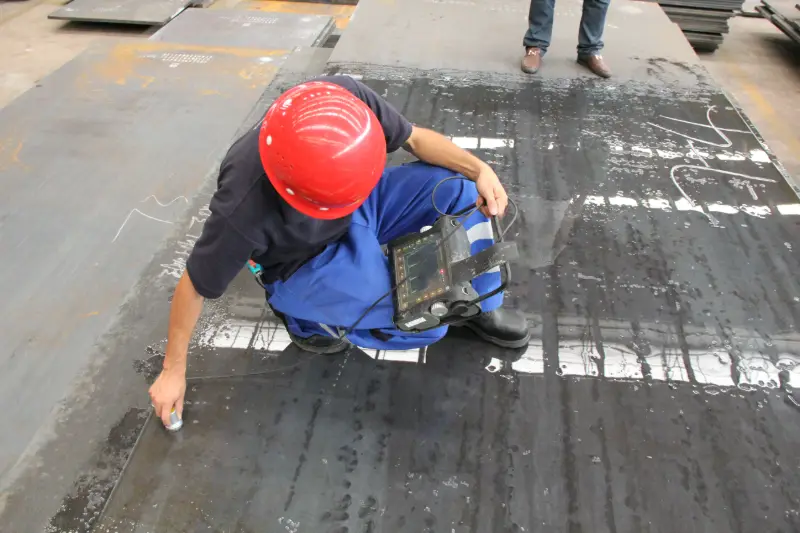
EN 10025-3 S460N Normalized High-Strength Structural Steel Plate
EN 10025-3 S460N Normalized High-Strength Structural Steel Plate - Full
Comprehensive material properties of S460N carbon and low-alloy high-strength structural steel according to EN 10025-3:2019, including chemical composition, mechanical properties at various thicknesses, physical constants, international equivalent grades, and application guidance.
Hot rolling, normalizing, welding, cutting, bending, drilling, machining; supplied in normalized or normalized rolled condition (+N)
- Phone : +8618037372205
- Email : [email protected]
- WhatsApp: Contact via Whtsapp
- WeChat: +8618037372205
EN 10025-3 S460N Normalized High-Strength Structural Steel Plate Introduction
S460N is a normalized/normalized rolled weldable fine-grain structural steel defined in EN 10025-3:2019. It combines a minimum yield strength of 460 MPa with good toughness and excellent weldability, achieved through fine grain practice and controlled rolling followed by normalizing.
- Guaranteed impact energy at -20°C (min 40 J)
- Thickness range typically up to 200 mm for plates and wide flats
- Low carbon equivalent (CEV) ensures easy welding with appropriate preheat
- Supplied in the +N condition (normalized or normalized rolled)
This material is widely used in heavy steel structures, bridges, offshore platforms, and pressure vessels where both high strength and reliable toughness are required.
EN 10025-3 S460N Normalized High-Strength Structural Steel Plate Chemical Composition
Chemical requirements for S460N as specified in EN 10025-3:2019. Values are in weight percent (max unless a range is given). A minimum total aluminium content or other fine grain elements must be present to ensure fine grain practice.
- Carbon equivalent (CEV) limits apply based on product thickness.
- Elements like Nb, V, Ti, and Al provide grain refinement and precipitation strengthening.
| Chemical Element | Standard Value | Remarks |
|---|---|---|
| C | ≤0.20 | max |
| Si | ≤0.60 | max |
| Mn | 1.00 – 1.70 | |
| P | ≤0.030 | max |
| S | ≤0.025 | max |
| Nb | ≤0.05 | max |
| V | ≤0.20 | max |
| Alt (total Al) | ≥0.020 | min; ≥0.015 if other grain refiners used |
| Ti | ≤0.05 | max |
| Cr | ≤0.30 | max |
| Ni | ≤0.80 | max |
| Mo | ≤0.20 | max |
| Cu | ≤0.55 | max |
| N | ≤0.020 | max |
| CEV | ≤0.47 (t ≤40 mm); ≤0.49 (40 < t ≤100 mm) | CEV = C+Mn/6+(Cr+Mo+V)/5+(Ni+Cu)/15 |
EN 10025-3 S460N Normalized High-Strength Structural Steel Plate Thermal and Electrical Physical Properties
Typical physical properties for low‑alloy structural steels of the S460N type. These values are not part of the mandatory product standard but are commonly used for design calculations.
- Thermal expansion and thermal conductivity are temperature‑dependent; the table provides values at different service temperatures.
- Electrical resistivity is given at room temperature.
| Property | Typical Value | Unit | Test Condition |
|---|---|---|---|
| Density (ρ) | 7850 | kg/m³ | At 20°C |
| Modulus of elasticity (E) | 205 – 210 | GPa | At 20°C |
| Shear modulus (G) | 80 – 82 | GPa | At 20°C |
| Poisson's ratio (ν) | 0.30 | – | At 20°C |
| Thermal expansion (α) | 12.0 × 10⁻⁶ | K⁻¹ | 20–100°C |
| Thermal expansion (α) | 12.5 × 10⁻⁶ | K⁻¹ | 20–200°C |
| Thermal expansion (α) | 13.0 × 10⁻⁶ | K⁻¹ | 20–300°C |
| Thermal expansion (α) | 13.6 × 10⁻⁶ | K⁻¹ | 20–400°C |
| Thermal conductivity (λ) | ~53 | W/(m·K) | At 20°C |
| Thermal conductivity (λ) | ~51 | W/(m·K) | At 100°C |
| Thermal conductivity (λ) | ~49 | W/(m·K) | At 200°C |
| Thermal conductivity (λ) | ~46 | W/(m·K) | At 300°C |
| Thermal conductivity (λ) | ~43 | W/(m·K) | At 400°C |
| Specific heat capacity (c) | ~460 | J/(kg·K) | At 20°C |
| Electrical resistivity (ρₑ) | ~0.25 | µΩ·m | At 20°C |
EN 10025-3 S460N Normalized High-Strength Structural Steel Plate Mechanical Properties
Minimum mechanical properties according to EN 10025-3:2019 for the longitudinal direction.
- Yield strength and tensile strength vary with plate thickness.
- Elongation requirements are valid for a gauge length of 5.65√S₀.
- Charpy‑V notch impact energy is tested at -20°C; the average of three specimens shall not be less than 40 J, with one individual value permitted to be 70% of the specified minimum.
| Property | Requirement | Unit | Test Condition |
|---|---|---|---|
| Yield strength (ReH) | ≥460 | MPa | Thickness ≤ 16 mm |
| Yield strength (ReH) | ≥440 | MPa | Thickness 16–40 mm |
| Yield strength (ReH) | ≥430 | MPa | Thickness 40–63 mm |
| Yield strength (ReH) | ≥410 | MPa | Thickness 63–80 mm |
| Yield strength (ReH) | ≥400 | MPa | Thickness 80–100 mm |
| Yield strength (ReH) | ≥380 | MPa | Thickness 100–150 mm |
| Yield strength (ReH) | ≥370 | MPa | Thickness 150–200 mm |
| Tensile strength (Rm) | 540–720 | MPa | Thickness ≤ 100 mm |
| Tensile strength (Rm) | 530–710 | MPa | Thickness 100–200 mm |
| Elongation after fracture (A) | ≥17 | % | Longitudinal, thickness ≤ 100 mm |
| Elongation after fracture (A) | ≥16 | % | Longitudinal, thickness 100–200 mm |
| Impact energy (KV) | ≥40 | J | -20°C, longitudinal, Charpy V‑notch |
EN 10025-3 S460N Normalized High-Strength Structural Steel Plate Exact Equivalent Material Standards and Substitute Grades
| Country/Region | Standard | Grade | Remarks |
|---|---|---|---|
| International (ISO) | ISO 630-3:2021 | S460N | Technically identical; same normalized fine‑grain requirements |
| European Union | EN 10025-3:2019 | S460N | Harmonized European standard |
| Germany | DIN EN 10025-3 | S460N | National adoption identical to EN |
| United Kingdom | BS EN 10025-3 | S460N | British adoption, fully equivalent |
| France | NF EN 10025-3 | S460N | French adoption, fully equivalent |
EN 10025-3 S460N Normalized High-Strength Structural Steel Plate Application Introduction
S460N is intended for heavily loaded welded structures that require guaranteed toughness at sub‑zero temperatures. Thanks to its low carbon equivalent, it can be welded with routine procedures, provided appropriate preheating and interpass temperatures are observed. Typical application fields include:
Product Applications: Welded bridge girders and box girders, Offshore platform legs and braces, Pressurized plant components (within design limits), Heavy‑lift crane booms and chassis, High‑rise building columns and floor beams, Tubular wind tower sections, Large storage tanks for liquids and solids
Processed into products: Base plates and end plates, Stiffeners and diaphragms, Flanges for built‑up sections, Lifting lugs and padeyes, Crane runway beams and brackets, Heavy‑duty fabrications in mining equipment, Structural nodes and transition pieces
Application industries: Bridge engineering, Offshore and marine structures (non‑certified positions), Pressure vessels and boilers, Heavy machinery and crane construction, Building and civil engineering frameworks, Wind turbine towers, Storage tanks and silos
EN 10025-3 S460N Normalized High-Strength Structural Steel Plate Similar / Nearby Substitute Materials
| Country/Region | Standard | Grade | Remarks |
|---|---|---|---|
| China | GB/T 1591-2018 | Q460D | Hot-rolled / TMCP; min YS 460 MPa, but not a normalized fine‑grain steel. Impact at -20°C (40J); welding behavior may differ. |
| Japan | JIS G3106:2020 | SM570 | Rolled steel for welded structures; min YS 460 MPa for t≤16 mm, TS 570–720 MPa; delivery condition as‑rolled or thermomechanically processed. Not always normalized. |
| USA | ASTM A572/A572M‑21 | Grade 65 | Min YS 450 MPa; standard low‑alloy structural steel without normalizing requirement. Not a direct fine‑grain counterpart. |
| International (ISO) | ISO 630-2:2011 | E460 | Thermomechanically rolled; minimum YS 460 MPa; this standard is withdrawn but still referenced. Not normalized. |
| Europe (EN) | EN 10025-4:2019 | S460M | Thermomechanically rolled; same yield class, but different delivery condition and impact properties. Often considered an alternative where normalizing is not mandatory. |
Notes:
For thicknesses above 200 mm, special agreements may be required. The typical physical properties listed are not part of the EN 10025-3 standard and are provided as design reference only. Charpy requirements can be upgraded to -50°C by selecting grade S460NL when needed. For high‑temperature mechanical properties, refer to design codes such as EN 1993‑1‑2.
- Share



