
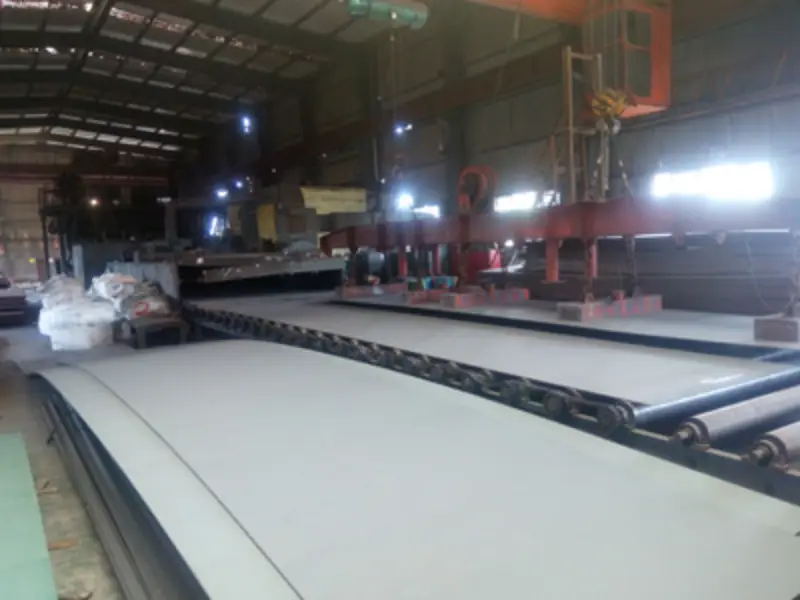
EN 10025-3 S420NL Normalized Fine Grain Structural Steel
EN10025-3 S420NL Plate: Normalized Fine-Grain Steel for Low-Temperature Toughness
Comprehensive material data for EN10025-3 S420NL, a normalized weldable fine-grain structural steel with guaranteed impact at -50 °C, ideal for heavy-duty and low-temperature applications.
Hot rolling followed by normalizing or normalized rolling
- Phone : +8618037372205
- Email : [email protected]
- WhatsApp: Contact via Whtsapp
- WeChat: +8618037372205
EN 10025-3 S420NL Normalized Fine Grain Structural Steel Introduction
S420NL is a normalized/normalized-rolled weldable fine-grain structural steel specified in EN 10025-3. Its designation indicates minimum yield strength 420 MPa, delivery condition 'N' (normalized or normalized rolled), and quality 'L' with minimum 27 J impact energy at -50 °C. This steel offers an excellent combination of high strength, reliable notch toughness at subzero temperatures, and good weldability, achieved through fine-grain practice using alloying elements such as aluminium, niobium, vanadium, or titanium. S420NL is primarily supplied as plates and wide flats in thicknesses up to 120 mm. It is widely employed in welded structures exposed to ambient or low temperatures, including bridges, offshore structures, pressure vessels, and heavy machinery. The controlled chemical composition and carbon equivalent value (CEV) ensure trouble-free fabrication. Typical delivery condition includes normalizing heat treatment after hot rolling, guaranteeing uniform mechanical properties across the thickness.
EN 10025-3 S420NL Normalized Fine Grain Structural Steel Chemical Composition
The steel is fully killed and contains fine-grain elements (e.g., Al, Nb, V, Ti) to achieve both the required strength and low-temperature toughness. Maximum carbon equivalent value (CEV) is 0.45% for product thicknesses ≤100 mm. Elements are controlled to ensure good weldability.
| Element | Standard Value (min–max or max, %) | Remarks |
|---|---|---|
| Carbon (C) | ≤0.20 | Product analysis may vary slightly |
| Silicon (Si) | ≤0.60 | |
| Manganese (Mn) | 1.00 – 1.70 | |
| Phosphorus (P) | ≤0.025 | |
| Sulfur (S) | ≤0.015 | |
| Niobium (Nb) | ≤0.07 | |
| Vanadium (V) | ≤0.12 | |
| Aluminium (Altot) | ≥0.020 | Total aluminium; acid-soluble Al ≥0.015 is also accepted if nitrogen-binding elements are present |
| Titanium (Ti) | ≤0.05 | |
| Chromium (Cr) | ≤0.30 | |
| Nickel (Ni) | ≤0.80 | |
| Molybdenum (Mo) | ≤0.10 | |
| Copper (Cu) | ≤0.55 | |
| Nitrogen (N) | ≤0.015 | |
| Nb+V+Ti | ≤0.22 | Sum of microalloying elements |
EN 10025-3 S420NL Normalized Fine Grain Structural Steel Thermal and Electrical Physical Properties
These values are representative of normalized low-carbon low-alloy steels and are not part of the mandatory EN 10025-3 requirements. They are provided for general guidance in design and simulation.
| Property | Typical Value | Unit | Condition / Remarks |
|---|---|---|---|
| Density (ρ) | 7850 | kg/m³ | At 20 °C |
| Modulus of elasticity (E) | 205 | GPa | At 20 °C |
| Shear modulus (G) | 80 | GPa | At 20 °C, calculated from E and ν |
| Poisson's ratio (ν) | 0.29 | — | At 20 °C |
| Thermal expansion coefficient (α) | 11.0 | 10⁻⁶/K | Between 20 °C and 100 °C |
| Thermal expansion coefficient (α) | 12.5 | 10⁻⁶/K | Between 20 °C and 400 °C |
| Thermal conductivity (λ) | 42 | W/(m·K) | At 20 °C |
| Specific heat capacity (cp) | 460 | J/(kg·K) | At 20 °C |
| Electrical resistivity (ρe) | 0.22 | µΩ·m | At 20 °C |
EN 10025-3 S420NL Normalized Fine Grain Structural Steel Mechanical Properties
Tensile and impact requirements depend on product thickness. For thicknesses not listed, interpolation is permissible as per the standard. Impact test is performed on longitudinal Charpy V-notch specimens at -50 °C, minimum average 27 J. Bending test (180°) applies to a wide thickness range.
| Property | Standard Requirement (min or range) | Unit | Test Conditions |
|---|---|---|---|
| Upper yield strength (ReH) | ≥420 | MPa | Nominal thickness t ≤ 16 mm, transverse |
| Upper yield strength (ReH) | ≥400 | MPa | 16 < t ≤ 40 mm, transverse |
| Upper yield strength (ReH) | ≥390 | MPa | 40 < t ≤ 63 mm, transverse |
| Upper yield strength (ReH) | ≥370 | MPa | 63 < t ≤ 80 mm, transverse |
| Upper yield strength (ReH) | ≥360 | MPa | 80 < t ≤ 100 mm, transverse |
| Upper yield strength (ReH) | ≥350 | MPa | 100 < t ≤ 120 mm, transverse |
| Tensile strength (Rm) | 530 – 680 | MPa | t ≤ 100 mm, transverse |
| Tensile strength (Rm) | 500 – 650 | MPa | 100 < t ≤ 120 mm, transverse |
| Elongation (A5, longitudinal) | ≥19 | % | t ≤ 40 mm |
| Elongation (A5, longitudinal) | ≥18 | % | 40 < t ≤ 63 mm |
| Elongation (A5, longitudinal) | ≥17 | % | 63 < t ≤ 100 mm |
| Elongation (A5, longitudinal) | ≥16 | % | 100 < t ≤ 120 mm |
| Impact energy (KV₂, longitudinal) | ≥27 (average), ≥19 (single) | J | -50 °C, V-notch, 10×10 mm specimen, t ≤ 150 mm |
| Bend test (180°) | Mandrel diameter = 2a | — | t ≤ 16 mm |
| Bend test (180°) | Mandrel diameter = 3a | — | 16 < t ≤ 40 mm |
| Bend test (180°) | Mandrel diameter = 4a | — | 40 < t ≤ 63 mm |
| Bend test (180°) | Mandrel diameter = 5a | — | 63 < t ≤ 120 mm |
EN 10025-3 S420NL Normalized Fine Grain Structural Steel Fully Equivalent Standards and Grades
| Country/Region | Standard | Grade | Remarks |
|---|---|---|---|
| Europe | EN 10025-3 | S420NL | Original specification |
| International | ISO 4950-2 | E420D | High yield strength flat steel products, part 2: products supplied in the normalized or controlled rolled condition; D: impact at -50 °C |
| United Kingdom | BS EN 10025-3 | S420NL | Identical adoption of EN |
| Germany | DIN EN 10025-3 | S420NL | Identical adoption |
| France | NF EN 10025-3 | S420NL | Identical adoption |
| Italy | UNI EN 10025-3 | S420NL | Identical adoption |
EN 10025-3 S420NL Normalized Fine Grain Structural Steel Application Introduction
S420NL is designed for heavy-load and low-temperature welded structures. Its guaranteed toughness at -50 °C and good weldability make it a preferred choice for critical applications where safety and reliability are paramount. It is normally delivered in the normalized condition (+N), and fabrication can include welding, cutting, cold forming (limited), and machining.
Product Applications: Welded bridge girders and arches, Offshore platform legs, jackets, and nodes, LPG and LNG storage tanks, Wind turbine towers and foundations, Heavy-duty crane booms, Hydroelectric penstocks and gates, Rolling stock and wagon frames
Processed into products: Built-up beams and columns, Flanges and web plates for plate girders, Node plates and stiffeners, Structural brackets and seatings, Crane runway beams, Support rings and stiffening rings for shells, Foundation plates and base plates, Rope drums and winch bases
Application industries: Bridge construction, Offshore and marine engineering, Pressure vessel and boiler making, Wind energy (tower structures), Heavy machinery and mining equipment, Civil engineering (stadiums, high-rise buildings), Low-temperature storage and cryogenic facilities
EN 10025-3 S420NL Normalized Fine Grain Structural Steel Similar or Comparable Material Alternatives
| Country/Region | Standard | Grade | Remarks |
|---|---|---|---|
| USA | ASTM A633/A633M | Grade E | Normalized, min yield 415 MPa (60 ksi), CVN 27 J at -50 °C; closely matches S420NL but lower yield. Suitable for low-temperature structural use. |
| China | GB/T 1591 | Q420E | High-strength low-alloy structural steel; min yield 420 MPa, impact at -40 °C, not fully equivalent due to insufficient low-temperature toughness for -50 °C service. |
| Japan | JIS G3106 | SM490B | Weldable structural steel, min yield 315–365 MPa, impact at -40 °C; lower strength and toughness. |
| Europe | EN 10025-4 | S420ML | Thermomechanically rolled weldable fine-grain steel, min yield 420 MPa, impact at -50 °C; alternative delivery condition when normalizing is not required. |
Notes:
- S420NL is fully killed and fine-grain treated; supplementary requirements (e.g., ultrasonic testing, through-thickness properties per EN 10164) can be agreed at the time of enquiry.
- For thicknesses >120 mm, the mechanical properties should be separately agreed with the manufacturer.
- When cold forming is required, the minimum bending radius should respect the bend test specifications, and stress relief annealing may be necessary depending on the degree of deformation.
- Share



