
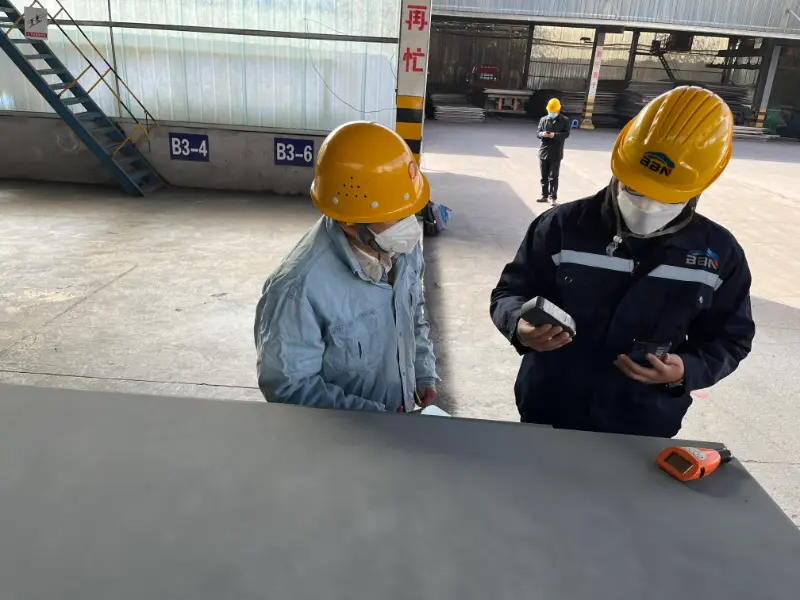
EN 10025-3 S420N Normalized Fine-Grain Structural Steel Plate
EN 10025-3 S420N Normalized Fine-Grain Structural Steel Plate - Properties & Equivalents
Comprehensive data on S420N under EN 10025-3: chemical composition, mechanical properties, thermal and electrical characteristics, international equivalents, and similar alloys.
Hot rolling, normalizing or normalized rolling, cold forming, welding, cutting, machining, surface treatment
- Phone : +8618037372205
- Email : [email protected]
- WhatsApp: Contact via Whtsapp
- WeChat: +8618037372205
EN 10025-3 S420N Normalized Fine-Grain Structural Steel Plate Introduction
S420N is a weldable fine-grain structural steel delivered in the normalized or normalized-rolled condition according to EN 10025-3. It offers a minimum yield strength of 420 MPa in thicknesses up to 16 mm, combined with good notch toughness down to -20 °C (longitudinal Charpy V-notch energy of 27 J).
The fine-grain microstructure, achieved through normalizing and microalloying with elements such as niobium, vanadium, and titanium, ensures a uniform, fine ferritic-pearlitic structure that provides:
- Excellent weldability with controlled carbon equivalent values
- High strength-to-weight ratio
- Good cold formability and ductility
- Reliable low-temperature impact properties
S420N is widely used in welded steel structures, bridges, pressure vessels, offshore platforms, and heavy machinery where both high strength and good toughness are required. It is typically supplied as heavy plates, hot-rolled strips, and wide flats.
EN 10025-3 S420N Normalized Fine-Grain Structural Steel Plate Chemical Composition
The chemical composition limits for S420N as specified in EN 10025-3:2019. The steel is microalloyed with grain-refining elements such as niobium, vanadium, and titanium. The sum of these three elements is controlled to a maximum of 0.22 %. A minimum aluminum content is required to ensure fine grain size. Phosphorus and sulfur are kept low for improved toughness and weldability.
| Element | Standard Value (%) | Note |
|---|---|---|
| C | ≤ 0.20 | Ladle analysis maximum |
| Si | ≤ 0.60 | |
| Mn | 1.00 – 1.70 | |
| P | ≤ 0.030 | |
| S | ≤ 0.025 | |
| N | ≤ 0.015 | Maximum nitrogen |
| Al (total) | ≥ 0.015 | Minimum total aluminum for fine grain practice |
| Nb | ≤ 0.05 | |
| V | ≤ 0.12 | |
| Ti | ≤ 0.05 | |
| Nb+V+Ti | ≤ 0.22 | Sum of microalloying elements |
| Cr | ≤ 0.30 | Residual; may be used to improve strength |
| Ni | ≤ 0.80 | |
| Mo | ≤ 0.10 | |
| Cu | ≤ 0.55 |
EN 10025-3 S420N Normalized Fine-Grain Structural Steel Plate Thermal and Electrical Physical Properties
The physical properties listed are typical for normalized carbon-manganese fine-grain structural steels such as S420N. These values are not mandatory per EN 10025-3 but are widely used in engineering calculations for design, thermal analysis, and welding procedure development.
- Density and elastic moduli are virtually constant across the thickness range.
- Thermal expansion increases with temperature; values provided for the most commonly used intervals.
- Electrical resistivity is given for 20 °C and increases with temperature.
| Property | Typical Value | Unit | Test Condition |
|---|---|---|---|
| Density (ρ) | 7.85 | g/cm³ | at 20 °C |
| Modulus of elasticity (E) | 210 | GPa | at 20 °C |
| Shear modulus (G) | 80 | GPa | at 20 °C |
| Poisson's ratio (ν) | 0.3 | – | at 20 °C |
| Thermal expansion coefficient (α) | 11.1 | 10⁻⁶ /K | 20 – 100 °C |
| Thermal expansion coefficient (α) | 12.0 | 10⁻⁶ /K | 20 – 200 °C |
| Thermal expansion coefficient (α) | 12.9 | 10⁻⁶ /K | 20 – 300 °C |
| Thermal expansion coefficient (α) | 13.7 | 10⁻⁶ /K | 20 – 400 °C |
| Thermal conductivity (λ) | 52 | W/(m·K) | at 20 °C |
| Thermal conductivity (λ) | 51 | W/(m·K) | at 100 °C |
| Thermal conductivity (λ) | 48 | W/(m·K) | at 200 °C |
| Thermal conductivity (λ) | 44 | W/(m·K) | at 300 °C |
| Specific heat capacity | 460 | J/(kg·K) | at 20 °C |
| Electrical resistivity (ρₑ) | 0.16 | µΩ·m | at 20 °C |
EN 10025-3 S420N Normalized Fine-Grain Structural Steel Plate Mechanical Properties
The mechanical properties of S420N depend on the product thickness. The values below are taken from EN 10025-3:2019. The minimum yield and tensile strengths decrease gradually with increasing thickness, while the elongation requirements remain very consistent.
- Testing is performed on longitudinal test pieces.
- Impact energy is determined on Charpy-V specimens at -20 °C for the "N" designation.
- Bend test is a technological test; the minimum bending mandrel diameter is given as a multiple of the specimen thickness (a).
| Property | Specified Minimum/Maximum | Unit | Test Condition |
|---|---|---|---|
| Yield strength (ReH) | 420 | MPa | Plate thickness t ≤ 16 mm, longitudinal |
| Yield strength (ReH) | 400 | MPa | 16 < t ≤ 40 mm, longitudinal |
| Yield strength (ReH) | 390 | MPa | 40 < t ≤ 63 mm, longitudinal |
| Yield strength (ReH) | 370 | MPa | 63 < t ≤ 80 mm, longitudinal |
| Yield strength (ReH) | 360 | MPa | 80 < t ≤ 100 mm, longitudinal |
| Yield strength (ReH) | 340 | MPa | 100 < t ≤ 200 mm, longitudinal |
| Tensile strength (Rm) | 520 – 680 | MPa | t ≤ 100 mm, longitudinal |
| Tensile strength (Rm) | 500 – 660 | MPa | 100 < t ≤ 200 mm, longitudinal |
| Elongation after fracture (A5/L₀=5.65√S₀) | 19 | % | t ≤ 40 mm, longitudinal |
| Elongation after fracture (A5) | 18 | % | 40 < t ≤ 63 mm, longitudinal |
| Elongation after fracture (A5) | 17 | % | 63 < t ≤ 100 mm, longitudinal |
| Elongation after fracture (A5) | 16 | % | 100 < t ≤ 200 mm, longitudinal |
| Charpy impact energy (KV₂) | ≥ 27 | J | -20 °C, longitudinal, min. specimen width ≥ 10 mm |
| Bend test (bending mandrel diameter) | 2a | – | t ≤ 16 mm, 180° bend, longitudinal |
| Bend test (bending mandrel diameter) | 3a | – | 16 < t ≤ 40 mm, 180° bend, longitudinal |
| Bend test (bending mandrel diameter) | 4a | – | 40 < t ≤ 63 mm, 180° bend, longitudinal |
| Bend test (bending mandrel diameter) | 5a | – | 63 < t ≤ 80 mm, 180° bend, longitudinal |
| Bend test (bending mandrel diameter) | 6a | – | 80 < t ≤ 100 mm, 180° bend, longitudinal |
EN 10025-3 S420N Normalized Fine-Grain Structural Steel Plate Fully Equivalent Material Standards and Replaceable Designations
The following standards and grades are technically identical to EN 10025-3 S420N. They are direct European adoptions and the ISO 630-3:2012 standard, which shares the same chemical, mechanical, and delivery requirements. Products certified to any of these norms can be used interchangeably.
| Country/Region | Standard | Designation | Remarks |
|---|---|---|---|
| European Union / CEN | EN 10025-3 | S420N | Base European standard; normalized condition |
| Germany | DIN EN 10025-3 | S420N | Identical to EN 10025-3 |
| United Kingdom | BS EN 10025-3 | S420N | Identical to EN 10025-3 |
| France | NF EN 10025-3 | S420N | Identical to EN 10025-3 |
| Italy | UNI EN 10025-3 | S420N | Identical to EN 10025-3 |
| Spain | UNE EN 10025-3 | S420N | Identical to EN 10025-3 |
| International | ISO 630-3 | S420N | Identical technical requirements; equivalent normalized fine-grain steel |
EN 10025-3 S420N Normalized Fine-Grain Structural Steel Plate Application Introduction
S420N is designed for demanding welded structures where high strength combined with good toughness and weldability is essential. It can be processed by thermal cutting, cold forming, and all common welding techniques. Normalized delivery provides a homogeneous structure with predictable mechanical properties.
- Thick plates are used for heavy structural members.
- The steel is suitable for fatigue-loaded components when proper detailing is observed.
- Hydrogen-induced cracking can be avoided by following standard preheat and filler metal guidelines.
Product Applications: Heavy welded bridges and viaducts, Penstocks, lock gates, and hydraulic steel structures, Offshore platform topside modules and jackets, Pressure vessels (up to certain temperature and pressure limits), Wind turbine tubular towers and transition pieces, Structural frames for high-rise buildings, Shipbuilding (deck plates, hull stiffeners, depending on classification society approval)
Processed into products: Main girders and cross beams, Columns and compression members, Crane runway beams, Welded I‑ and box‑section members, Node castings and welded joints in tubular structures, Heavy-duty excavator booms and arms, Flanges and webs of plate girders, Base plates and connection plates
Application industries: Civil engineering and building construction, Bridge engineering, Offshore and marine structures, Pressure vessel and storage tank fabrication, Mining and earthmoving machinery, Wind energy (tower sections), Railway vehicle manufacturing, Crane and heavy lift equipment
EN 10025-3 S420N Normalized Fine-Grain Structural Steel Plate Similar or Comparable Substitute Materials
When an exact match for S420N is not available, the following steels provide similar strength, toughness, and weldability, although some differences in delivery conditions or composition limits exist. Each substitute should be evaluated against the specific design and fabrication requirements.
| Country/Region | Standard | Designation | Remarks |
|---|---|---|---|
| China | GB/T 1591 | Q420NC | Normalized/normalized-rolled grade with yield strength ≥ 420 MPa below 16 mm; lower Mn range and different microalloying compared to S420N; impact temperature is 0 °C for C-quality, but Q420NE has -20 °C |
| United States | ASTM A572/A572M | Grade 60 (Type 1 or 2) | Yield strength 415 MPa (60 ksi); the steel is not mandatory normalizing. Impact and fine-grain requirements are not inherent, additional specifications needed |
| Europe | EN 10025-4 | S420M | Thermomechanically rolled fine-grain steel with the same yield strength; delivery condition differs; may be an alternative when normalizing is not required |
Notes:
Welding: S420N can be welded by all conventional methods (SMAW, GMAW, SAW, FCAW). Preheat is generally not required for moderate thicknesses when low-hydrogen consumables are used, but should be considered for thicknesses above 30 mm or when the carbon equivalent is near the upper limit.
Forming: Cold forming is possible; the minimum bending radius should be according to the recommended values in EN 10025‑3 or the manufacturer's instructions.
Corrosion resistance: Typical for carbon‑manganese structural steels; protective coatings (painting, galvanizing) are required for outdoor exposure.
Further processing: Suitable for hot‑dip galvanizing; the steel may be subjected to stress relief annealing when extensive cold forming has been applied, but the temperature must be below the normalizing range to preserve properties.
- Share



