
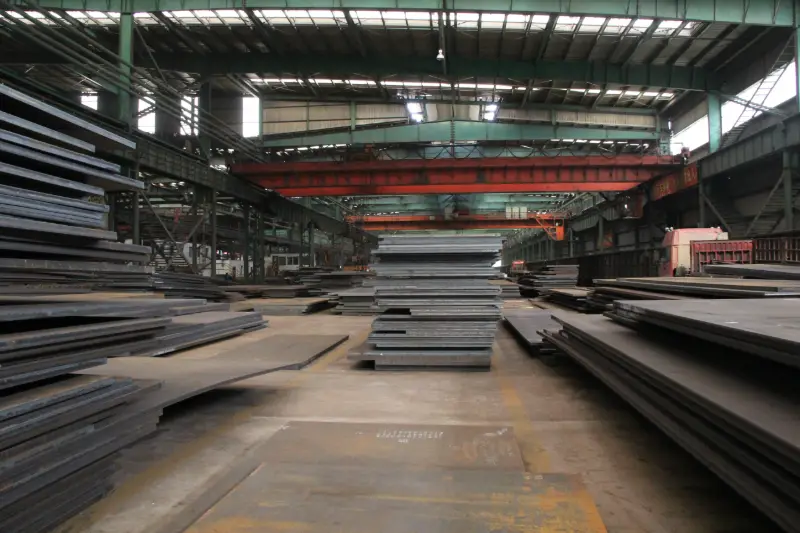
EN10025-3 S355NL
EN10025-3 S355NL: Low-Temperature Fine-Grain Structural Steel Plate for Welded Construction
Comprehensive technical data for S355NL steel plate according to EN 10025-3, including chemical composition, mechanical and thermal properties, international equivalents, and application guidance.
Hot rolling, normalizing, normalizing rolling, welding, cold forming, machining, cutting
- Phone : +8618037372205
- Email : [email protected]
- WhatsApp: Contact via Whtsapp
- WeChat: +8618037372205
EN10025-3 S355NL Introduction
EN10025-3 S355NL is a weldable fine-grain structural steel delivered in the normalized or normalized rolled condition, designed for low-temperature service down to -50 °C. It belongs to the family of thermomechanically or normalized rolled steels with a minimum yield strength of 355 MPa. The grade designation 'N' indicates normalized/normalized rolled delivery condition, while 'L' specifies guaranteed impact toughness of at least 27 J at -50 °C (longitudinal). S355NL offers excellent weldability, good notch toughness, and resistance to brittle fracture, making it suitable for heavy welded structures in cold climates, such as offshore platforms, bridges, pressure vessels, and crane booms. Its fine-grained microstructure ensures high strength and toughness without compromising formability.
EN10025-3 S355NL Chemical Composition
The chemical composition of S355NL is strictly controlled to ensure fine grain size, good weldability, and low-temperature toughness. Maximum limits are given for elements such as carbon, phosphorus, and sulfur to avoid brittleness. Microalloying elements niobium, vanadium, and titanium refine the grain structure and enhance strength. The carbon equivalent (CEV) is limited to ensure crack-free welding. Values are according to EN 10025-3:2019, Table 2, for thicknesses ≤ 100 mm. For thicker products, some limits may vary.
| Element | Content (%, max unless range) | Notes |
|---|---|---|
| Carbon (C) | ≤ 0.18 | |
| Silicon (Si) | ≤ 0.50 | |
| Manganese (Mn) | 1.00 – 1.70 | |
| Phosphorus (P) | ≤ 0.020 | Very low to guarantee toughness |
| Sulfur (S) | ≤ 0.010 | Very low for cleanliness |
| Aluminium total (Altot) | ≥ 0.020 | Required for fine grain |
| Niobium (Nb) | ≤ 0.05 | Microalloying element |
| Vanadium (V) | ≤ 0.12 | |
| Titanium (Ti) | ≤ 0.05 | |
| Chromium (Cr) | ≤ 0.30 | |
| Nickel (Ni) | ≤ 0.50 | May be added for toughness |
| Molybdenum (Mo) | ≤ 0.10 | |
| Copper (Cu) | ≤ 0.55 | |
| Nitrogen (N) | ≤ 0.015 | Residual element |
| Carbon equivalent (CEV) | ≤ 0.43 (typical) | CEV = C + Mn/6 + (Cr+Mo+V)/5 + (Ni+Cu)/15; for thickness ≤ 30 mm |
EN10025-3 S355NL Thermal and Electrical Physical Properties
These physical properties are informative and typical for normalized low-alloy structural steels of this class. They are not mandatory requirements of EN 10025-3 but can be used for design calculations. Values may vary slightly with actual composition and heat treatment.
| Property | Typical Value | Unit | Remarks |
|---|---|---|---|
| Density (ρ) | 7.85 | kg/dm³ | At room temperature |
| Modulus of elasticity (E) | 210 | GPa | At 20 °C |
| Shear modulus (G) | ~81 | GPa | At 20 °C |
| Poisson's ratio (ν) | 0.3 | — | |
| Thermal expansion coefficient (α) | 12.0 | 10⁻⁶/K | 20–100 °C |
| Thermal expansion coefficient (α) | 12.5 | 10⁻⁶/K | 20–200 °C |
| Thermal expansion coefficient (α) | 13.0 | 10⁻⁶/K | 20–300 °C |
| Thermal conductivity (λ) | 50 | W/(m·K) | At room temperature |
| Specific heat capacity (cp) | 460 | J/(kg·K) | At room temperature |
| Electrical resistivity (ρₑ) | 0.20 – 0.25 | μΩ·m | At room temperature |
EN10025-3 S355NL Mechanical Properties
Mechanical properties are guaranteed for the normalized/normalized rolled condition. Yield strength and tensile strength depend on product thickness. Elongation and impact energy ensure sufficient ductility and toughness at low temperature. Bending tests confirm formability. Data from EN 10025-3:2019, Tables 5 and 6, for longitudinal test pieces unless specified otherwise.
| Property | Value | Unit | Test Conditions |
|---|---|---|---|
| Yield strength (ReH) | ≥ 355 | MPa | Thickness ≤ 16 mm |
| Yield strength (ReH) | ≥ 345 | MPa | 16 mm < thickness ≤ 40 mm |
| Yield strength (ReH) | ≥ 335 | MPa | 40 mm < thickness ≤ 63 mm |
| Yield strength (ReH) | ≥ 325 | MPa | 63 mm < thickness ≤ 80 mm |
| Yield strength (ReH) | ≥ 315 | MPa | 80 mm < thickness ≤ 100 mm |
| Tensile strength (Rm) | 470 – 630 | MPa | All thicknesses up to 100 mm |
| Elongation (A5) | ≥ 22 | % | Thickness ≤ 16 mm, gauge length 5.65√S₀ |
| Elongation (A5) | ≥ 21 | % | 16 mm < thickness ≤ 40 mm |
| Elongation (A5) | ≥ 20 | % | 40 mm < thickness ≤ 63 mm |
| Elongation (A5) | ≥ 19 | % | 63 mm < thickness ≤ 100 mm |
| Impact energy (KV₂) | ≥ 27 (min. single 19) | J | Temperature -50 °C, longitudinal, V-notch |
| Bend test | No cracks | Bending angle 180°, mandrel diameter 2t (t≤16mm); 3t (16mm |
EN10025-3 S355NL Completely Equivalent Material Standards and Alternative Grade Designations
S355NL is primarily defined in European standard EN 10025-3. Identical designations are used in ISO and in national standards that adopt EN 10025-3 directly. No other international standard provides an exact match with the same chemical, mechanical, and -50 °C impact requirements.
| Country / Region | Standard | Grade | Remarks |
|---|---|---|---|
| European Union | EN 10025-3 | S355NL | Base standard |
| International | ISO 630-3 | S355NL | Technically identical to EN 10025-3 |
| Germany | DIN EN 10025-3 | S355NL | Direct adoption |
| United Kingdom | BS EN 10025-3 | S355NL | Direct adoption |
| France | NF EN 10025-3 | S355NL | Direct adoption |
| Italy | UNI EN 10025-3 | S355NL | Direct adoption |
| Spain | UNE EN 10025-3 | S355NL | Direct adoption |
EN10025-3 S355NL Application Introduction
S355NL is specifically developed for heavy welded structures that operate at low ambient temperatures and require assurance against brittle fracture. The combination of high strength, excellent weldability, and guaranteed toughness at -50 °C makes it a preferred material in arctic and cold-region engineering projects. It is normally supplied as plates, which can be formed, welded, and machined into complex components. Typical applications span offshore, civil engineering, energy, and heavy machinery sectors.
Product Applications: Offshore platform legs and decks, Road and railway bridge girders, Liquefied gas storage tanks, Wind turbine tubular towers and transition pieces, Crane booms and jibs, Heavy-duty structural frames for arctic buildings, Ship hulls and icebreaker structures
Processed into products: Welded box girders and fabricated beams, Reinforcement ribs and stiffeners, Flanges and web plates, Column and brace members, Padeyes and lifting lugs, Brackets and base plates, Shell sections for pressure vessels
Application industries: Offshore and marine engineering, Bridge construction, Pressure vessel and storage tank fabrication, Wind energy (tower and foundation structures), Heavy lifting and transport equipment, Mining and earthmoving machinery, Shipbuilding (cold-environment vessels)
EN10025-3 S355NL Similar or Alternative Grades with Closest Properties
These grades offer comparable strength levels but differ mainly in impact test temperature, delivery condition, or fine-grain approach. They may serve as substitutes after engineering assessment, especially when low-temperature toughness requirements can be relaxed.
| Country / Region | Standard | Grade | Remarks |
|---|---|---|---|
| European Union | EN 10025-2 | S355J2+N | Normalized, min. 27 J at -20 °C; higher service temperature |
| European Union | EN 10025-2 | S355K2+N | Normalized, min. 40 J at -20 °C; still not -50 °C |
| European Union | EN 10025-4 | S355ML | Thermomechanical rolled, 27 J at -50 °C; alternative processing route |
| European Union | EN 10025-3 | S355N | Same strength, but only 27 J at -20 °C; NL version is preferred for low temperature |
| China | GB/T 1591 | Q355NE | Normalized delivery, impact energy 27 J at -40 °C, not -50 °C. Requires re-evaluation for -50 °C. |
| USA | ASTM A572 / A572M | Grade 50 [345] | Similar strength, no guaranteed low-temperature impact unless supplementary requirements |
| Japan | JIS G3106 | SM490C | Hot rolled, impact at 0 °C, not equivalent for low-temperature use |
Notes:
For thicknesses above 100 mm, the user should consult the steel manufacturer as some mechanical property values and chemical limits (e.g., CEV) may be adjusted. The bending test requirement is generally valid for plates ≤ 40 mm; for thicker plates, alternative testing may be agreed. When welding S355NL, preheating and interpass temperature control should follow established welding guidelines (e.g., EN 1011-2) to avoid cold cracking. Post-weld heat treatment is not typically required but can be applied if stress relief is needed. The actual impact test temperature and orientation (transverse or longitudinal) must be specified at the time of order, with L-grade normally referring to longitudinal testing at -50°C.
- Share



