
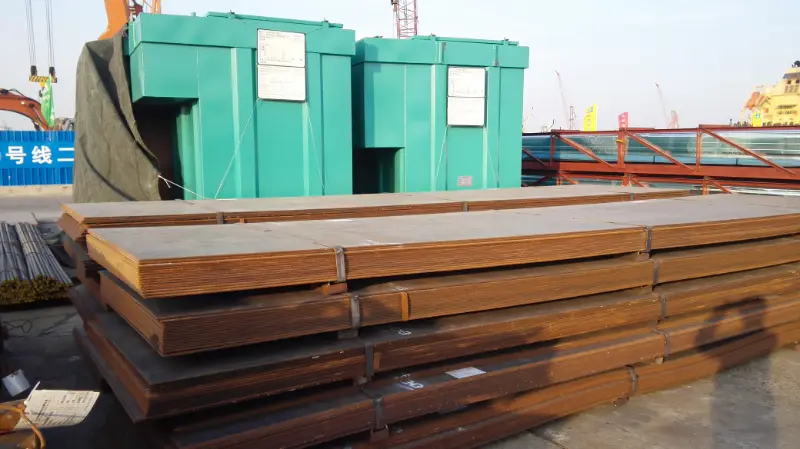
EN10025-3 S355N Steel Plate
EN10025-3 S355N Steel Plate: Comprehensive Data on Carbon & Low-Alloy High-Strength Material
In-depth technical analysis of S355N steel per EN10025-3, including chemical composition, mechanical and thermal properties, international equivalents, and application guidance for structural engineering.
Welding, Machining, Hot Forming, Cold Forming, Cutting
- Phone : +8618037372205
- Email : [email protected]
- WhatsApp: Contact via Whtsapp
- WeChat: +8618037372205
EN10025-3 S355N Steel Plate Introduction
S355N is a weldable fine-grain structural steel defined by the European standard EN10025-3. The designation 'S' stands for structural steel, '355' indicates a minimum yield strength of 355 MPa for thicknesses ≤ 16 mm, and 'N' specifies the delivery condition as normalized or normalized rolled. This steel grade is known for its excellent combination of high strength, good weldability, and notch toughness at low temperatures, making it suitable for heavily loaded welded structures. As a fine-grained steel, it offers superior resistance to brittle fracture, ensuring reliability in critical applications like bridges, offshore platforms, and heavy machinery.
EN10025-3 S355N Steel Plate Chemical Composition
The chemical composition of S355N is carefully designed to ensure high strength and notch toughness. Maximum limits are applied to elements like Carbon (C), Phosphorus (P), and Sulfur (S) to guarantee excellent weldability. The fine-grain structure, crucial for low-temperature toughness, is achieved through controlled additions of grain-refining elements such as Aluminum (Al), Niobium (Nb), Vanadium (V), and Titanium (Ti).
| Element | Standard Value (Max, %) | Remarks |
|---|---|---|
| Carbon (C) | ≤ 0.20 | For nominal thickness ≤ 30 mm |
| Carbon (C) | ≤ 0.22 | For nominal thickness > 30 mm |
| Silicon (Si) | ≤ 0.60 | All thicknesses |
| Manganese (Mn) | 0.90 - 1.65 | All thicknesses |
| Phosphorus (P) | ≤ 0.030 | All thicknesses |
| Sulfur (S) | ≤ 0.025 | All thicknesses |
| Aluminum (Al, total) | ≥ 0.020 | Grain-refining element; minimum content |
| Niobium (Nb) | ≤ 0.05 | Grain-refining element |
| Vanadium (V) | ≤ 0.12 | Grain-refining element |
| Titanium (Ti) | ≤ 0.05 | Grain-refining element |
| Nitrogen (N) | ≤ 0.015 | All thicknesses |
| Copper (Cu) | ≤ 0.55 | Residual element |
| Molybdenum (Mo) | ≤ 0.10 | Residual element |
| Chromium (Cr) | ≤ 0.30 | Residual element |
| Nickel (Ni) | ≤ 0.30 | Residual element |
EN10025-3 S355N Steel Plate Thermal and Electrical Physical Properties
Physical properties are essential for engineering calculations involving heat transfer, thermal stress, and electromagnetic fields. These values are typical for S355N at ambient temperature and may vary slightly depending on exact composition and temperature. The thermal expansion coefficient is key for assessing expansion in welded joints, while thermal conductivity and specific heat capacity are crucial for calculating preheating temperatures and heat distribution.
| Property | Standard Requirement Value | Unit | Test Condition |
|---|---|---|---|
| Density (ρ) | ~ 7.85 | g/cm³ | At 20 °C |
| Modulus of Elasticity (E) | ~ 210 | GPa | At 20 °C |
| Shear Modulus (G) | ~ 81 | GPa | At 20 °C |
| Poisson's Ratio (ν) | ~ 0.3 | At 20 °C | |
| Thermal Expansion Coefficient (α) | ~ 11.7 x 10⁻⁶ | K⁻¹ | Range: 20 °C to 100 °C |
| Thermal Expansion Coefficient (α) | ~ 12.5 x 10⁻⁶ | K⁻¹ | Range: 20 °C to 200 °C |
| Thermal Expansion Coefficient (α) | ~ 13.6 x 10⁻⁶ | K⁻¹ | Range: 20 °C to 400 °C |
| Thermal Conductivity (λ) | ~ 42 | W/(m·K) | At 20 °C |
| Thermal Conductivity (λ) | ~ 40 | W/(m·K) | At 200 °C |
| Specific Heat Capacity (c) | ~ 460 | J/(kg·K) | At 20 °C |
| Specific Heat Capacity (c) | ~ 480 | J/(kg·K) | At 200 °C |
| Electrical Resistivity (ρ_e) | ~ 0.20 - 0.25 | µΩ·m | At 20 °C |
EN10025-3 S355N Steel Plate Mechanical Properties
The mechanical properties of S355N are thickness-dependent and are guaranteed for the normalized delivery condition. The steel exhibits a minimum upper yield strength (ReH) and a defined range for tensile strength (Rm). Elongation after fracture (A) and Charpy-V impact energy (KV) at low temperatures are critical indicators of ductility and toughness, essential for structural safety.
| Property | Standard Requirement Value | Unit | Test Condition |
|---|---|---|---|
| Yield Strength (ReH) | ≥ 355 | MPa | Nominal thickness ≤ 16 mm |
| Yield Strength (ReH) | ≥ 345 | MPa | Nominal thickness 16 < t ≤ 40 mm |
| Yield Strength (ReH) | ≥ 335 | MPa | Nominal thickness 40 < t ≤ 63 mm |
| Yield Strength (ReH) | ≥ 325 | MPa | Nominal thickness 63 < t ≤ 80 mm |
| Yield Strength (ReH) | ≥ 315 | MPa | Nominal thickness 80 < t ≤ 100 mm |
| Tensile Strength (Rm) | 470 - 630 | MPa | Nominal thickness ≤ 16 mm |
| Tensile Strength (Rm) | 470 - 630 | MPa | Nominal thickness 16 < t ≤ 40 mm |
| Tensile Strength (Rm) | 470 - 630 | MPa | Nominal thickness 40 < t ≤ 63 mm |
| Tensile Strength (Rm) | 470 - 630 | MPa | Nominal thickness 63 < t ≤ 80 mm |
| Tensile Strength (Rm) | 470 - 630 | MPa | Nominal thickness 80 < t ≤ 100 mm |
| Elongation after fracture (A) | ≥ 22 | % | Longitudinal, nominal thickness ≤ 16 mm |
| Elongation after fracture (A) | ≥ 21 | % | Longitudinal, nominal thickness 16 < t ≤ 40 mm |
| Elongation after fracture (A) | ≥ 20 | % | Longitudinal, nominal thickness 40 < t ≤ 63 mm |
| Elongation after fracture (A) | ≥ 19 | % | Longitudinal, nominal thickness 63 < t ≤ 100 mm |
| Charpy Impact Energy (KV2) | ≥ 40 | J | Longitudinal, Test temp. -20 °C, t ≤ 150 mm |
| Charpy Impact Energy (KV2) | ≥ 63 | J | Transverse, Test temp. -20 °C, t ≤ 150 mm |
| Bend Test (Mandrel Diameter) | 3t | mm | Bend angle 180°, t ≤ 16 mm |
| Bend Test (Mandrel Diameter) | 4t | mm | Bend angle 180°, 16 < t ≤ 100 mm |
EN10025-3 S355N Steel Plate Exactly Equivalent Material Standards and Replaceable Grades
| Country/Region | Standard | Grade | Remarks |
|---|---|---|---|
| International | ISO 4950-2 | E355D | Grade with guaranteed impact properties at -20 °C, equivalent to S355N. |
| European Union | EN 10025-3 | S355NL | Same strength level as S355N but with guaranteed impact energy down to -50 °C. |
| Brazil | ABNT NBR 5000 | G-355N | Direct adoption of the European standard in the Brazilian normative system. |
EN10025-3 S355N Steel Plate Application Introduction
S355N steel is a workhorse material for general and heavy-duty structural engineering. Its excellent weldability and guaranteed low-temperature toughness make it highly reliable for dynamic and static loads alike. It is predominantly used in its normalized condition to ensure a fine, homogeneous microstructure. The material is well-suited for all conventional workshop processes, including flame cutting, cold forming with attention to its high strength, and all common arc welding methods.
Product Applications: Welded plate girders for bridges, Tubular towers for wind turbines, Pressure vessel shells and heads (non-cryogenic service), Hulls and decks of workboats and barges, Frames and booms for heavy crawler cranes, Columns and trusses for high-rise building frames
Processed into products: Stiffeners, flanges, and webs for welded beams, Base plates and anchor assemblies, Connecting plates, gussets, and cleats in trusses, Shafts and axles for heavy machinery, Rolled and welded rings for flanges, Machine frames and support structures subject to vibration
Application industries: Civil Engineering and Bridge Construction, Offshore and Marine Engineering, Energy Sector (Wind turbines, Power plants), Transportation and Heavy Vehicles, Architectural Metalwork (Stadiums, Airports), Mining and Earth-Moving Equipment
EN10025-3 S355N Steel Plate Similar / Nearby Substitute Materials Recommendation
| Country/Region | Standard | Grade | Remarks |
|---|---|---|---|
| United States | ASTM A572 / A572M | Grade 50 [345] | Yield strength is 345 MPa, slightly lower than S355N. Heat treatment (normalizing) not mandatory unless specified by a supplementary requirement. Good structural carbon steel. |
| Japan | JIS G3106 | SM490A | Grade with minimum yield strength of 325 MPa for t≤16mm, lower strength but excellent weldability. Used for welded structures. |
| China | GB/T 1591 | Q355NC | Grade with min. yield strength 355 MPa and impact test at 0 °C. Closest Chinese equivalent in terms of strength and normalized delivery. |
| Russia | GOST 19281 | 17G1S | Manganese-silicon steel with min. yield strength around 345 MPa. Historically a widely used structural grade with good weldability. |
| India | IS 2062 | E350 C | High-strength structural steel with a minimum yield strength of 350 MPa for thicknesses ≤ 20 mm, but the standard allows non-normalized delivery. |
Notes:
S355N is supplied in the normalized (+N) condition, which guarantees the specified properties. For thicknesses over 80 mm, the normalizing process is critical to achieve through-thickness ductility. When ordering, options can be specified for improved through-thickness properties (e.g., Z-quality per EN 10164), ultrasonic testing (UT) to EN 10160, and supply with a specific inspection certificate like 3.1 or 3.2 per EN 10204. Preheating is recommended for welding in cold weather or when fabricating thick sections to prevent hydrogen cracking.
- Share



